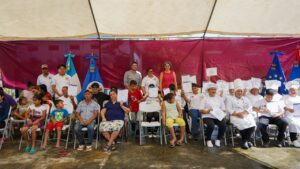

Photo by OAS: Graduation Ceremony at the Ta’Amay Training Center in Arenal
Sometimes it takes very little to ignite the entrepreneurial spirit. A small push, a bright idea, the guiding hands of a skilled mentor—these are often all it takes to turn possibility into purpose. Across Belize, the entrepreneurial spark is increasingly being fuelled thanks to partnerships between the European Union, local stakeholders, and international organizations.
In the Adjacency Zone between Belize and Guatemala, collaboration between the European Union and the Office of the Organization of American States (OAS) has strengthened the provision of free training programmes that build local capacities and generate new economic opportunities. This includes young people like David Uck, a 25-year-old from Benque Viejo del Carmen who, after a month-and-a-half-long intermediate course on the ins and outs of barbering, is now the proprietor of his very own barbershop.

Photo by: Ignite Ltd. – David Uck, Owner of Dahir Barbershop
Dahir Barbershop, named after David’s son, is currently the only barbershop in the Santa Cruz area of town, and David has amassed a small but steadily rotating clientele. Offering services that range from everyday haircuts to eyebrow grooming, the shop has quickly become a community staple.
“I always thought about having something of my own,” says the young cook turned barber. “By opening the barbershop, I’m now my own boss, and it’s helped me a lot financially.”
 Photo by Ignite Ltd.
David is one of more than 600 beneficiaries who have taken part in the free, certified training courses offered at the Ta’Amay Centres administered by the OAS Office in the Adjacency Zone. These centres, located in Benque Viejo del Carmen (Belize), Arenal (Belize and Guatemala), Melchor de Mencos, and Santa Cruz (Guatemala) are part of the Cultures for Peace Programme, an OAS initiative funded by the European Union which aims to strengthen people’s skills and promote peaceful coexistence.
 Photo by Ignite Ltd. Ta’Amay Training Center Graduates
Empowerment Through Enterprise
Through a wide array of training courses, the Ta’Amay Centres have been providing people with avenues for making income, the confidence to start their own businesses, and the skills needed to build long-term economic independence. They have also been serving as spaces of empowerment, particularly for women of all ages. Entrepreneurship thus becomes a pathway for the personal and economic development of women, allowing them the opportunity to strengthen their sense of independence and leadership skills that extend into their homes and their communities.
Like David, 37-year-old Mariela de Jesús Santos López of San José Succotz and 48-year-old Jency Julil Muralles residing in Benque Viejo, have been able to transform newly acquired skills into thriving businesses. Of the over 600 Belizean training graduates of the Ta’Amay Training Centre, more than 450 are women.

Photo by Ignite Ltd. – Mariela Santos, Owner of Revive Beauty Salon
Since opening her salon, Revive, Beauty by Mariela, in 2022, Mariela has significantly expanded her services using the training she received at the Ta’Amay Centre.
“I’ve taken several courses in cosmetology in Ta’Amay,” she explains. “I have taken one for eyebrow mapping, eyelash treatments, barbering, facials, makeup, hairstyling…so, a little bit of everything that has to do with cosmetology.”
Today, business is booming, and Mariela even finds herself frequently enlisting the help of her younger sister to manage her growing list of clients.
Meanwhile, for Jency Muralles, consistently taking part in classes has allowed her to find not just financial stability but emotional support, as well.

Photo by: Ignite – Jency Muralles, Owner of Bash.bz Piñatas
“In our groups, in all those courses that we take, a lot of us communicate with each other,” Jency says. “We have problems—different kinds of problems, difficulties in our lives. We talk about it, and it’s like therapy for us. In many ways, we motivate each other, and that’s nice.”
With certificates in sewing, event planning, customer service, entrepreneurship, and even bartending under her belt, Jency now finds herself busy with work but fueled by a strong sense of purpose and renewed confidence in her ability to provide for her son.

Photo by: Ignite Ltd. – Ta’Amay Training Center
Classes offered at the Ta’Amay Centres range from cooking and beauty services to graphic design, customer service, and even the fundamentals of small business and entrepreneurship. More than simple technical training, these programs allow participants to transform their skills into sustainable livelihoods. In Arenal, for example, women like Karen Chan have found that enrolling in baking classes goes far beyond learning a trade means the difference between having to purchase three-day-old store-bought bread transported from far away and having daily access to fresh, locally made loaves readily available for her entire community.


Photo by Ignite Ltd. – Karen Chan and Ema Valladares, Bakers for the community bakery
Through shared use of the Centre’s facilities, Karen and other women in Arenal, like Ema Valladares, have gone one step further, establishing a small community bakery, selling bread and other pastries to the residents. It is her hope, says Karen, that in the next few years they’ll be able to establish a permanent brick-and-mortar bakery within the community and further expand the business.
The collaboration between the European Union, the OAS, and local actors has enabled training to become a foundation for community organization and the generation of livelihoods. Beyond individual outcomes, these initiatives reveal a broader effect: when resources, knowledge, and responsibilities are shared, pathways for development are opened and conditions that foster coexistence and peace in the Adjacency Zone are strengthened.
Connecting Creative Trailblazers With Opportunity
Though often overlooked in the past, small and medium enterprises have always served as the backbone of our communities. From the baker and the seamstress to the barber and, yes, even the artist, entrepreneurs serve as the beating heart of our economy.
While the Ta’Amay Centres focus on technical and trade-based entrepreneurship, another initiative funded by the European Union has been helping creatives and cultural practitioners to strengthen their footing in the professional world. Thanks to EU support, over 100 Belizeans from the cultural and creative sectors have had the opportunity to take part in diverse activities including skill trainings, exchanges, art residencies, and international exhibitions.

Photo by Ignite Ltd. – Abdon Tzib capturing a portrait of his grandfather Clemente Tzib
About twenty miles away from El Arenal, in the village of San Antonio, Cayo, Abdon Tzib has spent the past decade capturing indigenous culture and landscapes on camera. His work, a powerful blend of photojournalism and nature photography, has gained international recognition since he participated in the 2024 Transcultura Programme funded by the EU and implemented by UNESCO.
Through the programme, Tzib, who also photographs special events and serves on the board of directors of the indigenous-managed Elijio Panti National Park, was able to take his photography beyond the borders of Belize by participating in PHotoESPAÑA, a major international festival in Spain. This International Festival of Photography and Visual Arts is held annually in Madrid and allows young photographers the chance to network with industry professionals, including curators and cultural managers.

Photo by Ignite Ltd.
“My work has gotten international recognition and has opened new avenues for me in the niche community of indigenous professionals,” Abdon says. “I’ll forever be grateful for the opportunities granted to me by Transcultura and the EU.”
Equipped with a camera and his love for his Maya culture, Abdon has been able to capture small, albeit powerful, glimpses of his heritage: an old fire hearth that has been in his family for generations, his grandmother washing dishes or making tortillas on the comal, and even the natural landscapes that surround his home. He has even been able to capture rare moments in nature, like the majestic but elusive jaguar prowling through the jungle foliage and the rare Ornate Hawk-Eagle perched high up in the trees.
And while Abdon has been capturing culture and nature’s beauty on camera, Belize City native Landee Longsworth has been doing so with clay. The proprietor of Sol Clay Jewelry, Landee is one of nine talented artists from across the Caribbean region who have benefited from EU-funded scholarships for learning jewelry making and ceramic art in Caltagirone, a town in Sicily, Italy, which is world-renowned for its ceramics. It is an experience which she hails as being “truly transformative.”
“I felt seen being chosen by the EU and by the Transcultura Programme to be a part of this journey…there were people in Italy who were impressed with the work that I was doing, and it’s been so, so sweet to see that I’ve inspired many young people to tap into something new,” said Landee.
For Abdon, participation in the EU-funded Transcultura Programme culminated in his winning the Transcultura Environmental & Landscape Photography Contest in 2025—a feat that allowed him to share those glimpses of Belizean life at an international exhibition in Cuba and with persons from across the globe.

Photo by Ignite Ltd. – Abdon Tzib, Photographer and participant in the EU – funded Transcultura Programme
“To me, it makes me very emotional,” he adds. “Because actually it allows me to change the narrative of the Maya way of life. You can freeze those moments and tell the same story over and over and over again with that one frame. The pictures that you’re going to see are the essence of what I believe the representation of my people should be.”
Since his involvement in the EU supported initiative, Abdon has also found purpose in teaching others. To date, he has taught over fifty children, both independently and through partnership with the National Institute of Culture and History. In doing so, he has been able to pass on not just technical skills but his passion for storytelling and traditional heritage.
Meanwhile, for Landee, beyond mastering the art of ancient ceramic molding and painting, her trip to Italy, one of the 27 countries of the EU, provided her with the inspiration needed to diversify her store’s offerings. Today, she sells ceramic home accessories in addition to handmade earrings and other jewelry. She has also begun to offer clay art classes during the summertime.

Photo by Ignite Ltd. – Landee Longsworth, Owner of Sol Clay Jewelry and participant in the EU- funded Transcultura Programme
Preserving Culture, Creating Income
In southern Belize, similar stories of empowerment through partnership have been unfolding. In the Toledo District, the EU has been working alongside organizations like the Sarstoon Temash Institute of Indigenous Management (SATIIM) to not only support community livelihoods but promote the preservation of culture.
Through EU funding and SATIIM’s support, the indigenous fashion brand Xe’il has been paving the way for sustainable fashion in Belize, producing handcrafted pieces rooted in tradition while creating new economic opportunities for Maya women. That includes Mopan Maya women like Melania Salam, for whom the craft of embroidery is legacy, passed down through generations. Originally from Pueblo Viejo and now living in San Antonio Village, Toledo, she learned the craft at the age of nine from her mother.

Photo by Ignite Ltd. – Melania Salam, Maya Artisan Embroider and Seamstress
“My mom taught me when I was a little girl,” she shares, “when school was closed, and we didn’t have anything to do at home, she taught us to do embroidery.”
Through Xe’il, Melania and other skilled embroiderers like her have been keeping the ancient tradition of xok’bil chuuy alive.
Rooted in Mopan Maya tradition, the intricate xok’bil chuuy (counted-stitch embroidery) carries deep cultural significance. Each pattern has a meaning or tells a story. Designs made by Xe’il, including totes, shirts, and dresses, utilize these stitches. Through the brand, the women of San Antonio and other neighboring villages have been able to benefit from EU-funded training sessions that help them refine their skills and produce embroidery that is both beautiful and market-ready
“With the training I recently got, I learned to make my xok’bil chuuy really neat,” Melania explained. “I used to do it before and it would have a lot of white spots, but now it comes out fine, just black yarn.”
Also a resident of San Antonio, Lamberta Sho has been sewing since the age of twelve. Now, at the age of forty two, it has become a steady source of income for her. Working from home, she balances her daily chores with embroidery, dedicating hours each afternoon to her craft. Lamberta joined Xe’il in 2023 and has since strengthened her skills through the training provided.

Photo by Ignite Ltd. – Lamberta Sho, Maya Artisan Embroider
“I feel proud of myself,” she says, encouraging others to take part in trainings as well. “I tell people they should push themselves, they should put some interest.”
The impact of the EU’s partnership with SATIIM to support the women artisans engaged inXe’il is wide-reaching. The benefits of the initiative extend across different experiences, skill levels, and even cultures.
Susana Pop, a young mother, and a Kekchi Maya woman, began her journey into embroidery creating pillowcases and tortilla cloths. Through Xe’il, she was able to learn xok’bil chuuy—a style of embroidery not usually practiced in her community—and expand both her skills and her opportunities. Motivated by the need to support her family, she now contributes to her household income through her embroidery work.


Photos by: Ignite Ltd – Susana Pop (L) & Incris Maquin (R) Maya Artisan Embroiders
Like Susana, Incris Marleni also credits Xe’il with refining her skills.
“It’s far different from when we used to sew before,” She notes. “There’s a difference with the scaling and the gridding.”
“To me,” she adds, “it makes me proud to sell embroidery, so I have my little income. And I feel proud of myself that I could afford things on my own.”
Beyond being able to support herself financially, Incris, and all the other women who have been trained under and worked with Xe’il are now able to, quite literally, weave their own stories through their embroidery.

Photos by: Ignite Ltd – Group Photo of Maya Artisans from Xe’il Belize Group (front)
and Ms. Monisha Hyde (back)
Our entrepreneurs are the innovators, the creative minds, and the game changers whose pursuits play an important role in shaping our economy. Yet for many, entering the world of entrepreneurship comes with significant barriers, including limited access to skill-building opportunities. This is doubly true for those living in marginalised communities.
Within its Global Gateway strategy, the EU supports trainings, education, and skills development opportunities for Belizeans that enhance income-generating opportunities and job access and creation. In doing so, the European Union is helping to cultivate a new generation of entrepreneurs and creatives in Belize who are both building businesses and shaping their communities, one story (and opportunity) at a time.
The post European Union Partnership Empowers Belize’s Game Changers appeared first on Belize News and Opinion on www.breakingbelizenews.com.
Photo by OAS: Graduation Ceremony at the Ta’Amay Training Center in Arenal Sometimes it takes very little to ignite the entrepreneurial spirit. A small push, a bright idea, the guiding hands of a skilled mentor—these are often all it takes to turn possibility into purpose. Across Belize, the entrepreneurial spark is increasingly being fuelled
The post European Union Partnership Empowers Belize’s Game Changers appeared first on Belize News and Opinion on www.breakingbelizenews.com.