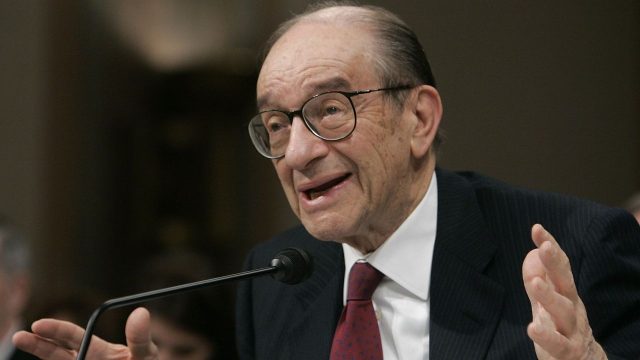
Alan Greenspan was perhaps the most influential economic policymaker of his or any era. The former Federal Reserve chairman died this week at 100, leaving behind a debate about whether he supercharged the American economy or inadvertently caused its near-destruction.
Greenspan “helped define modern American capitalism” during his two-decade Fed tenure, said NBC News. Greenspan’s policy judgments “created an enormous amount of wealth and prosperity for our country” during the decade-long economic expansion of the 1990s, Kevin Hassett, the director of the National Economic Council, said to CNBC. On the flip side, critics say the Ayn Rand acolyte’s embrace of laissez-faire capitalism set the stage for the financial collapse that caused the late aughts’ Great Recession. Greenspan’s push to deregulate financial institutions “stripped away key safeguards, which could have helped avoid catastrophe,” the Financial Crisis Inquiry Commission said in a 2011 report.
Good? Or lucky?
Greenspan was a “maestro of monetary policy,” said The Economist. His Federal Reserve “kept the American economy humming” through one of the longest economic booms on record. But it was not long after he left the Fed that the global financial crisis arrived. Greenspan defended the institution’s “light regulatory touch” that critics blamed for the crash, and he argued that the Obama administration’s interventions were “preventing the massive correction” that markets needed to recover. Such excuse-making raised a question about Greenspan’s formerly shiny reputation: “Had he been good, or merely lucky, and then unlucky?”
No one promoted the free-market system “with more ardor” than Alan Greenspan, Roger Lowenstein said at The New York Times. Those principles “work well most of the time,” but the 2008 financial collapse “was not one of those times.” Greenspan’s Federal Reserve “failed to crack down on hyperpermissive lending terms” that let Americans too easily borrow too much money for houses they could not afford. The damage to Greenspan’s reputation “should be imprinted” in the memory of every economic policymaker.
Greenspan’s “worst moment” came when he pronounced himself “shocked” that banks had failed to protect themselves or their shareholders in the rush to make bigger profits, said The Wall Street Journal. In truth, Greenspan had a “keen” understanding that “government can’t fine-tune the economy or create wealth.”
Lessons for Kevin Warsh
Greenspan’s supporters remember his Fed delivering “mostly stable prices, booming asset markets and steady economic growth,” Jonathan Levin said at Bloomberg. Those fans include Kevin Warsh, the new Fed chairman appointed by President Donald Trump. Warsh should understand that Greenspan’s hot economy was partly produced “from a good deal of economic and demographic luck” — the kind of positive development “Warsh can’t bet on today.”
The newly appointed Fed chairman should learn from Greenspan’s legacy as a “bipartisan operator,” Harry Kraemer said at Forbes. Greenspan served under both Republican and Democratic presidents, after all. The Fed’s commitment to “balancing low unemployment and rising inflation does not have to be politicized.”
Both booms and busts define his Federal Reserve chairmanship