Thirty years after the start of South Africa’s Truth and Reconciliation Commission (TRC), Under the Shade of a Tree I Sat and Wept arrives not to commemorate but to question.
In collaboration with the Kosovo-based Qendra Multimedia, the production draws an unlikely but deeply resonant parallel between the TRC and Kosovo’s Movement for the Reconciliation of Blood Feuds. The latter was a grassroots initiative in the early 1990s that saw more than 1 200 blood feuds resolved through acts of public forgiveness.
On paper, the comparison feels almost improbable. One is a state-sanctioned process emerging from the end of apartheid; the other, a community-driven movement rooted in centuries-old customary law. But in playwright Jeton Neziraj’s hands, the two become mirrors, reflecting not just each other but the fragile, often contradictory nature of reconciliation itself.
The play doesn’t offer easy answers. Instead, it asks a deceptively simple question: Why do people forgive?
For Neziraj, the origins of the work are as intimate as they are historical. It began, he tells me, with a meeting. “An old man wanted to have a coffee,” he says, recalling the encounter in Kosovo in 2024. The man had sought him out to talk about the blood feud reconciliation movement, frustrated that it had slipped to the margins of public memory. As he spoke, recounting his involvement in the process, he began to cry.
“That moment was it,” Neziraj says. “It was a crucial moment.”
The emotions of that encounter which were raw and unresolved decades later, became the spark. For Neziraj, it was a reminder that history is not something fixed in the past but something that continues to reverberate through the present, often in ways that remain unexamined.
In Kosovo, the reconciliation movement had once mobilised hundreds of thousands of people, with families publicly forgiving the killers of their loved ones in an effort to halt cycles of retaliatory violence. But the outbreak of war soon after eclipsed the acts of collective courage, burying them beneath the larger narrative of conflict.
“Somehow nobody really wanted to go back anymore,” he says.

The play, then, becomes an act of return. A way of excavating what was left behind. The connection to South Africa emerged almost organically.
In searching for a “mirror” through which to examine Kosovo’s experience, Neziraj and his collaborators turned to the TRC, a process globally recognised, extensively documented and yet deeply contested.
When Neziraj first visited Johannesburg in 2020, he connected with Greg Homann, the artistic director of the Market Theatre, and the seeds of a collaboration were planted. What followed was a years-long process of research, exchange and ultimately co-creation, bringing together performers and creatives from South Africa, Kosovo and across Europe.
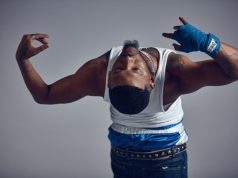
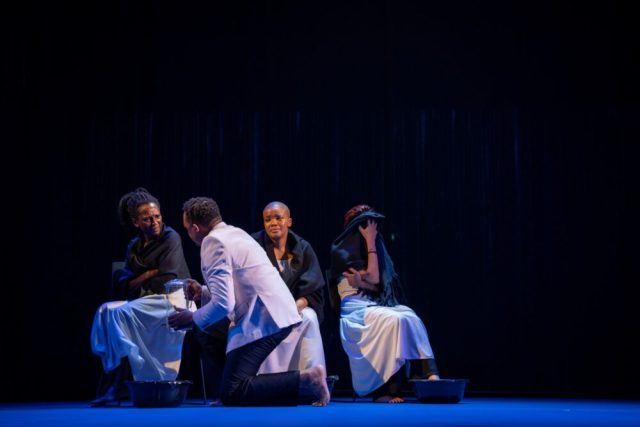
The result is a production that feels as global as it is specific. On stage, seven performers move fluidly between languages, geographies and identities, embodying stories drawn from both contexts. A South African actor might inhabit the voice of a Kosovar witness; a European performer might step into the shoes of an apartheid-era figure.
The effect is initially disorienting. But as the play unfolds, the logic becomes clear: they are not characters in the traditional sense but vessels for testimony.
“We didn’t want to create boundaries,” Neziraj explains. “The focus of the play is much more important than trying to make distinctions.”
The approach is central to the play’s form, which resists conventional narrative structure in favour of something more fragmented, more porous.
Neziraj estimates that more than 70% of the material is drawn directly from archival sources, interviews and historical records. The rest emerges from the rehearsal process itself, shaped by the actors’ responses to the material, their own reflections and moments of improvisation.
Layered on top of this is a third element: fiction. Small, sometimes playful interventions such as a seemingly incongruous scene or a sudden shift in tone that disrupt the weight of the testimonies without undermining them.
The result is a kind of theatrical collage, where past and present, fact and interpretation, constantly bleed into one another.
At times, the actors step out of their roles entirely, debating the material they are performing, questioning its meaning or even its validity. It’s here that the play’s meta-theatrical dimension comes into focus.
“Our idea was not just to bring those historical initiatives to the surface,” Neziraj says, “but to bring them into dialogue with this time.”
That dialogue is perhaps most striking in the way the play handles the question of forgiveness.
In South Africa, the TRC framed forgiveness within a moral and in many ways, spiritual framework, influenced by figures such as Desmond Tutu, who positioned reconciliation as both an ethical imperative and a pathway to national healing.
In Kosovo, the motivations were different. “There, religion was almost non-existent in the process,” Neziraj explains. “It was inspired by the idea of national unity and the fear of war that was approaching.”
Faced with the prospect of widespread conflict, communities chose to resolve internal divisions, recognising that survival would depend on collective solidarity.
“If you are not reconciling,” he says, “what kind of chances do we have to survive?”
In both cases, forgiveness emerges not as a purely personal act but as a social strategy.
A way of reimagining the future in the face of overwhelming violence.

Watching the play in Johannesburg, it’s difficult not to feel the weight of its questions pressing in from all sides.
The TRC, for all its achievements, remains unfinished business. Many cases were never prosecuted. Many stories were never fully told. The promise of reconciliation, for many, feels incomplete.
By placing South Africa’s experience alongside that of Kosovo, the play refuses the comfort of exceptionalism. It suggests that the challenges of reckoning with the past, of balancing truth, justice and forgiveness, are not unique but shared.
At the same time, it resists cynicism. If anything, it insists on the radical possibility that, under certain conditions, societies can choose a different path.
“Forgiveness from a weakness was turned into a social value,” Neziraj says.
But perhaps the most provocative question the play poses is not about the past but the present.
What values, it asks, are we producing now?
If earlier generations, in moments of crisis, were able to generate processes like the TRC or the blood feud reconciliation movement which were imperfect and contested but undeniably transformative, what are the equivalents today?
“Are we producing any kind of values,” Neziraj asks, “or shall we maybe recognise them and inspire ourselves with those values that have been generated?”
It is a question that lingers long after the final scene.
As the lights come down, there is no neat resolution. No cathartic release. Just the quiet persistence of unresolved thought.

In a world increasingly defined by division, by competing truths, by the erosion of shared narratives, Under the Shade of a Tree I Sat and Wept doesn’t pretend to offer solutions.
Instead, it offers something both more modest and more demanding: an invitation to sit with discomfort, to listen across differences and to seriously consider what it might take to forgive. And, more importantly, what it might take to build something from that forgiveness that lasts.
Drawing from archives and lived experience, the international production probes the emotional and political complexities of reconciliation in a fractured world