The US–Israel assault on Iran is sending tremors through global energy markets, raising the risk of higher fuel prices, accelerated inflation and delayed interest rate cuts in South Africa.
As the conflict escalates across the Middle East, even a limited disruption to oil flows through the Strait of Hormuz could quickly feed into South Africa’s fuel price, pushing up inflation and complicating the country’s fragile economic outlook.
The national treasury was modelling possible economic scenarios as global markets reacted to the conflict, Finance Minister Enoch Godongwana said in an interview with the Mail & Guardian this week.
South Africa imports most of its fuel and therefore has little control over global price movements.
“My team is building a scenario plan to assess the implications, depending on the extent of the problem. Insofar as fuel is concerned, we are a price taker because we are not a producer of gas or oil,” he said.
“For that reason … it is likely to have serious implications for us if the situation remains unresolved.”
Higher oil prices feed directly into inflation which, in turn, influences interest rate decisions and borrowing costs across the economy.
Slower growth would weaken revenue projections and place additional pressure on the debt trajectory outlined in the 2026 budget.
Recent history shows how quickly geopolitical shocks can derail fiscal planning, Godongwana said, recalling how Russia’s invasion of Ukraine had transformed global energy markets almost overnight: “In 2022 I delivered the budget. I woke up the next morning and Dr Pieterse (senior treasury official) said: ‘Minister, your numbers are gone.’”
“That is the environment in which we operate,” Godongwana said.
The risk to South Africa lay in how quickly instability in the Middle East could ripple through global energy markets, economists said.
The main economic risk lay in how energy markets responded to instability around the Strait of Hormuz, noted Daniel Meyer, a professor of economics at the University of Johannesburg.
“A prolonged disruption could push oil prices to around $100 per barrel. That would translate into roughly a R1 to R1/litre increase in South Africa’s fuel price,” Meyer said, estimating that every rand increase in petrol prices added roughly 0.4 percentage points to inflation.
“That would likely push inflation above 4% and could force interest rate increases of between 0.25 and 0.5 percentage points.”
Higher borrowing costs would place further pressure on an economy struggling with weak growth and high unemployment. While a complete and sustained closure of the Strait of Hormuz remained unlikely, markets often reacted strongly even to the threat of disruption, Meyer said.
“There is a very limited chance that Iran can block the strait for an extended period. But even temporary instability in such a critical energy corridor can move oil prices sharply,” he said.
The escalation had reduced the likelihood of domestic interest rate relief in the near term, said Elna Moolman, the head of South Africa macroeconomic research at Standard Bank Group.
“The likelihood of an interest rate cut in March has declined significantly and now seems plausible only if the war is decisively ended within the next week,” Moolman said.
‘If a more protracted war underpins sustainably higher oil prices, interest rate relief could be delayed even further. Monetary easing before year-end would likely only be feasible if the rand does not weaken materially and sustainably.”
Much of the uncertainty centres on a single strategic chokepoint in the Middle East — the Strait of Hormuz. The narrow waterway between Iran and Oman, connects the Persian Gulf to global shipping routes and carries roughly a fifth of the world’s traded oil as well as a significant share of global liquefied natural gas exports.
Energy shipments from Saudi Arabia, Kuwait, Iraq, the United Arab Emirates and Qatar pass through the strait before reaching international markets. Even the threat of disruption is enough to push global oil prices higher.
For oil-importing economies such as South Africa the impact is immediate. Higher crude prices translate into more expensive petrol and diesel, pushing up transport costs, food prices and ultimately inflation.
The escalation had injected new uncertainty into global markets, said Raymond Parsons, an economics professor at the North-West University business school.
“The latest geopolitical developments have raised key questions about the future stability of the political economy of the Middle East,” Parsons said, noting that for energy markets, the central question remained the stability of the Strait of Hormuz.
“The biggest immediate impact for countries like South Africa will inevitably be the elevated uncertainty about global oil prices and therefore the prospect of higher fuel costs in the months ahead.
“Oil prices are widely expected to spike in the short term and stay high for a period, depending on the outcome of the war and in the absence of new supply measures to offset higher prices.”
Although the Organisation of the Petroleum Exporting Countries has indicated that additional production could be brought online if necessary, the stability of shipping routes remains the decisive factor.
“There are conflicting reports about the latest status of the strait. The global oil price outlook therefore remains very uncertain in the highly volatile geopolitical circumstances now existing in the Middle East,” Parsons said.
The economic risks stem directly from the rapid escalation of the conflict which follows Israeli and United States strikes inside Iran that killed the country’s supreme leader and several senior military commanders.
Iran responded with missile strikes on US bases across the region, raising fears of a wider confrontation that could draw in other regional actors.
The attacks have also caused significant civilian casualties inside Iran. Iranian officials say hundreds of civilians have been killed in strikes on residential areas and public facilities, including a strike on a girls’ school in the southern city of Minab that left 183 schoolgirls dead.
Iranian officials have framed their response as an act of self-defence after the strikes.
Iran’s ambassador to South Africa, Mansour Shakib Mehr, said the attacks violated international law and the principles of state sovereignty.
Iran regarded the strikes as unlawful aggression, Mehr told a media briefing in Pretoria this week.
“Our act is our inherent right. Our actions are directed at military bases used against us,” he said, referring to Iranian missile strikes on US military installations in the region.
“We respect the sovereignty of our neighbouring countries. Our actions are directed at military bases used against us, not against those governments.”

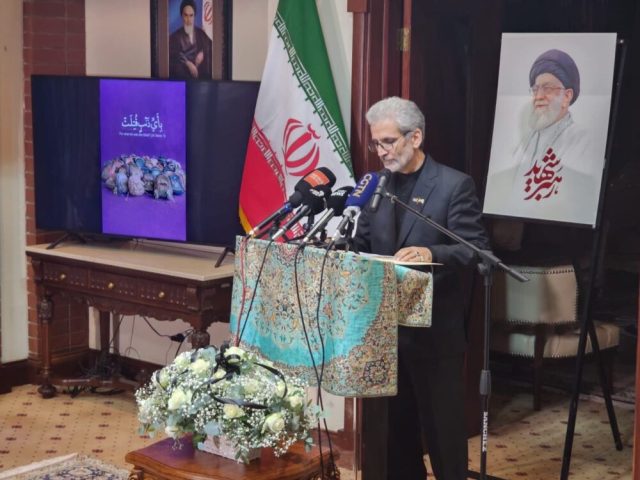
the memorial service for Ayatollah Ali Khamenei, Iran’s supreme leader,
who was among those killed in the attacks. Photo: @MbuyiseniNdlozi/X
He also rejected allegations circulating in South African political discourse that Iran had funded the country’s genocide case against Israel at the International Court of Justice.
The claim has appeared periodically in political commentary and on social media since Pretoria filed its case against Israel in December 2023, arguing that Tel Aviv’s military campaign in Gaza violated the Genocide Convention.
“That is a rumour that is being circulated,” Mehr said when asked about the allegation, calling South Africa’s move a courageous act.
“The case was filed by the government of South Africa. If anyone has evidence of such allegations, they should present it.”
The legality of the strikes has also become a central point of international debate.
The United Nations Charter placed strict limits on when states could resort to military force, said Mahmoud Patel, a professor of international law at the University of the Western Cape.
Article 2(4) prohibited the use of force against another state unless authorised by the United Nations Security Council or undertaken in self-defence after an armed attack.
“A strict reading of Article 51 suggests that self-defence is permitted only after an armed attack has occurred,” Patel said, adding that expanding the doctrine of pre-emptive self-defence risked weakening the legal framework governing international conflict.
“The idea of pre-emptive self-defence is founded on conjecture. It allows powerful states to project military force across borders while still claiming to act within the confines of legality.”
Beyond the legal debate, the conflict is placing regional governments under intense geopolitical pressure.
Governments in the Gulf faced a delicate balancing act, former South African ambassador to Qatar Faizel Moosa said.
“The Gulf states are caught between a rock and a hard place. They rely on the US for security guarantees but they also maintain long-standing economic relationships with Iran,” Moosa said.
“Qatar’s liquefied natural gas, Saudi oil and the energy exports of several Gulf states all move through the Strait of Hormuz. That corridor is absolutely critical to the global economy.”
As Iranian conflict rattles oil markets and raises economic risks for South Africa, Finance Minister Enoch Godongwana is building a scenario plan to assess the implications for the country