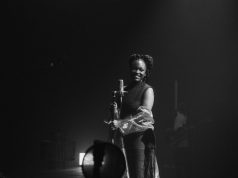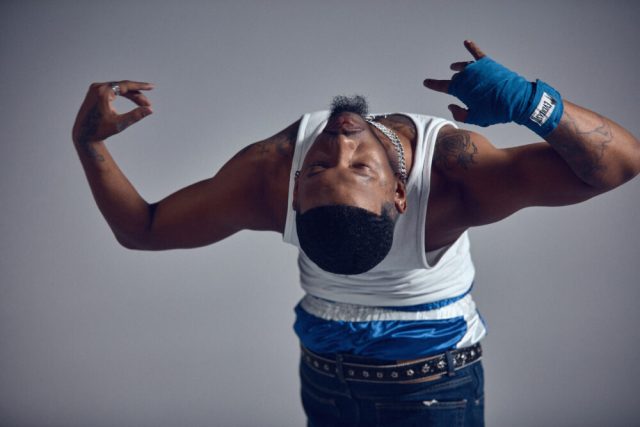
There was a stillness about him that night — one that did not announce itself with bravado but with something far more arresting. A quiet, emotional poise.
When Lee-ché Janecke, known to the world as Litchi HOV, stepped onto the stage to accept the Standard Bank Young Artist Award for Dance, it was not just a career milestone. It was a moment thick with memory, lineage and a kind of arrival that felt both deeply personal and historically loaded.
An internationally recognised choreographer, creative director and movement architect, Litchi HOV has built a reputation for crafting visually striking, emotionally charged performances that move seamlessly between stage, film and global pop culture.
His work, often rooted in storytelling and physical expression, has travelled across borders, placing him among a new generation of South African artists reshaping how dance is seen and experienced.
In the audience sat his mother, his sister, his people. The ones who had witnessed the long arc of becoming. They urged him gently but insistently to tell his story, not just of success but of resilience, of movement, of breaking what he calls “generational curses”.
A few days later, when we speak the same emotional clarity lingers in his voice. He is reflective, grounded and acutely aware that what he carries is bigger than himself.
“I only found out later,” he says, “that both my parents were dancers.” It lands almost like a revelation in motion. Growing up, dance was not formally named as inheritance but it lived in his body nonetheless. “There was always this natural pull to movement,” he explains.
By his final years in school, the pull had taken over. “My academics were great,” he says, “but this thing, this passion was louder.” Choosing dance was not just about career direction; it was a decision that would shape the architecture of his life.

Dance, as many practitioners will tell you, is often a selfless discipline. It demands the body, the spirit, the time, sometimes without giving much back. I ask him if he has ever considered walking away, trading it all for something more stable, more predictable.
He laughs softly but there is weight beneath it. “Of course those moments exist,” he admits. “You feel them. You see other people give up but for me, quitting has never been an option. Not because it hasn’t been hard but because of what the choice to stay represents”.
“I made a commitment,” he says. “Not just to dance but to breaking something. To not going back.” There is a sense that returning to a safer, more conventional path would feel like a kind of betrayal, not just of the work he has done but of the younger version of himself who chose this life despite the odds. “It wouldn’t satisfy the child in me,” he says. “And it wouldn’t mean anything now, after everything.”
What sustains him then is not just discipline but perspective. He speaks about learning to sit with emotion, the highs and the inevitable lows. “You carry everything,” he says. “But you learn how to move through it.” It is a dancer’s philosophy, yes but also a life one.

That sense of movement through time, through pain, through history was palpable on the night of the awards. Many of the recipients spoke about ancestors, about God, about legacy, about being vessels for something older and larger. For Litchi HOV, the connection is deeply rooted in his mother.
“I’ve watched her fight,” he says. “I’ve watched her survive things I can’t even fully explain.” There is reverence in the way he speaks about her but also a kind of quiet inheritance.
When doubt creeps in, as it inevitably does, he returns to that. To the understanding that his presence in the spaces is not accidental.
“I remember where I come from,” he says. “I remember that I’m breaking something. That I’m creating a place that didn’t exist before.”
If his personal philosophy is grounded in reflection, his daily life is anything but static. There is no such thing as routine in the traditional sense. “It’s not a 9-to-5,” he says. “Every day is different. Every day is an adventure.”
A typical day might begin with prayer and quiet grounding, followed by the physical demands of training. From there, it could unfold in any number of ways: rehearsals, meetings, travel, performances, creative development. “You could end your day at 10pm,” he says, “or in the early hours of the morning and then the next day you’re on a flight to another country.”
It is a life that requires constant recalibration, constant energy. When downtime does come, he protects it fiercely. “I disappear,” he says, laughing. “I stay at home. I don’t want to be texted or called; you have to disconnect,” he says. “Otherwise you burn out.”
Collaboration, however, remains central to his practice. When I ask about the people who have shaped his journey, he lists Tyla, Uncle Waffles, Busiswa and Kamo Mphela, to name a few. “I love working with people who have vision,” he says. “People who are not afraid to break barriers.”
There is a particular appreciation for artists who challenge norms, who push beyond what is comfortable or expected. These are the relationships he returns to, the ones built on mutual respect, shared risk and creative alignment. “Those are the ones that last,” he says.
At the same time, his gaze is firmly set on the future. He speaks with excitement about the possibility of working with global artists such as Usher, Chris Brown or even the legendary Janet Jackson. These are people whose work he has studied, admired and imagined himself alongside. It is not ambition in the traditional sense but something more expansive: a desire to be in conversation with the world.
And yet, for all the international recognition, for all the accolades, there is an insistence on staying grounded. When I mention the way he carries himself, his humility, his openness, he seems almost bemused by the idea of being seen as a “superstar”.
“I didn’t come into this for fame,” he says simply. “I didn’t come into it for attention.” The visibility, the recognition, it is something he is learning to navigate. “People will call me that,” he says, “and it can be overwhelming.”
He does what he can to remain anchored. He avoids getting lost in the noise, in the external validation.
“I don’t want it to get to my head,” he says. “I don’t want it to change who I am.”
What matters, ultimately, is authenticity. The person on stage, the person on screen that is one facet of who he is. But offstage, in conversation, in everyday life, he is committed to being “a loving, caring, real person”. It is not a performance; it is a principle.
“I treat every conversation the same,” he says. “No matter who I’m speaking to.” It is a simple idea but one that feels increasingly rare. In an industry often marked by hierarchy and ego, his approach is disarmingly human.
As our conversation draws to a close, the question becomes inevitable: What next?
The award, he explains, offers more than recognition, it offers possibility. For the first time in a long while, he will have the opportunity to create work that is entirely his own. “I haven’t been able to do that,” he says, “because I’ve been giving so much of myself to other projects.”
Now, there is space to return to his own voice, his own vision. To create something that is not shaped by external demands but by internal necessity. “I want to pour everything into it,” he says.
In the end, what Litchi HOV offers is not just movement but meaning. A reminder that the body can carry history, that art can be a form of resistance, that choosing yourself over and over again is its own kind of revolution.
A deeply personal portrait of Litchi HOV, the award-winning choreographer turning movement into a language of memory, resilience and generational change