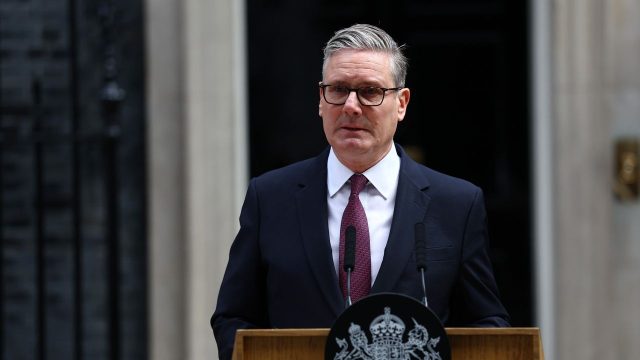
Another prime minister resigning from office adds to the “unprecedented instability in the modern history” of Britain, said an editorial in Le Monde.
Following his announcement on Monday, Starmer will still “seek to make his final mark on the world stage as a lame-duck prime minister”, said Politico. But a planned EU-UK summit on 22 July has been postponed amid indecision over Britain’s intentions regarding the continent.
With Starmer’s imminent departure, and many of the policies of his likely successor Andy Burnham as yet unknown, Britain’s instability is having tangible consequences on the world stage.
How was Starmer viewed?
“God save the king and this desolate land of the United Kingdom,” said Antonello Guerrera in La Repubblica. Since Starmer was elected in 2024, he has appeared a “robotic and insipid leader” on the domestic front. He has “always been a Hamlet: paralysed by indecision, doubt, and sunk by tragic ineptitude”. And on Monday, “the curtain fell”.
But, aside from being “humiliated” by Donald Trump on social media, many world leaders thanked Starmer for his service, including his “staunch ally” Volodymyr Zelenskyy, his “comrade” Emmanuel Macron, and Giorgia Meloni. Ursula von der Leyen, president of the European Commission, paid tribute, saying: “It can take many leaders years to grow into the statesman you became in just two years.”
“Pragmatic, cool and rational”, Starmer embodied a strain of “anti-politics” and could get the job done without a fuss, said Enrico Franceschini in La Republicca. But these qualities were eroded by a “lack of charisma, the inability to communicate, and the limited political vision of a prime minister animated by good intentions but unable to implement them”.
Where did it go wrong?
“Beleaguered” Starmer’s tenure was “troubled” from the outset, said Euronews. From failing to declare gifts in the first few months of his premiership, to appointing Peter Mandelson as US ambassador, to numerous policy U-turns on “welfare reform, introducing digital IDs and scrapping winter fuel payments”: his time in office was “littered with controversy”.
Starmer was also “undone by economic stagnation” and “underspending on defence”, said Quentin Letts in The Washington Post. But perhaps the reason he stayed in power so long was that there was “no obvious answer” as to who could replace him.
Fundamentally, Starmer “broke his promise of stability” and “orchestrated constant changes of strategy”, said Claudi Pérez in El País. In his defence, he inherited a “poisoned chalice” of “stagnant” growth, but overall, like “bad tennis players”, he made “too many unforced errors”.
Is Britain an isolated case?
Since Britain voted to leave the EU in 2016, No. 10 has become a “hot seat”, said Deutsche Welle. Whoever succeeds Starmer will be the seventh leader in that period, and will be “grappling with profound political, economic, and social problems”.
Before Starmer, according to Der Spiegel, the UK had “gambler” David Cameron, someone who tried to “pick up the pieces” in Theresa May, the “scandals”-ridden Boris Johnson, a “zigzag” six-week tenure from Liz Truss, and a leader of “negative momentum” in Rishi Sunak. Downing Street has become a “transit station”.
But the rest of Europe is equally fractured, said Pérez in El País. Since the financial crisis in 2008, there has been a “collapse” of centrist parties in Europe. France has had seven prime ministers in the past eight years, and in Germany, Friedrich Merz’s popularity is “plummeting” and the “grand coalition is falling apart”. Further afield, the US’ “politics are a mess”.
Is the future brighter with Burnham?
The “charismatic” Burnham is a “rising star”, with “decades of experience in national and regional politics”, said DW. And he is perhaps the “last hope to counter the rising right-wing populists of Reform UK”.
The new MP for Makerfield provides a “glimmer of hope” for the UK, said Pérez in El País, not least because he is in favour of “resetting the relationship with the EU”. That is the “greatest reform this country needs”. It has been “plagued by a nauseating post-imperial nostalgia, an epidemic of fear, and a mediocre political class that has been hitting rock bottom for almost 20 years”.
Burnham “may well prove a more skilled rider”, said The Washington Post. But each of the last six prime ministers “arrived promising to be the exception to the merry-go-round of predecessors and unquenchable voter rage”. And he “won’t have much time to figure it out”.
With the prospect of seven prime ministers in the last ten years, some see Downing Street as a revolving door, and Britain as ‘ungovernable’