[Many thanks to Peter Jordens for bringing this item to our attention.] Micha Frazer-Carroll (The Guardian UK) says, “During my visit to the Fuze Caribbean art fair in the Bahamas, I marvelled at how creators captured the complex nature of Caribbeanness.”
When I tell people I’m travelling to the Bahamas to report on Fuze Caribbean art fair, no one believes I’m really going for work. There are smirks and jokes about it being a tough life, about drinking from coconuts on the beach. The tourist gaze pervades global perceptions of the Caribbean. This week, I speak to the region’s artists about how they use images to speak back.
I have Antiguan and Jamaicanheritage, so I’m familiar with the fantasies the Caribbean sparks, which Antiguan-American writer Jamaica Kincaid described as so beautiful that its fluffy white clouds, blue spectral waters and “bottomless” black nights seemed “unreal”. Images have done much to flatten the Caribbean in the global imagination – so why shouldn’t Caribbean people use images to speak back?
“Artists from The Bahamas and the wider Caribbean are in constant dialogue with the expectations of outsiders looking at our destinations as spaces of relaxation and service,” says leading Bahamian artist and curator John Cox, who I meet on a gallery tour of the nation’s capital, Nassau. “Those expectations often fetishise exotic notions of paradise, drawing on Hollywood images of an appealing landscape inhabited by people whose lives and cultures are presumed to be less sophisticated.”
What does it mean to ‘paint Black’?
Through this process, culture becomes flattened, and local people participate to make a living. Take the capital’s famous straw market, one of the nation’s most popular tourist attractions, where vendors sell bags and other items made from woven silver top and palmetto palms. The market helped local women earn money in the early days of tourism; now many of its goods are imported from China, and you can buy a bag with Minnie Mouse’s face braided onto it. Artist Anina Major, who recently exhibited at TERN gallery in Nassau, has made ceramic sculptures from hand-weaved clay to resemble the baskets. But in her work, they are crumpled and sinking into themselves – a deflated replica of Bahamian identity, performed entirely for the tourist gaze. I encounter this cynicism and resentment towards tourists among many of the Bahamians I meet.
Other artists decentre the tourist, going deeper into cultural traditions, such as Caribbean connection with the sea, the flora and the land. Virtually everywhere you look at the fair, there are fluorescent colours: pinks, yellows and aquas. Antonius Roberts, another of the Bahamas’ foremost and prolific artists, suggests that this palette may be the reason that when he first went to study in the US, he was told to stop “painting Black”. “It was seen as too bright, the paint coming right out of the tube,” he tells me. “I was like: ‘You haven’t been to the Caribbean have you? You haven’t seen our beautiful beaches, right? You haven’t seen our bright tropical sunlight?’” [. . .]
The art fair is hosted at a luxury resort. I feel alienated from the American tourists here on bachelor parties who fill the resort’s casinos, in which it is illegal for Bahamians to play. In a throwaway comment during the gallery tour, I remark that I’m “not like them” – and a Black British curator, who regularly visits her sister in the Bahamas, responds quickly: “You are”. [. . .]
For full article, see https://www.theguardian.com/news/2026/nov/18/caribbean-artists-speaking-truth-to-the-world
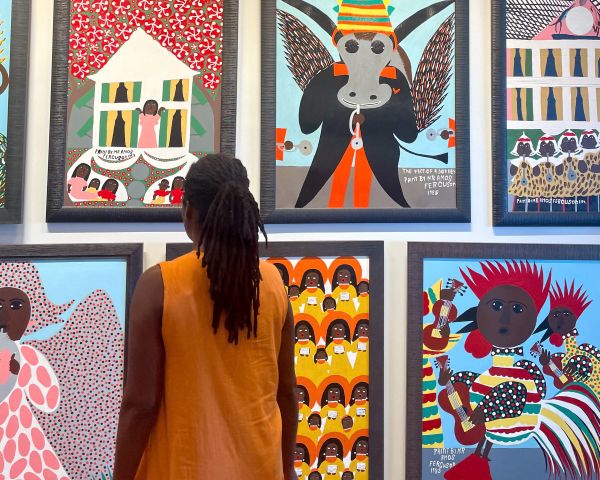
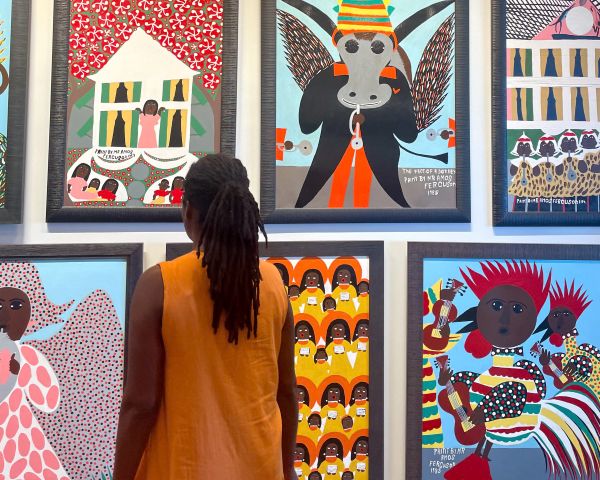
[Photo above by Micha Frazer-Carroll/The Guardian. Going deeper with cultural traditions … curator Chantel Akworkor Thompson views Bahamian folk artist Amos Ferguson’s work at V&M Gallery in the Bahamas.]
[Many thanks to Peter Jordens for bringing this item to our attention.] Micha Frazer-Carroll (The Guardian UK) says, “During my visit to the Fuze Caribbean art fair in the Bahamas, I marvelled at how creators captured the complex nature of Caribbeanness.” When I tell people I’m travelling to the Bahamas to report on Fuze Caribbean