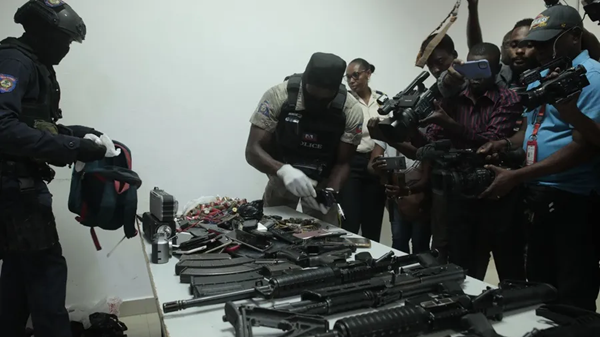
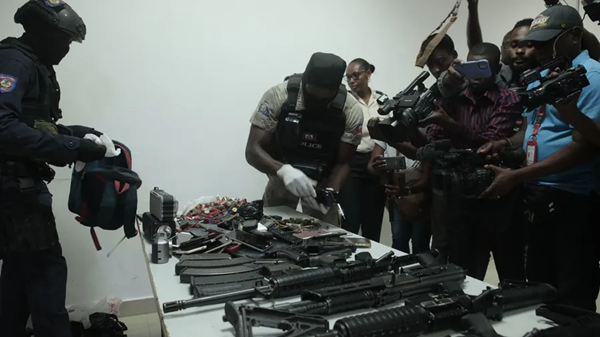
The full title of this article is “Haiti: how gangs manage to restock their weapons despite seizures and international sanctions.” Caroline Popovic reports for France Info La1ere-Martinique. She writes that the arsenals of ammunition used by Haitian gangs come from stockpiles from the Dominican Republic’s army and national police, weapons from Haiti’s own national stocks, ammunition sold by the Companhia Brasileira de Cartuchos, and firearms from the United States.
In its 2026 report, the UN Security Council-mandated Panel of Experts on Haiti confirms that armed groups continue to procure weapons and ammunition, despite measures taken to combat this trafficking. Gangs maintain their striking power and their ability to replenish their stocks of weapons and ammunition. “Collusion between gangs and Haitian police officers—who supply them with weapons and facilitate their movement—undermines security operations, allowing gang leaders to evade arrest.”
Politicians who arm gangs
Political figures use gangs to remain in power. Alfrédo Junior Antoine, a former deputy for the Kenscoff constituency, employed the services of gangs to intimidate his opponents and carry out massacres.
Nenel Cassy, a former senator for the Nippes department, contributed to the creation of Fantome 509, a violent group composed of armed individuals, including police officers.
Criminal networks—which extend into the administration and the business world—thwart police operations and investigations. Gangs maintain ties with both state and private-sector actors.
The Haitian police have arrested several corrupt officers. In Jamaica, 51 firearms bearing the markings of the Haitian National Police have been seized in connection with drug trafficking cases.
Martinique, Guadeloupe, and French Guiana cited by the UN
Most trafficking networks operate between the United States and Haiti. In the United States, firearms are purchased under the buyer’s own name from federally licensed firearms dealers. Traffickers frequently use encrypted messaging services to sell weapons and ammunition in Haiti and elsewhere.
In 2025, a messaging group called “Arms Market”—managed by an individual using a phone number registered in France—offered handguns and semi-automatic rifles for sale, most of which were second-hand. The phone numbers of potential buyers were registered in Haiti, the Dominican Republic, and the French overseas territories and departments of Guadeloupe, French Guiana, and Martinique.
Weapons favored by gangs
Ammunition seized in Haiti was produced by more than 30 manufacturers across 20 countries, including nations in Europe, Asia, and the Americas.
Basic handguns sell for between $2,000 and $4,000, while semi-automatic rifles cost between $5,000 and $8,000. Weapons are less expensive when imported directly from the United States. A semi-automatic rifle that costs between $500 and $700 in the United States can be sold for approximately $2,500 in the Dominican Republic.
Excerpts translated by Ivette Romero. For full, original article, see https://la1ere.franceinfo.fr/martinique/haiti-les-gangs-continuent-a-se-reapprovisionner-leurs-stocks-d-armes-a-feu-1759152.html?Yw
Also see https://docs.un.org/fr/S/2026/714
The full title of this article is “Haiti: how gangs manage to restock their weapons despite seizures and international sanctions.” Caroline Popovic reports for France Info La1ere-Martinique. She writes that the arsenals of ammunition used by Haitian gangs come from stockpiles from the Dominican Republic’s army and national police, weapons from Haiti’s own national stocks,