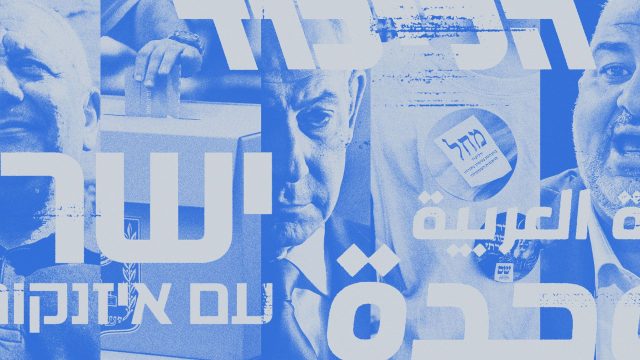
Arab parties could reshape the political landscape of Israel after securing a record number of seats in Tuesday’s bitterly fought election. The left-wing Joint List, which includes Hadash, Balad and Ta’al, alongside the socially conservative Ra’am party led by Mansour Abbas, are on course for 18 of the Knesset’s 120 seats.
With neither Benjamin Netanyahu or his main rival, former military chief Gadi Eisenkot, close to securing a majority on their own, the Arab parties’ strong showing could make them “kingmakers”, said Liam Stack in The New York Times. “But building a governing coalition with Arab participation remains a fraught exercise in Israel.”
What did the commentators say?
Arab Israeli citizens make up around 20% of the country’s population, and at this election they have turned out in record numbers, driven by what Al Jazeera’s Nour Odeh called “an existential moment for Palestinian-Israelis”.
Their success at the polls poses an “urgent and fundamental challenge to the country’s mainstream opposition: either cooperate with Arab Israelis or hand Benjamin Netanyahu a roadmap to political survival”, said Julian Borger in The Guardian.
While Yair Golan, leader of the left-wing Democrats party, hailed the results as an “opportunity to form a change government in partnership with Israel’s Arab citizens”, for the larger opposition parties, the picture is “less straightforward”, said The Washington Post. Their voters tend to “lean further right, and many have long rejected any government propped up by Arab lawmakers”.
Eisenkot has not explicitly ruled out working with the Arab parties but the conditions he has set for any party to join him are so stringent they may make any partnership impossible. Then there are the concessions the various Arab factions would demand in return for power-sharing. “Cooperation would have to survive those disagreements,” said Zvika Klein in The Jerusalem Post. “A shared interest in replacing a prime minister does not settle what comes afterwards.”
What next?
If no bloc secures the 61-seat threshold once the final result is announced, it falls to Israel’s president, Isaac Herzog, to decide who he asks first to try to form a government. They then have six weeks to cobble together a coalition, after which the challenge is passed on to the next option.
Although Netanyahu and Eisenkot are “unlikely to enter a formal coalition with Arab parties”, the record Arab turnout is still “significant”, said Nada AlTaher in The National.
With Netanyahu’s chances of forming a majority government all but over, he would be forced into putting together a unity government. This would have to include members of the opposition, potentially pushing extreme figures such as Itamar Ben-Gvir and Bezalel Smotrich out of a future cabinet.
It’s “not the outcome” Arab voters, or indeed those fundamentally opposed to Netanyahu staying in power, will have hoped for, said Danny Citrinowitz, from the Institute for National Security Studies, but it could at least force the PM towards a more moderate position.
Strong election showing could make them ‘kingmakers’ but ‘building a governing coalition with Arab participation remains a fraught exercise’