
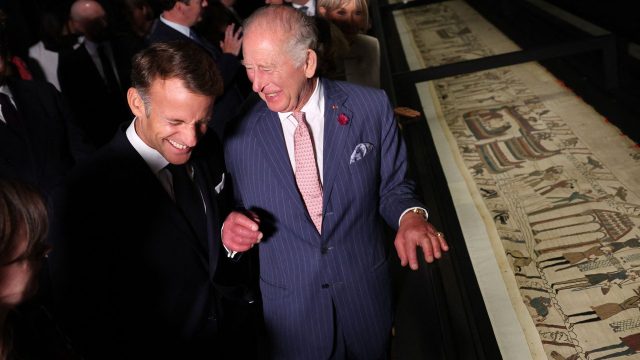
“Why is everybody so mad?” said The Wall Street Journal, about the Bayeux Tapestry’s return to Britain and the “class war” that has broken out around it.
Britons who want to see the historic embroidered cloth dating from the 11th century “say they’re being treated like Taylor Swift fans on Ticketmaster”, while “American tech billionaires, luxury hotel guests and museum sponsors get to skip the line”.
‘Akin to a birthright’
The Bayeux Tapestry “holds a particular position in British public consciousness” because “it tells, over 230 feet of finely embroidered cloth, the story of the last time England was conquered” – the victory of William of Normandy at the Battle of Hastings in 1066.
“For many Brits, seeing it is akin to a birthright.” But when tickets went on sale people found them hard to get, and then “word started to trickle out about who was having no trouble getting in”. For example, the luxury hotel One Aldwych offered tickets to the tapestry as “part of a package stay, with guests in rooms that cost around $1,100 (£825) a night promised a viewing any date and time of their choosing”.
Meanwhile, some visitors are being given a different experience, said Lara Brown in The Spectator. “Most art critics and journalists” have been “permitted by museum marshals to stop and appreciate the thing”, but “the rest of us commoners will have no such luck”.
After queueing outside, we were “informed by our guide that we would be going inside in precisely 32 seconds”. There we were “introduced to a cartoon bird who would guide us through our ‘experience’”. After a further hour’s wait, we reached the display and realised that the focus of the staff is to get us “through the exhibition hall as fast as humanly possible”.
Bayeux biscuits and a Norman soldier teddy
“The reason the queue is going slowly is because people are dawdling inside”, said Giles Coren in The Times. And “they are hustling people along inside because they don’t want the queue to be too long”. So “how, exactly, Einstein, do you think they can solve both” of those problems?
I am “sympathetic” towards the British Museum, said Brown in The Spectator, because “hundreds of thousands of people want to visit” and “they need to find a way to get us all through”. Although I’m “grateful to have seen such an important piece of English history”, I would have been “even more grateful if I had been allowed to properly look at it”.
Nicholas Cullinan, director of the British Museum, acknowledged that “the experience has not been as smooth as we would have liked”, and announced new measures including longer opening hours, an audio guide and extra seating for those stuck in the queue.
But his statement “stopped conspicuously short of an apology”, said The Telegraph. So “the question now is whether the museum’s attempts to right the ship will prove enough, or be seen as too little, too late”.
Meanwhile, visitors can enjoy the gift shop, which manages to “upstage” the exhibit itself, said CNN. “A box of Bayeux biscuits, Bayeux Tapestry horseman keyrings, a maritime tea light holder and a Norman soldier teddy bear”, are among the delights on offer to commoner and tech billionaire alike.
Tech billionaires and art critics can take their time enjoying the 11th-century relic in London. But the public must hurry along