
Nesrine Malik (The Guardian) asks “Why does the often-maligned Caribbean obeah tradition endure?” She says, “The practice, which merges pre-Abrahamic African religion, Christianity, and indigenous Caribbean features, has been stigmatised in the region.” See full article and illustrations at The Guardian. [Many thanks to Peter Jordens for bringing this item to our attention.]
Babus, Fakis, Sangomas – these are a few of the names of spiritual or mystical healers and practitioners found all across the African continent. A version of the tradition they follow, obeah, made its way to the Caribbean among enslaved populations, from West Africa. Today, obeah endures, despite colonialism and the adoption of Christianity across much of the Caribbean.
This week, I spoke to our Caribbean correspondent, Natricia Duncan, about the tradition, and a new Jamaican film that highlights aspects of obeah. Our conversation revealed to me that obeah, something I knew very little about, was in fact uncannily familiar.
Obeah – ‘demonic’, or demonised?
Obeah is a syncretic practice that merges pre-Abrahamic African religion, Christianity, and indigenous Caribbean features. It is part medical and natural, utilising material from animal and plant life to heal; and part supernatural, using spells to ward off evil and summon good fortune. To west Africans, obeah broadly falls in the “juju” tradition of folk magic. For Haitians, it’s similar to vodou, for African Americans, hoodoo. The common belief is that forces in the spiritual world can influence the material one through physical objects such as amulets, charms and talismans, or ritualistic concoctions to heal or curse. [. . .]
Obeah looms large in the Caribbean cultural imagination. Natricia, who is from Saint Vincent and the Grenadines, says that she was keenly aware of obeah and related spiritual beliefs and traditions growing up. During electricity outages in her community, the candles came out and “jumbie” stories were told, ones “based on a belief in spirits, in a world we can’t see, in supernatural abilities”. Natricia describes frequent interventions from elders, who gave advice to children to make sure that someone didn’t “do them” – that is, cast an evil spell on them. They believed that spells could be cast through the use of personal physical objects, sometimes as simple as a borrowed pencil. “As a child, you really believe these things.”
But in Natricia’s experience, obeah is also closely connected with herbalism. The belief is that “there is power in nature, in the soil, in animals”. [. . .]
Colonial connections
While speaking with Natricia, I’m struck by just how similar her childhood experiences were to mine, considering I grew up across the world from her in Africa. I saw that same deference to traditional healers during periods of illness, that same fear of being hexed by haters, that same belief in the supernatural that could be leveraged for effect in the material world. The only difference is that, in the Caribbean, there is more tension between these practices and Christianity than there is in Sudan with Islam. In her experience as a Christian, Natricia tells me, obeah “represents evil”.
That stigma can be traced back to enslavement and colonisation. During enslavement, many of these practices represented something that offered hope, togetherness, a sense of identity and a connection to the homeland from which they were stolen. But they were opaque to Christian colonisers in the Caribbean, who began to group these diverse practices under the umbrella of “obeah”, and demonise them. From the 18th century onwards, a time characterised by large scale plantation enslavement and subsequent revolts, anti-obeah legislation began to pass. [. . .]
For full article, see https://www.theguardian.com/news/2026/jun/17/why-does-the-often-maligned-caribbean-obeah-tradition-endure
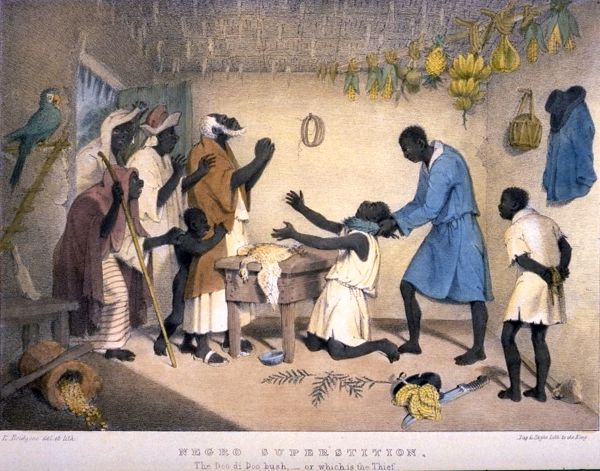
[Illustration above: Stigmatised … an obeah practitioner at work, Trinidad, 1836. Photograph: slaveryimages.org.]
Nesrine Malik (The Guardian) asks “Why does the often-maligned Caribbean obeah tradition endure?” She says, “The practice, which merges pre-Abrahamic African religion, Christianity, and indigenous Caribbean features, has been stigmatised in the region.” See full article and illustrations at The Guardian. [Many thanks to Peter Jordens for bringing this item to our attention.] Babus, Fakis, Sangomas – these