A baby’s initial understanding of safety is in their mother’s womb and her warm, loving hands.
But when that sanctuary is abusive and chaotic, the effects can be dire for the child all the way into adulthood.
As a toddler, bestselling author Moshitadi Lehlomela sucked her thumb thin and dry as a self-soothing mechanism in response to her mother’s hostile energy.
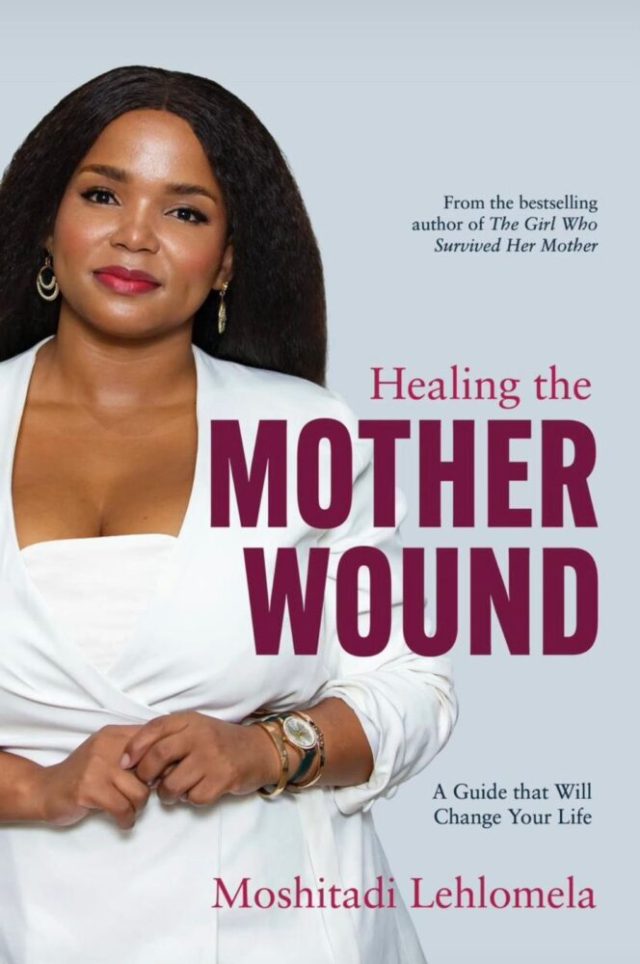
“Her body, my home, was in distress. My first taste of toxicity,” she writes in her latest book, Healing the Mother Wound.
Growing up, Lehlomela didn’t understand why her mother’s behaviour was erratic and unkind.
“On some days she would rage at even the smallest mistakes and inconveniences, physically and verbally abusing us,” she writes.
By age six, the author began to develop self-protective, regulating and soothing strategies to cope with her mother’s wrath — tools she shares in books and her coaching courses.
Confronting the mother wound with care

The mother wound, often called “mommy issues”, is a psychological trauma resulting from maternal neglect, abuse, abandonment or emotional unavailability.
Drawing from her work as a mother wound recovery coach, Lehlomela offers a compassionate approach to the often-unspoken topic in many families.
In her first book, Girl Who Survived Her Mother, Lehlomela writes from a survivor’s perspective. In the much-anticipated follow-up, she offers a transformative guide to healing one of the most complex forms of trauma — one caused by harmful mothering.
The book is based on her online course, “The Self-Mothering Care Practice”, grounded in the idea of reparenting one’s unresolved mother wound.
Divided into five parts and structured around bite-sized but profound chapters, the book explores definitions of the mother wound, reparenting the inner child, grieving and learning to thrive.
The book, like many in the self-help genre, borrows from psychology and neuroscience, often from a Western lens.
Lehlomela’s work also uses ancient indigenous knowledge and spirituality in pursuit of African-centred approaches to healing.
The accessible writing style attempts to give language to the agonising emotions.
“I am a firm believer that language plays an important role in healing and that, when used intentionally, it can empower people.”
When something is easy to understand, she adds, “it feels more doable and taking that first step becomes less intimidating”.
Lehlomela says she doesn’t have the power to heal others.
“Instead, I see my role as an educator who has gained tools through education and experience and can share them so people can heal themselves.”
The relationship between mother and child is sacred. Yet many people, the author says, relate to their mothers as though they are helpless children who did not yet have the tools to process their emotions.
Thus, the thought of confronting unresolved mother wounds can be daunting and overwhelming.
“This is why I make it a point to gently guide readers first into the realisation that they are adults
now, with a nervous system capacity to feel without being consumed by their emotions.”
“This book is designed to support readers through the healing process in a way that is careful and compassionate, helping them engage with their pain without re-traumatising themselves.”
One of the major steps discussed in the book is acknowledging the mother wound.
Whether the harm was done intentionally or unintentionally, the book argues that the wounds cannot simply be explained away or avoided if one wants true healing.
From this acknowledgment, healing can begin to take shape through self-care activities, establishing boundaries, therapy and finding nurturing communities.
Healing through the African lens
Weaving in traditional Bapedi wisdom, Healing the Mother Wound also explores cultural concepts of healing as Africans — a contextual element often missing in most self-help works.
In part two of the book, for instance, Lehlomela writes about Go ikelela, meaning “to abstain”, “detox” or “fast”. The idea is essentially the need to practise self-care and self-preservation as part of recovery and wellness.
“It is a practice people in my culture observe during various life events, including sickness, pregnancy, postpartum recovery and mourning,” explains the Limpopo-born author.
For a long time, many Africans, Lehlomela says, have felt alienated from therapy and inner-child healing work.
“When the language used in these spaces does not feel familiar or culturally grounded, people struggle to see themselves in the concepts being presented. This disconnect can make healing feel foreign and inaccessible.”
Introducing the concept of Go ikelela, a universally African practice, helps bridge that gap. Through the cultural lens, notions of self-care are also reframed. This is to show, the author says, that they are not new trends but practices African communities have long understood and embodied through rest, connection, ritual and collective care.
Using the cultural practices therefore demystifies and confirms that healing work is not something new or imported.
“It acknowledges that boundaries as a tool for self-care have always existed within African cultures, even if they are expressed differently. It affirms that those ways are valid and not wrong.”
Traumatic cultural and social norms
While some cultural practices are an essential part of the healing process, Lehlomela is not blind to the harm the practices could cause.
The author, for instance, challenges cultural practices such as Lebollo la Basadi — initiation for girls. At nine years old, the author was taken to such a school by her mother and grandmother.
In what was supposed to be a rite of passage to womanhood and motherhood, young Lehlomela felt abandoned and rejected — a trauma she carried into her adult years. Often viewed as sacred practices, the author argues that initiation schools are “a product of cultural motherhood steeped in patriarchy”.
Other cultural expectations, such as a child’s absolute obedience towards their parents, especially the mother, could cause childhood trauma. Lehlomela’s pen questions the fallacy of growing a thick skin, developed by victims in order to endure a mother’s abuse and not go against culture.
“Because you are being good to your abusive mom, her body is relaxed in the safety of your kindness. This creates a parasitic relationship where you are her supply and she is the energy vampire. This is the dynamic of every abusive relationship. The abuser glows while the victim withers.”
Due to her own insecurities, inadequacies and jealousy, Lehlomela’s mother carried a sense of darkness that dimmed the author’s light as a child.
She writes: “I learned very early in my life that it was unsafe to outshine my mother and that she saw me as her competition as opposed to just her daughter. I wasn’t supposed to be better than her at anything and although I never thought of myself in that way, she often took it upon herself to tell me that I could never be better, smarter or prettier than her.
“My accomplishments were always met with criticism, dismissal and animosity.”
The author’s mother was, however, not born abusive and depressed. Poverty and an abusive home run by relatives due to her own absent mother defined her childhood. As an adult, the author’s mother was faced with an abusive mother-in-law and a distant husband — factors further contributing to her distress.
In turn, the book shows how a parent’s unresolved wounds get passed on to their children — a vicious generational cycle that haunts many families and relationships.
Based on the cultural, religious and social conditioning, Lehlomela says our noble intentions to show love and kindness towards an abuser can be self-abandonment. Thus, awareness of the wound, creating boundaries and self-care become vital parts of inner-child healing.
Avoiding confrontation with the mother wound might feel like an easier approach when we are children. As adults, however, we are no longer the anxious and helpless boys or girls we were. Now older and wiser, we can try to confront the traumas that dictate our behaviours.
If unresolved, we risk forever being stuck in a loop of toxicity — leading to shattered families and relationships.
“When we focus on individual healing, we begin to cease harming others. Healing awakens our nurturing spirit and helps us become better parents, friends, partners and simply better fellow human beings.
“The world is better for it if we all commit to doing the inner work.”
Author Moshitadi Lehlomela confronts childhood trauma in Healing the Mother Wound