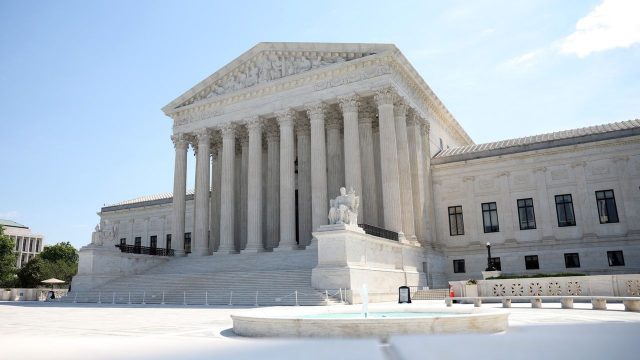
The Supreme Court released a slew of opinions to mark the end of its current term, and one of them could prove to be a landmark case for personal protections: The court ruled that privacy laws must protect against widespread searches of phone location data. The decision could prove to have monumental effects on future Fourth Amendment cases.
What did the Supreme Court decide?
The Court’s opinion in the case, Chatrie v. United States, held that people have an “expectation of privacy from the government as their mobile devices track them throughout their daily activities,” said Politico, even if this data has already been shared with tech companies like Google and Apple. The crux of the case stemmed from a 2019 armed robbery at a Virginia bank and how police tracked down the robber.
During the hunt for the robbery suspect, police used a cellular data search warrant called a geofence warrant to “capture location data from all the phones in the vicinity of the bank for 30 minutes before and after the robbery,” said The New York Times. The eventual suspect was found using the geofence warrant. But he argued that this type of broad search was illegal under the Fourth Amendment, which protects against unreasonable searches and seizures, because innocent people’s data could also be obtained using the search.
The Trump administration pushed back, arguing that “users did not have an expectation of privacy after voluntarily sharing their location data with companies like Google,” said Politico. But the Supreme Court did not buy that argument, ruling that “sensitive data scooped up by geofence warrants counts as a Fourth Amendment search, and offers individuals a reasonable expectation of privacy, even if they may be in a public area,” said The Guardian. The 6-3 ruling included dissents from conservative-leaning Justices Samuel Alito, Clarence Thomas and Amy Coney Barrett.
What is the bigger picture?
The Court did not completely strike down the use of geofence warrants, instead sending the matter back to the Circuit Court of Appeals to determine whether these warrants are actually constitutional violations. “It is therefore now up to the court of appeals to decide whether, at each step of the search process, the warrant satisfied the Fourth Amendment’s requirements of particularity and probable cause,” Justice Elena Kagan wrote in her majority opinion.
The Court’s decision could weigh the scales in determining whether the lower court eventually cuts down geofence warrants. Privacy advocates have “raised concerns about geofence warrants, calling them a form of dragnet surveillance because the information is not just about one suspect, but anyone who was in the location in question,” said NBC News. These advocates have “warned that such warrants could be used to target disfavored political groups, including protesters.”
In the meantime, while the lower court decides, the Supreme Court’s ruling “narrows the scope of what cloud-stored data the federal government can lawfully obtain without an individualized warrant,” said The Hill. Policing could also be affected by the ruling, as geofence warrants are “typically employed by investigators when they know specific details of a crime but don’t yet have a suspect.” Not allowing them to proceed could make solving crimes using cellular data more difficult.
The highest court said broad phone sweeps must be constitutionally protected