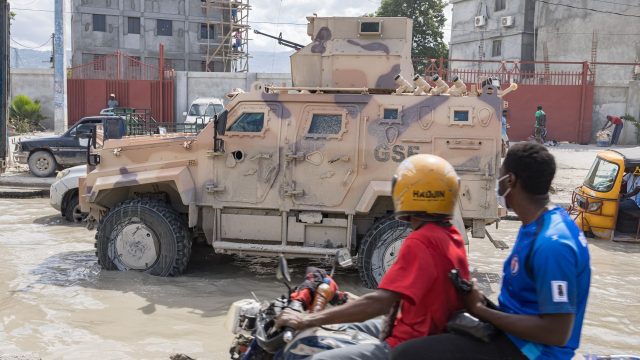
You have to hand it to El Salvador’s president, Nayib Bukele: first he transforms his own country, “once the most dangerous in the Americas, into the safest nation in the Western hemisphere”. Now he is looking to do the same to Haiti, said Arturo McFields in The Hill. In a move that has made the world sit up, he has sent in over 2,000 Salvadorean troops, promising to eliminate the criminal gangs that control almost 90% of the capital, Port-au-Prince, and act as the de facto authorities in much of the rest of the country.
Bukele is no stranger to strongman tactics: he has imprisoned 3% of El Salvador’s male population in his crackdown against drug traffickers. And he began his war against Haiti’s gangs last week in the same unrestrained fashion – with an air assault on the house of Wilson “Death any Day” Joseph, leader of the 400 Mawozo gang.
Unrestrained assault
It was Joseph who precipitated Bukele’s reaction, said Stephen Gibbs in The Times. His gang is thought to have been behind the kidnapping last month of four Salvadoreans working for the UN-backed Gang Suppression Force. And when Bukele declared he’d send in troops to rescue them, Joseph retorted that he was ready to fight and would be waiting.
That was not a put-down the man who styles himself “the world’s coolest dictator” could ignore. “Where is that house?” Bukele asked his many social media followers, after seeing images of Joseph’s swanky villa circulating on X. “Give us the exact address, and we’ll destroy it.” A day later, he posted video footage of men fleeing the building as two helicopters swoop low over the mansion and open fire. Up to 20 are thought to have been killed, though Joseph himself seems to have escaped. “We kept our promise,” was Bukele’s caption for the video, written in Creole.
Although Bukele insists he had Donald Trump’s blessing, US Secretary of State Marco Rubio has publicly distanced the US from this military adventure. Indeed, the international community as a whole is reeling at Bukele’s audacity, said Haitian journalist Likenton Joseph in Le National. But let Amnesty International accuse him all it likes of breaking international law – those finer details matter not a jot to Haitians, who have had to endure years of “kidnappings, sexual violence, assassinations and extortion” by the gangs. Bukele is nothing less than our saviour, said Haitian commentator Frantz Duval in Le Nouvelliste. In the streets of the capital people chant his name, and cheer his soldiers. It is a blessed relief to see someone taking action after “years of weakness” by the security forces and the UN missions.
On the back foot
“Few places on Earth are as miserable as Haiti,” said The Economist’s editorial board. “The last elected president was tortured and shot dead in his home”; some 16,000 people have perished in the turmoil; and the UN force, fearful to take on gangs armed with military-grade weapons, rarely leaves its base. In short, “the status quo is so dire Bukele might improve it. But the risks are huge.” He was able to make El Salvador safe with remarkably little bloodshed, mainly through mass imprisonments and suspending the rule of law. “Haiti, by contrast, is more like a warzone. Gangs are stronger, the state is weaker… Victory here would be more akin to winning a civil war.”
Actually, there’s already been a shift in Haiti since Bukele began his campaign, said Robert Muggah on The Conversation. Earlier this month, the head of the “Boston” gang was killed in a drone strike – part of a Bukele-inspired flurry of anti-gang action by Haiti’s security forces. But who knows if such small gains will translate into lasting security or just add to the havoc? One thing is indisputable, though, said Roberson Edouard on AlterPresse. For Haitians, the arrival of the Salvadorans has signified a huge “symbolic break”. The gangs, long considered invincible, are now on the back foot. Bukele has done in two weeks what the UN has failed to accomplish “in 10 years”.
El Salvador’s Nayib Bukele takes on criminals controlling Port-au-Prince