Kai Trotz-Motayne (C& América Latina, 14 May 2026) reviews artwork by Guadeloupean artist Kelly Sinnapah Mary. Here are excerpts; see full review and an array of Sinnapah Mary’s paintings at C& AL.
Colonial powers have bound African and Indian lives to the same exploitative plantation system in the Caribbean, while engineering racial divisions. Guadeloupean artist Kelly Sinnapah Mary depicts these “complicated intimacies” by embodying the Caribbean experience of rupture and connection. [. . .]
When my paternal grandparents left Guyana for the United States, they placed my father and his brother in the care of my grandfather’s sister Clarice, an Indo-Guyanese woman with no children of her own. For my father, who is Dougla (or Batta in the French islands, denoting a person of African and Indian ancestry), his upbringing unfolded amid often unspoken but felt racial tensions between the different sides of his family. Such tensions are to be located in Guyana’s colonial history, as for example in the 1905 Ruimveldt Riots, where union protests unfolded amongst British colonial authorities’ divide-and-rule strategic use of Indo-Guyanese workers to replace striking Afro-Guyanese laborers. The riots exposed how exploiting racial divisions was a persistent and entrenched tactic in Guyanese plantation society. The way those politics bled into and strained my own familial relationships reveals both the difficulty (and necessity) of African and Indian entanglement throughout the region.
Despite what the tension may cause one to perceive, the lives of Indian and African people in the region are deeply connected to one another. After the abolition of slavery, Indian indentured laborers were brought to the Caribbean to replace formerly enslaved Africans on plantations. This new system tied African and Indian lives to the same exploitative system while systemically separating them by race. Many of these indentured workers landed first in Guyana before being dispersed to work strenuously and tirelessly on plantations throughout the Caribbean. In recognizing our past we too need to position the Caribbean not simply as a geographic region, but a convergence of peoples bound by these complicated intimacies.
It is within this context that the work of Guadeloupean artist Kelly Sinnapah Mary resonates so powerfully. Sinnapah Mary approaches Caribbean-ness not as a fixed inheritance but instead as an ongoing process reconstructed through both memory and imagination. Her art considers the entanglements of African, Indian, Indigenous, and European histories, exploring how the past continues to inform contemporary Caribbean life. For much of her life, Sinnapah Mary identified as Afro-Caribbean, only learning of her indentured Tamil heritage as an adult. The journey of this identity and realization is clear in her work and is perhaps a reminder that to be Caribbean is to hold all of it: Indigenous, African, Indian, Chinese and other histories alike. To understand that it is a shared pain of our past that we can only hold and heal from when we come together. Sinnapah Mary has drawn on Édouard Glissant’s concept of Tremblement (a refusal of fixed, imperial thought) as central to her practice, offering a way to build the self through relation without erasure. [. . .]
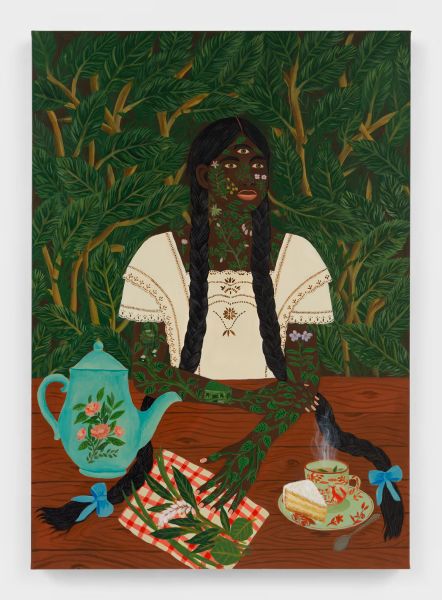
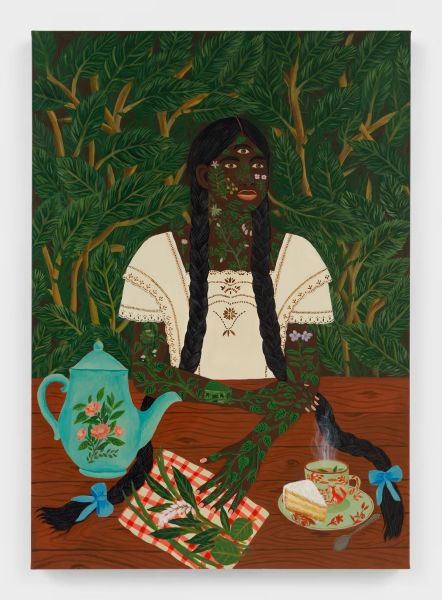
In Man Yaya Taught Me About Plants (2025), Violette sits at a colonial high tea (a vestige of British imperial culture popular throughout the Caribbean) yet the third eye marked on her forehead invokes Hindu cosmology. When my mother encountered the image, she immediately read it as a reference to a “see far” person, someone in the Caribbean with the capacity to intuit, someone who may have been here before. In truth, like the Caribbean itself, it can hold all of these meanings at once. This layering of references from Hinduism to African spiritual systems; from Caribbean folklore to French fables creates a field of expressive possibility where the artist’s history, identity, and imagination converge. Sinnapah Mary’s work refuses immediate transparency, instead using the language of the Caribbean where identity is fluid, relational, and continually emerging. [. . .]
Kai Trotz-Motayne is a Guyanese-Canadian researcher and writer from Tkaronto/Toronto, whose work takes inspiration from the many Caribbean people that raised her.
For full article, see https://contemporaryand.com/en/america-latina-magazine/texts/the-convergence-of-african-and-indian-lives-in-kelly-sinnapah-mary-s-paintings
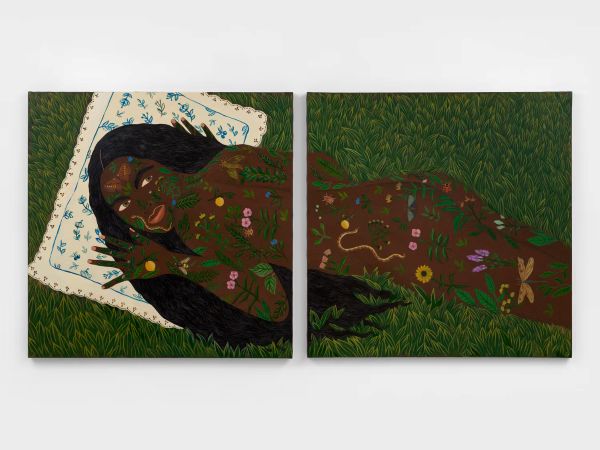
[Shown above, photo by Dan Bradica Studio: Kelly Sinnapah Mary, 1) “The Book of Violette: Man Yaya taught me about plants,” 2025. Acrylic on canvas 162 x 114,3 cm; 2) “Invisible Vegetation of Desire,” 2025. Acrylic on canvas 100 x 200 cm. Courtesy of the artist and James Cohan, New York.]
Kai Trotz-Motayne (C& América Latina, 14 May 2026) reviews artwork by Guadeloupean artist Kelly Sinnapah Mary. Here are excerpts; see full review and an array of Sinnapah Mary’s paintings at C& AL. Colonial powers have bound African and Indian lives to the same exploitative plantation system in the Caribbean, while engineering racial divisions. Guadeloupean artist