President Lee Jae Myung warned earlier this month that the conflict in Iran represented a “war-like situation” for South Koreans. As oil reserves continue to dwindle, even if normal service in the Strait of Hormuz were to resume, it would take a long time for supplies to catch up.
The war is “serving as a significant turning point” for South Korea to shift to renewable energy, South Korea’s Minister of Climate, Energy and Environment Kim Sung-hwan told CNBC. We must undergo a “fundamental energy transition” and “turn this challenge into a blessing in disguise”.
Rising oil prices, and the weakening of the won against the dollar, are “dealing a double blow” to the Korean economy, said The New York Times. But reliance on oil has also highlighted the domestic tussle for green energy action in a divided South Korean system.
‘Draconian’ measures
The “brightly illuminated” satellite images of South Korea at night, compared to the “sea of blackness” in the North, have long been seen as a “wider triumph of capitalism and democracy”, said Christopher Jasper, transport industry editor, in The Telegraph. However, due to the Iran war, these lights could be extinguished “in a matter of weeks”.
Compared to fellow developed countries, South Korea is “almost uniquely lacking in natural resources”, relying on imports to meet “90% of its energy needs”. Around 70% of its crude oil shipments, in addition to 20% natural gas, come from the Gulf. The country has seen fuel prices increase by a fifth, a ban on driving one weekday in five for individuals, and calls to reduce shower times and to charge electric cars and phones only in the daytime. Much more “draconian” measures could be just weeks away.
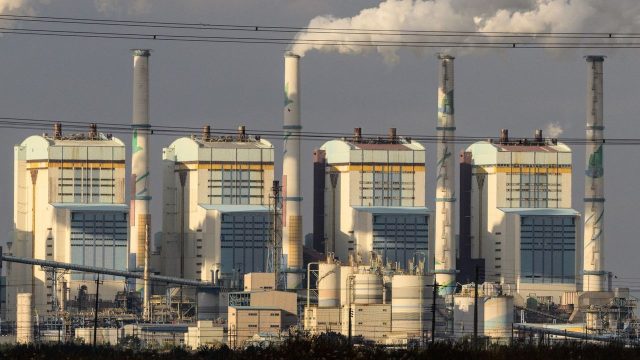
South Korea must face a “difficult home truth”, said David Fickling in Bloomberg. Behind the “sleek modern society” is an “insatiable appetite for fossil fuels that’s undermining its economy”. But this appetite presents a climate and “strategic” threat. State utility Korea Electric Power Corporation’s (Kepco) “huge” generation plants provide “tempting targets for rocket attacks”, and its proximity to North Korea and China leaves the South exposed to mine threats, should the conflict expand.
A ‘catalyst’ for energy reform?
The fossil-fuel vulnerability highlighted by the war in Iran, could be the “catalyst for a faster clean energy system”, said The Guardian. South Korea’s energy targets long predate the current war, aiming to generate 20% of electricity from renewables by 2030 and phase out coal by 2040.
As with most renewable energy, there must be the infrastructure to support it. The power generated by new energy is “colliding” with the grid’s capacity, meaning it is “in effect going to waste”. There is hope in the form of Kepco building high-voltage transmission lines to Seoul, but a decade-long wait and “resistance” from locals are taking the shine off the progress.
On top of the energy opportunities, this is a “fresh opportunity” to “strengthen Seoul’s hand” against North Korea, said Jenni Marsh in Bloomberg. According to Finance Minister Koo Yun Cheol, Middle Eastern countries are “lining up” to buy Korea’s missiles, with their 90% success rate and “affordable price tag” an attractive proposition for buyers. The crisis has also fuelled government investment into nuclear-reactor restarts to “maintain grid stability”. As North Korea’s Kim Jong Un “plays hard to get” with the US, and “refuses talks” with Lee, improving defence capabilities “looks like an increasingly smart option”.
President Lee’s “catnip” calls to transition to renewables due to the war in Iran have “no chance of being met”, said Fickling in the same outlet. For instance, Kepco has “effectively banned” all new generators in the “renewables-rich” east until 2032, all because its “crumbling grid is supposedly incapable of accepting new connections”. Decisions such as these will do “nothing to advance South Korea’s energy transition”. Society as a whole needs to fight against those who have kept them “hooked on polluting power”.
War in Iran represents ‘turning point’ for the country, though lack of infrastructure and effective action have not resolved its dependence on oil