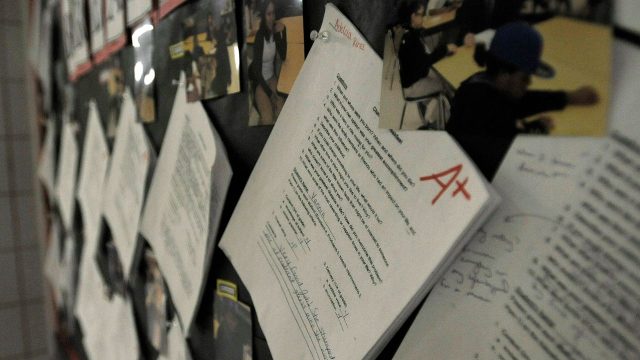
‘Report cards are sending parents the wrong signals’
Bloomberg editorial board
Most “students in the U.S. aren’t proficient in reading or math — but you wouldn’t know it by looking at their report cards,” says the Bloomberg editorial board. Grade inflation “has been seeping through the nation’s education system for decades and worsened during the pandemic,” and “today, more than half of schools use at least one ‘alternative grading’ strategy, including ‘no zeros.’” It “isn’t hard to see how such measures might obscure academic weaknesses and mislead parents.”
‘Why we should agree to agree’
Lisa Sherman at Time
At a “time when many of our most important conversations feel increasingly polarized, it’s easy to fall into patterns,” says Lisa Sherman. When a “conversation begins to feel too complex or emotionally charged, we often reach for a common refrain: ‘agree to disagree.’” But “building on the common ground that already exists is the key to bridging what divides us.” What “matters more than perfect agreement is what we do with disagreement once we’ve chosen to move forward.”
‘African governments need to take urgent action on fertilizer shortages’
Martin Fregene and Chakib Jenane at Al Jazeera
The “conflict between the United States, Israel and Iran is disrupting global fertilizer trade flows — and this stands to leave millions of African farmers without the ammonia, urea, phosphate, sulphur and other fertilizer inputs vital to growing more food in sub-Saharan Africa,” say Martin Fregene and Chakib Jenane. When “global supply falters, Africa’s farmers often feel the economic shocks the hardest.” Fertilizer security is “tied to food security, which, in turn, is linked to economic and social stability.”
‘Newspapers face tight supply as mills cut newsprint production’
Brier Dudley at The Seattle Times
As if “they didn’t have enough to deal with, America’s newspaper publishers are facing a tight supply of newsprint that’s driving up prices,” says Brier Dudley. The “crunch may be temporary but it highlights the uncertainty and cost pressures straining a local news industry that’s largely online nowadays but still heavily dependent on printed newspapers.” There is “little consolation” for “some local publishers scrambling for enough paper to print the next week’s newspapers.”
Opinion, comment and editorials of the day