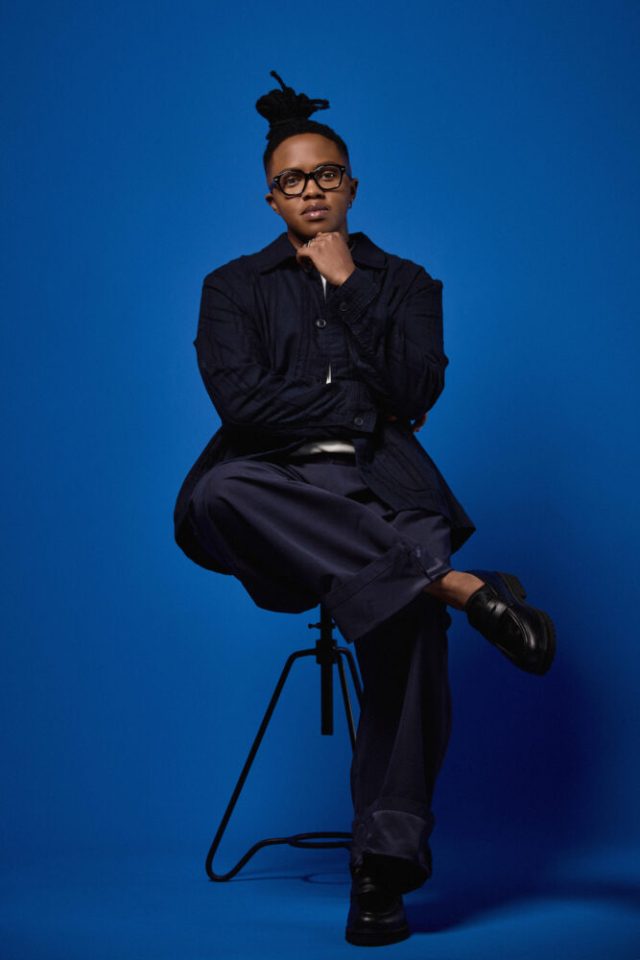
There’s a quietness to Ndumiso Manana when he speaks about success, not indifference but a kind of careful distance from it.
When I ask him where he was when he found out he had been named the 2026 Standard Bank Young Artist for Music, one of the most significant recognitions for creative excellence in South Africa, he pauses.
“I actually can’t remember,” he says, almost amused. “I was probably in rehearsal … or in studio.” It’s an answer that feels telling.
For an artist whose career has unfolded with remarkable speed from his 2020 debut to a Grammy-winning songwriting credit and collaborations with some of the biggest names in global music, the work has taken precedence over the moment of recognition.
And yet, the recognition matters. It always does.
The Standard Bank Young Artist Award has, for decades, marked turning points in South African creative careers, offering not only national visibility but a kind of institutional affirmation that an artist is shaping the present and future of their discipline. For Manana, it arrives at a moment when his voice is beginning to resonate far beyond the spaces that first nurtured it.
“Awards in general are humbling,” he tells me. “It’s an award for work that you’ve put in. So it’s both humbling and affirming that we’re doing the right thing.”
Manana’s journey into music, at least in its professional form, is relatively recent. His debut album In The Beginning Was The End, released in 2020, introduced a sound that resisted easy categorisation. It moved between electronic textures, R&B sensibilities, acoustic intimacy and subtle inflections of Afrobeats and amapiano.
What followed was the gradual unfolding of a larger artistic idea. His subsequent projects such as But Could The Moments In Between and the EP COMMA expanded both the sonic palette and the emotional terrain of his work, culminating in 2024’s Our Broken Hearts Mend.
Together, they form a loose trilogy, one that traces a movement from introspection to articulation, from fragmentation to a kind of healing.
But this sense of cohesion, he admits, was not always intentional.
“Initially it probably wasn’t as clear,” he says. “But when the second project started forming, the vision of the trilogy started forming. We became more intentional about creating that narrative as we continued.”
It’s a description that mirrors the way many artists come to understand their own work, not as something fully mapped out from the beginning but as something that reveals itself over time. Meaning, in this sense, is not imposed but discovered.
If there is a defining characteristic of Manana’s music, it is its fluidity. He moves between genres with an ease that feels less like experimentation and more like translation, an ability to inhabit different musical languages without losing his own voice.
“I’ve had the privilege of working with different artists in different genres,” he explains. “It’s been a learning curve at every point.”
That learning curve has been accelerated by high-profile collaborations. As a songwriter, he contributed to Twice As Tall by Burna Boy, a project that would go on to win a Grammy Award. He has also worked with artists such as Usher, Pheelz, Sauti Sol, Tyla, Amanda Black, Ami Faku and Cynthia Erivo, a list that spans continents and styles.
But rather than speaking about the collaborations in terms of prestige, Manana frames them as moments of exchange.
Working with Sauti Sol, for instance, exposed him to new approaches to melody, particularly the relationship between language and musical phrasing.
“A lot of the melodies that we write in our context are driven by the languages we use,” he says. “So it helped me think about melody differently … the relationship between language and melody to form a song.”
It’s a subtle but significant shift, one that speaks to a broader awareness of how music travels and how it is shaped not only by sound but by the linguistic and cultural frameworks that underpin it.
That awareness extends to his own songwriting process, which begins not with words but with feeling.
“Usually the feel, melody and subject matter are the first things to form,” he explains. “Lyrics are typically the last thing to fall into place.”
There is something almost instinctive about this approach, a trust in the emotional architecture of a song before its narrative is fully articulated. It’s a process that allows his music to retain a sense of openness, a space in which listeners can locate their own experiences.
I think everyone goes into the industry hoping that their music will connect with people,” he reflects. “What I understand now is that people have been able to relate to the work that we’ve done.”
That connection, he suggests, has been one of the most surprising aspects of his growth.
What once felt “extremely niche” has found its way into wider audiences, not by conforming to dominant trends but by trusting that there is room and appetite for multiplicity.
“Our region is not a monolith,” he says. “It’s not just one thing that people love.”
This idea that South African music is expansive and constantly evolving sits at the heart of how Manana understands his role within the landscape.
In recent years, genres like amapiano and Afro-tech have become the country’s most visible exports, shaping global perceptions of what South African music sounds like. But beneath that surface lies a far more diverse ecosystem, one that includes a growing community of artists working in R&B, alternative pop and genre-defying spaces.
“I’m a part of that journey,” he says. It’s a modest assertion but one that carries weight. Because what Manana is describing is not just participation but contribution, the work of expanding the boundaries of what is possible and what is valued.
“The goal for me is to make sure that by the time I exit the music industry, I’ve left a lasting impression and created opportunities for artists who want to make left-field or alternative music,” he says. “I want to create a culture of appreciation for different genres in the space.”
It is, in many ways, a statement of intent that aligns closely with the ethos of the Standard Bank Young Artist Award itself: to recognise not only excellence but influence; the capacity to shift how art is made and experienced.
And yet, for all its symbolic weight, the award does not seem to have altered Manana’s internal compass. If anything, it has reinforced a sense of freedom.
“It gives me more freedom,” he says. “People have been very generous with their opinions of me … so that’s allowed me to trust the process, trust my tastes and preferences.”
It’s a perspective that resists the pressure that often accompanies recognition; the expectation to deliver something bigger, louder, more definitive. Instead, Manana returns to something quieter, more sustainable: consistency.
“One thing I’ve learnt in the music industry is to try not to expect anything,” he says. “The desire for me has always been to see sustainable and consistent growth over the years.”
At the moment, that long-term vision is being carried forward in the most immediate of ways: live performance.

When we speak, Manana is in rehearsals, preparing for the first leg of a nationwide tour that begins in Johannesburg before moving to East London, Makhanda for the National Arts Festival, Durban, Cape Town and Pretoria.
The initial dates have sold out, a sign of an audience that is not only growing but deeply invested.
On stage, he is joined by a band of collaborators he describes simply as “some of my favourite musicians”, a collective that reflects the same ethos of collaboration and musical curiosity that defines his recorded work.
There are no opening acts.
“I personally feel like it’s not quite fair to do opening acts for a show like this,” he says. “It’s better if it’s a collaboration show.”
Looking ahead, there is more music on the horizon. A new album, written and produced, is set for release later this year, with a single expected in the coming months. It will be, in many ways, the next chapter in a story that is unfolding, one that has moved from intimate beginnings to global stages, from niche experimentation to broader resonance.
And yet, if there is a throughline in Manana’s journey so far, it’s a refusal to be defined by any single moment. Not the debut. Not the collaborations. Not even the award.
Instead, what emerges is a commitment to process; to the slow, often unpredictable work of making music that feels true and trusting that it will find its way to those who need it.
“I’m always a fan of music,” he says, almost as an aside, when we speak about artists he hopes to collaborate with, among them Nasty C, Santan Dave and Yebba.
It’s a simple statement but it lingers. Because in the end, beyond the accolades and the milestones, that is what remains: the listener, the student, the artist in rehearsal, in the studio, in the act of becoming.
Fresh off his Standard Bank Young Artist win, Manana reflects on growth, collaboration and creating space for alternative sound in South Africa