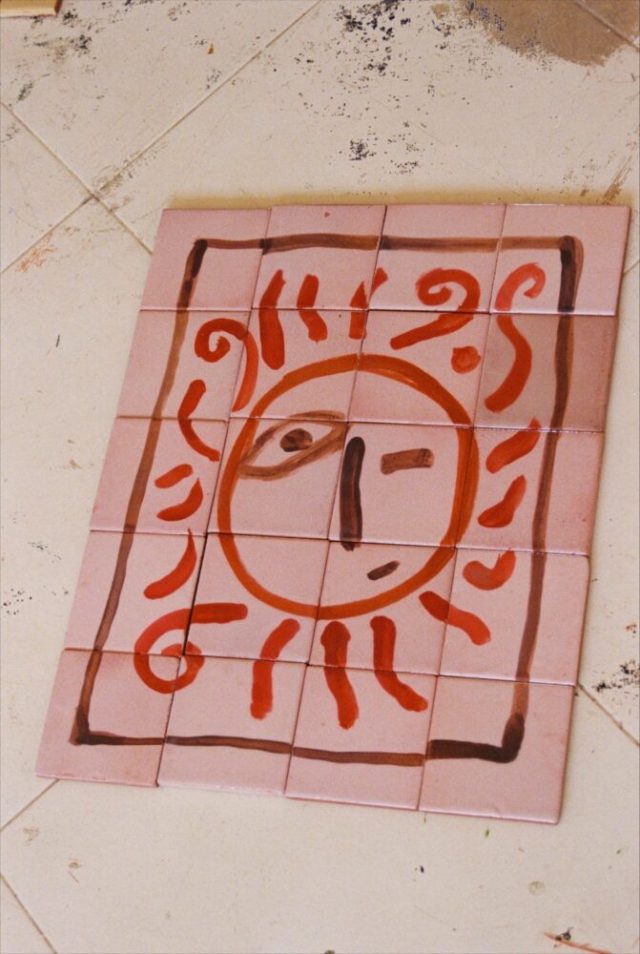
There are designers who follow trends and then there are those who shift the terms of the conversation entirely. LRNCE belongs firmly to the latter.
For more than a decade, the Marrakech studio has built a practice that resists speed, resists polish and resists the flattening gaze of global design. In its place, it offers something slower, more attentive: an insistence on process, on material and on the human hand.
In 2026, that insistence finds a new kind of visibility. Named Decorex Africa Designer of the Year, LRNCE will exhibit across both the Cape Town and Johannesburg editions of the fair, an unusual scale that signals not only the brand’s reach but its relevance within a broader continental shift. This is not simply recognition; it is positioning — a statement about where design, particularly African design, is headed.
Founded in 2013 by Laurence Leenaert and run alongside her husband, Ayoub Boualam, LRNCE has evolved from a small ceramics practice into a multidisciplinary design studio that moves between objects, interiors and immersive spatial experiences. Its language is immediately recognisable: playful yet grounded, raw yet deliberate. Clay, plaster, iron and wood are not just materials here; they are collaborators.
But before the exhibitions, before the international collaborations with Maison D’ORSAY and Parīlio Hotel, before the creation of Rosemary, their riad in the Marrakech Medina, there was something much quieter: a beginning that did not announce itself.
“Making,” Leenaert recalls, “was about understanding and discovering materials with my hands, experimenting. There was no pressure, just curiosity and giving myself the freedom to create.”
This origin point matters — not because it is sentimental but because it continues to shape the work.LRNCE’s relationship with Moroccan craft is often read as foundational but it was never a singular encounter. No neat beginning. No moment of revelation. Instead, it was something that accumulated over time.
“It was not a moment but rather a slow process and realisation,” Leenaert explains. “Spending time with the craftsmen and learning the techniques they inherited and translating this with my drawings.”
What emerges here is not a borrowing but a conversation — a back-and-forth between tradition and interpretation, between inherited knowledge and contemporary form. The artisans she works with do not simply produce; they hold histories of technique, of patience, of a different relationship to time.
“The patience the artisans have,” she says, “and the time in Morocco there is for family and each other … that was something I discovered and really appreciate.”
In many ways, LRNCE is as much about time as it is about material. It adopts a pace that runs counter to the urgency of contemporary production. It insists that making cannot be rushed without losing something essential.
When Leenaert started LRNCE in 2013, she was not responding to a clearly identified gap in the market. There was no grand positioning strategy. Instead, there was instinct.
After studying fashion in Ghent, she rented an atelier shared with other artists and began working. A trip to Morocco shifted something — not in a decisive, life-altering way but in a quieter, more persistent pull.
“I decided to move temporarily and give myself the freedom to explore,” she says. “It was more a feeling, intuition than a strategy. It was about building a bridge between my own visual language and the richness of Moroccan craft, without overthinking where it would lead.”
That bridge, fragile at first, has since become a defining structure.
Being named Decorex Africa’s Designer of the Year situates LRNCE within a larger conversation about design on the continent. But Leenaert is careful not to centre herself within that recognition.
“This feels less like a personal milestone,” she says, “and more like a signal of a broader shift — not a trend or a reference but a leading voice.”
What is shifting is not only aesthetic preference but value systems: a move towards work that foregrounds process over product, collaboration over extraction, specificity over generalisation. In this context, African design is not emerging; it is asserting itself.
LRNCE’s practice, rooted in Morocco yet globally legible, becomes a case study in how local specificity can travel without losing itself.
Expansion, however, comes with its own risks. As LRNCE’s audience grows, so too does the possibility of dilution. “Growth naturally brings dilution if you are not careful,” Leenaert admits.
The response is not to retreat but to stay close — close to the artisans, to the materials, to the rhythms of Marrakech. “My home, the place that inspires me, that’s Marrakech,” she says. “The work has to remain anchored, even as it travels.”
This anchoring is both practical and philosophical. It is about ensuring that the work remains accountable to its origins, even as it circulates globally.
One of the most striking aspects of LRNCE’s work is its refusal of perfection. Surfaces are uneven. Edges are soft. The trace of the hand remains visible. “Yes,” Leenaert says, “imperfection is a form of resistance.”
Resistance to the polished anonymity of mass production. To the idea that objects should appear untouched, unmarked by labour.
“Showing humanity,” she adds, “making one-of-a-kind objects … and also not taking everything too seriously. Let things breathe.”
In this way, imperfection becomes a quiet politics: a way of reintroducing the human into objects that might otherwise be stripped of it.


Decorex Africa’s 2026 theme, “The Soft Life”, could easily slip into aesthetic cliché — another visual trend divorced from lived experience. LRNCE approaches it differently.
“It is about creating space for slowness, for sensitivity,” Leenaert explains. “Choosing materials that age, spaces that invite rest.”
Softness, here, is not about surface-level comfort. It is structural. It asks how design can reshape the conditions of living — not just how spaces look but how they feel and hold.
In a world organised around productivity, softness becomes radical. It insists on rest, on care, on time.
If the materials LRNCE works with — clay, plaster, wood — could speak, they would probably resist urgency. They would remind us that drying takes time, that shaping cannot be accelerated without consequence, that endurance is slow work.
LRNCE’s expansion into interiors and spatial design was not a calculated pivot. It happened gradually, almost inevitably.
“The language we were developing couldn’t stay contained within individual pieces,” Leenaert says.
What began as objects became environments — worlds that could be entered and experienced. The shift is perhaps most fully realised in Rosemary, their boutique riad in Marrakech, where every element, from floors to textiles to furniture, has been designed in-house. “We created our own world,” she says simply.
It is a world where coherence is felt rather than imposed.
Exhibiting at both Decorex Cape Town (25 to 28 June 2026 at the Cape Town International Convention Centre) and Decorex Joburg (30 July to 2 August 2026 at the Sandton Convention Centre) offers LRNCE a rare opportunity to engage two distinct audiences.
“Each city has its own energy,” Leenaert reflects. “It’s about telling a story in different tones.”
The core narrative remains but its articulation shifts. This approach mirrors the brand’s broader philosophy: consistency without rigidity.
Collaborations have become an important part of LRNCE’s expansion, from Maison D’ORSAY to Parīlio Hotel. Each partnership requires a form of translation.
“You have to find your language, your way, without losing yourself,” Leenaert says. “It’s about identifying what is essential in your work.”
The process of adapting without erasing becomes a site of experimentation — a way of testing the limits of the brand’s language. “It’s very interesting and fun to go out of your comfort zone,” she adds.
LRNCE is less interested in being understood than in being felt. If a visitor walks into one of its Decorex exhibitions and leaves with anything, it is not necessarily knowledge.
It is a shift — a slowing down and a heightened awareness of material.
And if Leenaert could return to her younger self, just beginning in Marrakech and guided more by instinct than certainty, her advice would be understated.
“That things take time and that this time is necessary,” she says. “And that the joy in making is everything.”
In a cultural moment defined by acceleration, this feels almost radical: to trust time, to trust instinct, to make without knowing where it will lead.
Named Decorex Designer of the Year, LRNCE embodies a broader movement redefining African design through slowness, imperfection, and deeply collaborative craft practices