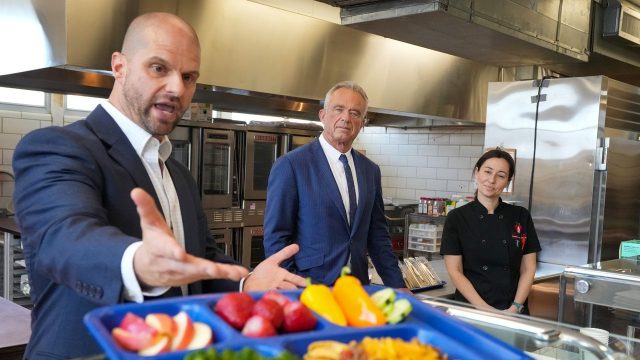
The MAHA movement, led by HHS Secretary Robert F. Kennedy Jr., has been pushing for healthier food for schoolchildren, but the Trump administration’s budget cuts might make this difficult. Combined with a series of changing MAHA-adjacent nutritional guidelines, some schools are reportedly finding it hard to fund kids’ lunches.
Why are schools having trouble providing lunches?
A large part of the issue lies with the new MAHA health guidelines, which encourages people to “avoid highly processed foods and prioritize ‘high-quality, nutrient-dense’ protein at every meal,” said NPR. These guidelines form the “basis of federal nutrition standards that schools participating in federal meal programs must follow.” But many school districts “rely on processed, premade foods to feed their students, and protein is already the most expensive ingredient on the cafeteria plate.”
Currently, the government’s federal reimbursement rate for a free school lunch is about $4.70, which “must cover the food and the supplies, our labor and our equipment, deliveries and utilities, and the list goes on,” Stephanie Dillard, the president of the nonprofit School Nutrition Association (SNA), said in a congressional hearing. Many have “lauded the push toward scratch-made meals and more whole food options,” said Fortune. But these healthier foods are typically more expensive, and experts worry that trying to fit them into just $4.70 will “further strain schools already concerned with the future of their school lunch programs.”
The push for healthier meals is being juxtaposed with the White House’s decision to “cut funding programs that allowed schools to buy local food from farmers,” said NPR. The USDA has reportedly ended the “Local Food for Schools Cooperative Agreement Program, erasing an estimated $660 million in funding” that was used to buy “unprocessed or minimally processed foods” for schools. The cuts come as nearly seven in 10 school administrators, 69.6%, don’t think the $4.70 reimbursement rate is “sufficient to cover the costs” of school lunches, according to an SNA survey.
Is there a solution?
Many experts are pushing for increased funding for school lunches, which could help offset the cost of their increasing expense. The “issue here is the operational reality of getting there with the current level of funding,” David Ortega, a professor of food economics and policy at Michigan State University, said to Fortune. “Not having enough staff, culinary training that comes with trying to do a lot of that more whole-food scratch cooking, the need for equipment and infrastructure — these are really operational issues that have to be addressed from a funding perspective.”
Enabling school districts to serve healthier foods is “what we’re trying to do,” Mara Fleishman, CEO of the Chef Ann Foundation, a school-food-reform organization, told The Christian Science Monitor. But doing so “requires support. It requires the right equipment. It requires funding.” Districts should be “shown how to create varied menus, identify where they can spend more on higher-quality ingredients, reassess labor costs and acquire the proper equipment.”
Government officials deny that budget cuts are hurting school lunch programs. “Out of a multitrillion-dollar government budget, it’s not surprising the media can find examples of cuts instead of ignoring the larger issue that the Trump administration is fighting for farmers and real food more than any administration in history,” senior White House adviser Calley Means told Bloomberg. The USDA has announced a $20 farm-to-table program grant for schools, describing it as “record-breaking,” Bloomberg said, even though this still leaves a “$640 million gap compared to what was cut last year.”
The Trump administration urges children to eat healthy while it slashes funding for local food