
Olivier Marboeuf’s “El otro color del oro” [The other color of gold] curated by Alejandra Labastida, is on view at the Museo Universitario Arte Contemporáneo (MUAC, (Halls 7 & 8) in Mexico City, Mexico, from November 7, 2026, to April 25, 2027. Read description below, at MUAC, and on FB: Olivier Marboeuf.
Description: “El otro color del oro” [The other color of gold] In the summer of 2026, Olivier Marboeuf [Guadeloupe] undertook a research trip to Veracruz, accompanied by Alejandra R. Bolaños. The trip was structured around the networks of friends and colleagues that Bolaños has cultivated over the course of her ten years of research in the region as an artist and professor. On their journey, they visited Xalapa, Chavarrillo, Tepalcate, Naolinco, Coatepec, Coyolillo, Córdoba, Yanga, Mataclara, Cuitlahuac, the Port of Veracruz, Jamapa, Medellín, Isla de en Medio, Chacaltianguis, Otatitlán, and Alvarado. There, they engaged with human and more-than-human communities, activists, musicians, artists, and academics—many of whom are Afro-Mexican.
This exhibition—whose title alludes to the many other human and non-human bodies extracted during the colonial era, besides gold — emerges from an interweaving of these encounters with Blueprints (2022), a long-term project by Marboeuf that develops a sonic and graphic archive-manifesto of Afro-Caribbean history. Far from offering exoticized or pacifying narratives, this speculative archive blends historical facts with mythologies, visible and invisible presences— both human and non-human— as well as words and symbols, to generate what the artist terms a cinema déparlant. While this concept has been translated into Spanish as cine del deshabla (“cinema of un-speaking”), this translation loses the underlying play on words: it misses both the notion of a device that refuses to speak in a conventional way and the resonance with a Haitian Creole term that evokes the delirious.

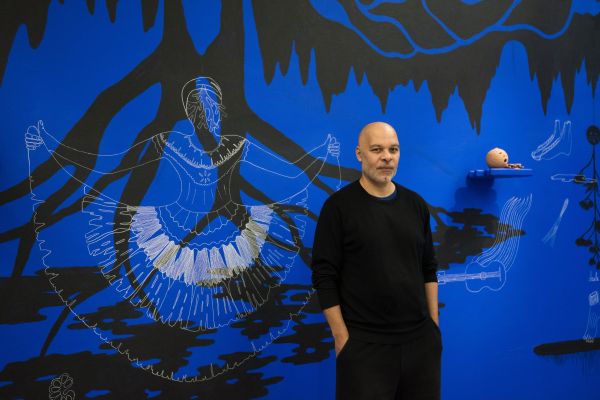
The mural, the ceramics, and the installation of sound and shadow that [. . .] occupy the galleries at the MUAC operate from this complex notion developed by Marboeuf, which refers to the production of a visual realm, populated by shadows and fleeting images, rooted in political, emancipatory practices of collective hallucination. His pieces are designed to escape the categories of the art world’s extractivist economy; therefore, they employ flight [escape], masquerade, babbling, and cacophony to avoid speaking in the manner they are expected to speak. In this sense, they do not seek to represent, but rather to create a site of enunciation— one that is autonomous, decentered, and blurred— to avoid increasing the vulnerability of certain bodies and the symbolic capitalization of others.
It is from this place [positioning, standpoint] that Marboeuf evokes a speculative archaeology of a vast network of boiling water springs and lava beneath the geological plateau of the Greater Caribbean, in which resides— underground and upside down— a mythical Black community that has learned how to breathe sulfur. Here, volcanoes function as communication systems between those living underground and those on the surface, mediated through sonic and visual hallucinations, vibrations, and shadows.
They say that [the existence of] this world is a legend, yet there are numerous accounts of beings with very dark skin— emerging from volcanoes— who join in revolutionary struggles, battles for water and land, and even carnival celebrations. The only record of this people is a codex consisting of a long poem, comprising thousands of verses— and an equal number of questions—titled Las preguntas [The Questions].
Through this mythological framework, the artist uses a mural to connect Afro-Mexican worlds with those of other Afro-Caribbean peoples, bringing together histories, struggles, and legends linked to water, volcanic energy, earthquakes, and visions. The sound piece is structured around a reading, in Spanish, of an excerpt from the codex Las preguntas, accompanied by music, telluric sonic material, and natural sounds, as well as narratives and documentary testimonies gathered in Veracruz. [. . .]
Excerpts translated by Ivette Romero. For the original text (in Spanish) and more information, see https://muac.unam.mx/
[Read more details posted by the artist at Olivier Marboeuf. Photo of the artist was taken from his Facebook page. El otro color del oro, 2026; Installation, mural, documentation, sound, MDF and ceramics; songs, storytelling, and readings. Poem “El otro color del oro,” by Olivier Marboeuf, and read by Alejandra Bolaños.]
Olivier Marboeuf’s “El otro color del oro” [The other color of gold] curated by Alejandra Labastida, is on view at the Museo Universitario Arte Contemporáneo (MUAC, (Halls 7 & 8) in Mexico City, Mexico, from November 7, 2026, to April 25, 2027. Read description below, at MUAC, and on FB: Olivier Marboeuf. Description: “El otro