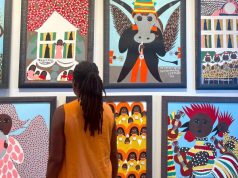
Minia Biabiany’s “Our Listenings” [Nuestras escuchas] curated by Virginia Roy Luzarraga, is on the view at the Museo Universitario Arte Contemporáneo (MUAC) in Mexico City, Mexico, until February 14, 2027. This moving image project was produced in collaboration with the Han Nefkens Foundation-Moving Arts Commission, the MUAC, MACBA in Barcelona, and The Bass in Miami. “Our Listenings” includes the participation of Murielle Biabiany, Chloé Cramer, Nouma de Lacroix Cobral, and Célia Poulot. Read descriptions below from the MUAC and the Han Nefkens Foundation.
The MUAC writes: “Between the 1970s and the 1990s, chlordecone was used as a pesticide on plantations in Guadeloupe and Martinique, despite its known high toxicity. The consequences of this health and ecological crisis—affecting both land and water—persist to this day and are embedded in the islands’ colonial memory. Guadeloupean artist Minia Biabiany addresses the historical violence that has been passed down through generations, as well as the possibility of listening to the territory itself. Furthermore, she explores the island’s histories in relation to contamination, lineages, and ancestral wisdom as valid forms of knowledge.”
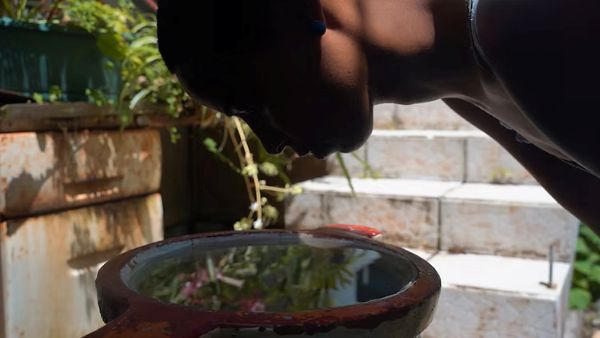
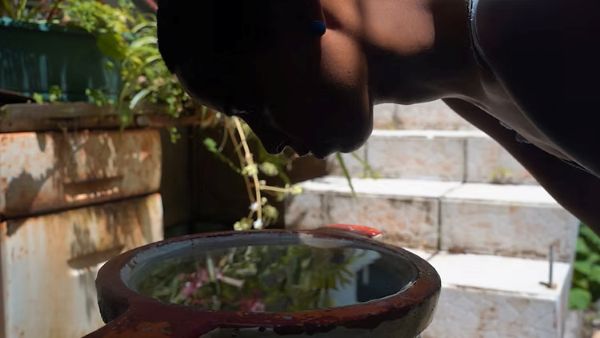
Description (from the Han Nefkens Foundation) [. . .] Our Listenings marks a significant shift in Biabiany’s practice toward collective creation. Bringing together close relatives—educators, a scientist, a permaculture practitioner, and an eight-year-old girl—the project transforms collective listening into a poetic and political practice of presence. Together, they explore their shared relationship to water in Guadeloupe, a territory deeply affected by chlordecone contamination used on banana plantations between the 1970s and 1990s, as well as ongoing colonial structures.
Far from an abstract ecological concern, water emerges as a lived political condition that shapes domestic rhythms, emotional states, and collective memory. In the exhibition, the video installation is accompanied by six burned-wood sculptures shaped like female sperm whales, a marine species native to Guadeloupe yet largely absent from the local collective imaginary.
Inspired by the echolocation of these cetaceans and the writings of Alexis Pauline Gumbs, Biabiany turns sound waves and whale dialects into a poetic methodology: deep listening and the ocean as pathways to resist the historical asphyxiation of slavery and capitalist extractivism. Within the work, the sea emerges as a protagonist bearing witness to history and foreign domination, exposing its own contamination while preserving ritual customs and ancestral knowledge. [. . .]
For more information, see https://muac.unam.mx/exposicion/minia-biabiany, https://www.hnfoundation.com/exhibitions/our-listenings-by-minia-biabiany/muac-%E2%80%93-museo-universitario-arte-contempor%C3%A1neo-mexico, and the artist’s page at https://miniabiabiany.com/homepage
For full description in Spanish, see https://muac.unam.mx/exposicion/minia-biabiany
Minia Biabiany’s “Our Listenings” [Nuestras escuchas] curated by Virginia Roy Luzarraga, is on the view at the Museo Universitario Arte Contemporáneo (MUAC) in Mexico City, Mexico, until February 14, 2027. This moving image project was produced in collaboration with the Han Nefkens Foundation-Moving Arts Commission, the MUAC, MACBA in Barcelona, and The Bass in Miami.