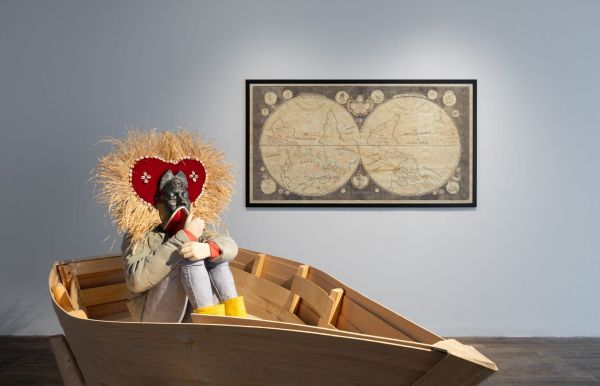
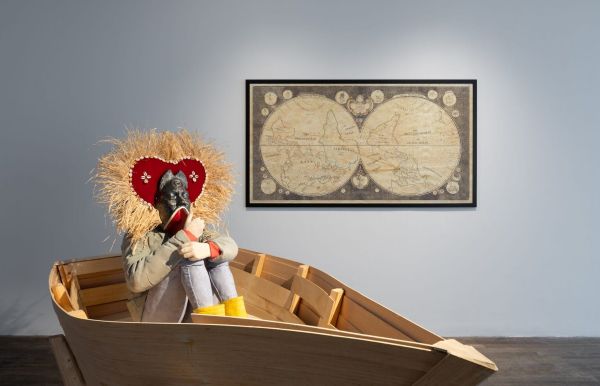
The full title of this article by Kate Mothes (Colossal) is “Eddy Firmin interrogates history and colonizing forces in provocative sculptures.” It is a thorough and thought-provoking review of the stunning work of Guadeloupean visual artist Eddy Firmin, whose work is on view in the exhibition “After the Island: Caribbean Canadian Ceramic” at the Gardiner Museum. Read the review and view many of Firmin’s pieces at Colossal. [Many thanks to Peter Jordens for bringing this excellent review to our attention. Also see our previous post After the Island.]
Hailing from the French West Indies in the Caribbean—specifically the island of Guadeloupe—and currently based in Montréal, multi-disciplinary artist Eddy Firmin is deeply interested in the history and politics of colonization and identity. His home region’s inextricable ties to the dark legacy of slavery informs a practice that interrogates how knowledge is shared and passed down through generations.
Throughout more than three centuries, upwards of 20 million or more people were transported to the Western Hemisphere to be sold as slaves in what is now viewed as one of the most atrocious crimes against humanity ever perpetrated. Millions died due to exhaustion, disease, and brutal transport and living conditions.
Chattel slavery was particularly extreme in the Caribbean, where roughly 40 percent of those taken from Africa were put to work on sugar cane plantations owned by European capitalists. Myriad African traditions crossed the Atlantic with members of their displaced communities, taking on new forms and evolving into tools for resistance.
One of these traditions is known as Gwoka, an Afro-Caribbean custom that involves music, dance, and storytelling. It continues today in contemporary form, taking place during festivals and other events, furthering a legacy of resilience that enslaved people drew on for mutual support and perseverance.
In Gwoka and similar artistic endeavors, technical ability and aesthetics “aim to seduce and mesmerize, while the hidden message fosters resistance to dominant discourse in the arts as in the social space,” Firmin says in a statement. Music and the way it’s broadcasted continues thematically in a large-scale collaborative work made with Afro-Caribbean and Franco-Canadian artist Géraldine Entiope titled “Pa ka tann ?!” A vibrant, elaborately patterned DJ booth with monumental speakers is set on top of a small car, from which Caribbean music can be played and celebrated.

The artist often works with ceramics, recontextualizing symbolic motifs and patterns and testing our associations with materials and their applications. Punching bags and tools are made of porcelain, while sculptures drawing on the African masking traditions are paired with glossy corporate branding. [. . .]
The artist also interprets consumerism as yet another colonizing force: when corporate interests and the demand for manufactured goods increasingly influence daily life, what happens to local and Indigenous customs, value systems, creativity, and autonomy? Here, shackles serve as a stark reminder of both a grim past and a present peril. [. . .]
For full review article, see https://www.thisiscolossal.com/2026/09/eddy-firmin-sculptures-installation-colonization-knowledge
[Top: E. Firmin’s “Sans signe” (Without Sign) (2023), ceramic, wood, fabric, straw, and digital print. Photo by Michael Patten, courtesy of the Gardiner Museum. Bottom: Géraldine Entiope and Eddy Firmin, “Pa ka tann ?!” (2023). See https://www.thisiscolossal.com/2026/09/eddy-firmin-sculptures-installation-colonization-knowledge.]
The full title of this article by Kate Mothes (Colossal) is “Eddy Firmin interrogates history and colonizing forces in provocative sculptures.” It is a thorough and thought-provoking review of the stunning work of Guadeloupean visual artist Eddy Firmin, whose work is on view in the exhibition “After the Island: Caribbean Canadian Ceramic” at the Gardiner