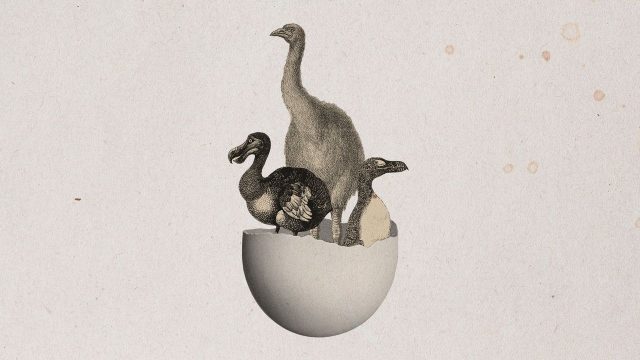
Colossal Biosciences, a Texas-based biotech company known for its de-extinction agenda and previous claims about genetically engineering dire wolves, has successfully hatched 26 chicks from artificial eggs. The company now hopes to use the technology to bring back extinct birds, including the dodo and the giant moa. But skeptics say de-extinction is not possible and the company may be overstating its claims.
A whole new bird
Eggs are a biological wonder. They are the “largest single cell of any species” and a “self-contained engine of incubation, doing away with the need for a living womb to keep a growing organism safe,” said Time. Because of eggs’ unique properties, artificially engineering them is a difficult task. However, Colossal Biosciences has managed to 3D-print artificial eggs with a “semi-permeable silicone-based membrane housed inside a rigid hexagonal support cup,” said the company in a release. The membrane was “engineered to replicate the gas-exchange function of a natural eggshell — allowing oxygen to pass through while retaining moisture and blocking contaminants.”
The company released a video showing the hatching chicks. Researchers “took recently laid chicken eggs and carefully poured their contents into the artificial shells, where they continued growing,” said MIT Technology Review. A “window on top lets researchers peek inside.” To “see them all moving around in their artificial eggs was absolutely mind-blowing,” said Andrew Pask, Colossal Biosciences’ chief biology officer, to the outlet. “You really feel you can grow life outside of the womb.”
“Artificial egg” may be a misnomer, according to some. “You’ve poured in all the other parts that make it an egg. It’s an artificial eggshell,” said Vincent Lynch, an evolutionary biologist at the University at Buffalo, to CBS News. In addition, “producing a chick from an artificial vessel is not necessarily new,” said Nicola Hemmings, who studies bird reproductive biology at the UK’s University of Sheffield, to CBS News. In the past, scientists “used cruder technology to create transparent eggshells that hatched chicks from plastic films or sacks,” mainly to “study chicken development and glean insights that can also be applied to other mammals and even humans,” said CBS News.
A crack at de-extinction
The company’s artificial shell is just a first step in larger de-extinction plans. Colossal Biosciences’ ultimate goal is to bring back extinct birds like the giant moa or dodo. The egg’s design is “variable in size” and “scalable from hummingbird-egg dimensions down to the soccer-ball-sized eggs of the South Island giant moa, which once stood nearly 12 feet tall,” said the release.
Before the company can resurrect an extinct species, “scientists will need to genetically engineer bird DNA at a much earlier stage,” said National Geographic. “Once the fertilized egg is laid, the embryo already has around 50,000 cells — that’s way too many cells to bioengineer,” Hans Cheng, a retired molecular geneticist who teaches at Michigan State University, told the outlet.
Colossal Biosciences previously claimed it revived the extinct dire wolf and hopes to resurrect species like the woolly mammoth and the Tasmanian tiger in the future. The company has also suggested its technology could support conservation efforts but included “no data or peer-reviewed scientific publications” in its release about the hatching chicks, “making it difficult to independently assess the claim,” said Nic Rawlence, an associate professor in ancient DNA at the University of Otago, at The Conversation. “If the technology lives up to the hype, it won’t be a silver bullet or panacea to stopping species declines, but it might just help.”
The technology could be used to bring back extinct birds