‘Communion: Finding My Way Back to Faith’ by JD Vance
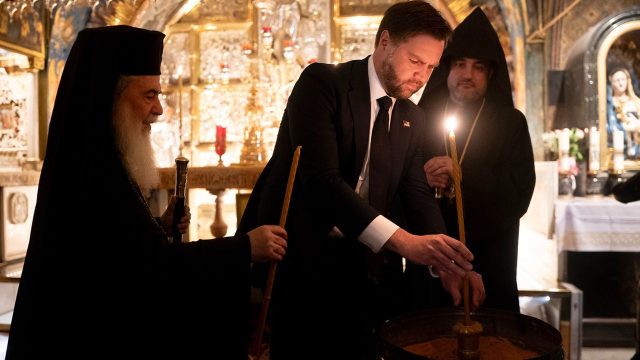
“For its first 177 pages, JD Vance’s new book is a thoughtful read,” said Molly Olmstead in Slate. It begins roughly where Hillbilly Elegy, his breakthrough 2016 memoir, left off: with the 2005 death of the grandmother he called Mamaw. Vance, raised in the Pentecostal-evangelical tradition, had by then become, in his words, “an angry atheist.” In Communion, our vice president depicts his journey to converting to Catholicism in 2019 with real care. Then the account reaches the start of his political career, and “what happened here is clear”: He wrote that first part of this book before he decided in 2021 to run for a U.S. Senate seat. Vance suddenly begins trashing straw-men foes and weakly defending his flip-flop on Donald Trump, and it’s depressing because, until then, “you might have forgotten you were reading a book from the same Vance who supported Immigration and Customs Enforcement’s brutal crackdown in Minneapolis.”
He talks early on about the importance of being humble in the face of life’s complexity, said Barton Swaim in The Wall Street Journal. But by the book’s second half, “he has cast humility aside,” suggesting, among other things, that the government should do more to make businesses fairer and kinder. At one point, he falsely accuses a conservative policy analyst of prioritizing corporate profits over family, and his “egregious” misreading of her argument “typifies the low regard he has for people who profess views he dislikes.” His arrogance is such a feature of the thinking, said Alexandra Petri in The Atlantic, that his new book reads like an account of “how he finally decided that Catholicism met his exacting standards.” He has famously counseled the pope to “be careful when he talks about matters of theology,” and here he complains that Pope Leo XIV’s emissaries weren’t specific enough when they directly shared concerns with him about the Trump administration’s inhumane treatment of migrants. “What did they take issue with, exactly?” he writes.
Still, Vance’s book “offers a telling look into the movement he may try to reform,” said Christian Paz in Vox. “I found his faith journey moving,” and it tracks with that of many young men who, after becoming disillusioned by secular culture, find meaning in the millennia-old teachings and rituals of the Catholic Church. So far, though, he can’t square the cruel politics of the president he serves with the church’s teachings about how to turn faith into good works. Communion reads to me like a book by a man “who has a deeply anxious personality, carries serious real scars from his childhood, and doesn’t really know who he is even now,” said Michelle Cottle in The New York Times. Having found some answers in Catholicism, “he seems upset that he can’t find a way to map that onto the world.”
‘The Traveler: One Man’s Quest for Humanity From the South Seas to Revolutionary Paris’ by Andrea Wulf
“George Forster is one of the most fascinating figures you have probably never heard of,” said Jennifer Szalai in The New York Times. Fortunately, Andrea Wulf’s new book “thrillingly” resurrects the 18th-century polymath’s life story, recounting how he became famous by his early 20s as a traveler, scientist, and author who was ahead of his time in speaking out against racism and sexism. Born in 1754 in a Prussian village that’s now part of Poland, Forster was 10 when he began traveling with his father, a pastor and naturalist. By 17, young George was living in England and fluent in several languages when he joined Capt. James Cook’s second voyage to the South Seas. He shared his vivid observations in a remarkable 1777 book, and however forgotten he is today, “it is invigorating to read him observing, thinking, and enthusing on the page.”
Likewise, “it is unusual to devote almost half a biography to only three years of a subject’s life,” said Nick Bartlett in The Guardian. But that’s how crucial the Cook voyage was in shaping Forster’s unusual sociopolitical views. He was instantly appalled by how his fellow Europeans treated the Indigenous peoples they encountered, devoting his time to getting to know the targets of the bias. Transformed, Forster wrote about his findings in 1777’s A Voyage Round the World and for the remainder of his life railed in his writings against the racism he detected in the philosophical writings of Immanuel Kant and Jean-Jacques Rousseau. Wulf came to know Forster’s mind so deeply that we follow his adventures “as if perched on his shoulder.”
“Forster was, on Wulf’s ample evidence, good to the core,” said John Banville in The Wall Street Journal. Life, though, was less kind in return. His father, who inspired his intellectual curiosity, was an irascible man who took more from George than he gave. Forster’s friends cuckolded him and his wife disdained him. Late in life, “Forster’s good sense deserted him,” as his enthusiasm for the French Revolution inspired him to openly back the Reign of Terror. He’d die in Paris of an illness at just 39. Still, “how many men of twice his age have lived a life so marvelous and rewarding?”
JD Vance finds religion again and three years in the life of a daring adventurer