
So impressed by this excellent article by Melissa Denes (The Guardian), who conducted research on late Cuban artist Ana Mendieta in advance of her upcoming exhibition at Tate Modern from July 15, 2026, to January 17, 2027. Denes writes, “Her shocking performances and stunning images made Mendieta the talk of the art world in the 1970s and 80s. Then she fell from a New York apartment block in 1985 – and her husband was charged with murder. As a major exhibition comes to London, her friends discuss her genius and their search for answers.” Denes writes about her iconic work, the buzz about the artist’s private life and horrific death, her childhood in Cuba, family memories, and elements to see in her upcoming show at the Tate Modern. [For full article and photos of Mendieta and her artwork, go to The Guardian.]
In the summer of 1985, Ana Mendieta was playing with gunpowder and a chainsaw. Just 5ft tall, the Cuban American artist worked outside her studio in Rome, trying to figure out the scale of a new commission for MacArthur Park, Los Angeles. Her idea was to cut up trees and burn the gunpowder directly into them, creating a totem “grove” inspired by her recent trips to neolithic sites. It was a breakthrough of sorts – permanent, monumental work that built on her performance art – and in a photograph of her standing next to a test piece, Mendieta looks proud, excited.
She had arrived in Italy two years earlier, after winning the prestigious Prix de Rome and a residency at its American Academy. She alienated half the staff, but fell in love with the city, driving like a local (right hand on the wheel, left middle finger out the window). Mendieta admired Roman women, mailing her friend, the film critic B Ruby Rich, a newspaper clipping of a pro-choice demonstration. “She said, ‘Look, they’re not like American women,’” remembers Rich. “‘They’re showing women butchered and dead from botched abortions. Look how much fiercer they are.’”
The sculptor Marsha Pels became Mendieta’s friend in Rome, though it wasn’t easy. “She wanted me to take her side in everything,” she tells me. Pels had befriended the academy’s gatekeeper, letting him use her studio as a hair salon. “Ana didn’t like him because he didn’t treat her like a royal highness one day. We fought, and I’d say, ‘If he’s cutting hair, then just don’t come in.’” But she could also be very generous. “When Ana was working with the trees, there was one I really liked, like a woman crossing her legs. I said, ‘Can I have that?’ and she said yes.”
In the evenings, Mendieta would mix a cocktail, or they’d walk down the hill to Trastevere. Earlier that year she had married the minimalist artist Carl Andre. He was 49 to her 36 and world famous – and when he visited from New York he would join them. [. . .]
By the time she moved to New York in 1978, Mendieta was getting noticed. Her friend Natalia Delgado, a lawyer, heard from a college professor about “this very interesting Cuban woman in Iowa” long before they met. By 1985 Mendieta was a rising star, which was what she and Andre argued about the night she died. In his 911 call he said, “My wife is an artist, and I’m an artist, and we had a quarrel about the fact that I was more, uh, exposed to the public than she was. And she went to the bedroom, and I went after her, and she went out the window.”
Andre, who died aged 88 in 2024, changed his account of what happened at least twice. He was in the room, then he wasn’t. They had both been drinking before she fell at 5.29am. But you won’t hear anything about that in Tate Modern’s upcoming exhibition, or from Mendieta’s estate, which is managed by her niece Raquel Cecilia Mendieta. After 40 years of having her art seen in the context of her death, they are firmly anti-biography. They find the books (Robert Katz’s 1990 pulpy but forensic Naked By the Window), the true-crime podcasts (Helen Molesworth’s 2022 Death of an Artist), even the protests against Andre’s exhibitions unhelpful, reducing Mendieta to a victim. A forthcoming Amazon TV dramatisation of Katz’s book, starring America Ferrara, is a new problem. [. . .]
[. . .] People who were friends with both wouldn’t talk to the police, or sided with Andre. The artist Frank Stella paid Andre’s $250,000 bail and the defence later portrayed Mendieta as a hot-headed Latina, whose art was evidence of suicidal tendencies. “It was explicitly racist,” Rich says. “Ana was a crazy Cuban drunk who flew out the window. It was completely nuts.”
But for Mendieta’s family, this just gets in the way.“Having to speak for Ana all the time,” says Raquel Cecilia, “it shocks me how much I have to say, ‘Why are you sensationalising her? Would you do that with Rothko [who died by suicide]?’ Ana took up space: [She’d say] ‘I’m not a ‘woman artist’, I’m an artist.’ She didn’t want these labels. But is it because she’s a woman?” [. . .]

The artist Juan Sánchez met Mendieta at the opening of her first AIR show in November 1979: “The place was crowded and they all wanted to talk to Ana. But that evening [the painter] Leon Golub threw a party at his loft and I chatted with her on the couch.” They met again at a group show. “She looked at my paintings and said, ‘Oh, you’re working with Taino petroglyphs [prehistoric Caribbean carvings]? Me too.’ We hit it off.”
Sanchez’s parents were Puerto Rican and the two artists spoke fluent Spanglish. They would meet at Mendieta’s place: “It was a one-room apartment, half studio, half living space. She’d be playing Cuban music and show me what she was working on. [. . .]
Sanchez was due to have lunch with Mendieta the day she died. “She never showed up … We went back to our friends’ apartment to see if she’d called.” [. . .]
For full article and photos of her artwork, see https://www.theguardian.com/artanddesign/ng-interactive/2026/jul/01/ana-mendieta-art-death
See information on the exhibition at https://www.tate.org.uk/whats-on/tate-modern/ana-mendieta
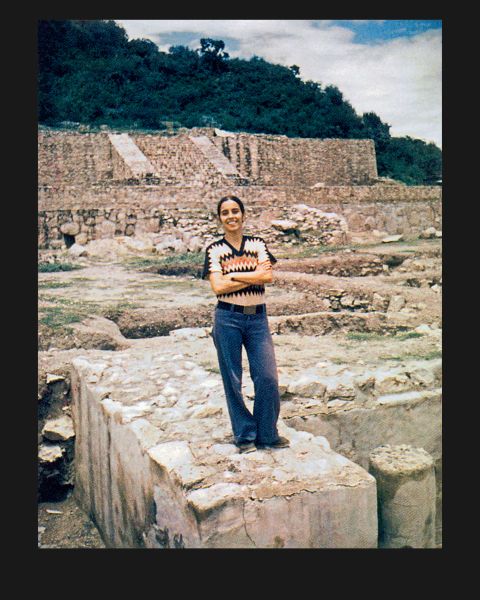
[Shown above: 1) Ana Mendieta at the Calixtlahuaca archaeological zone, outside Mexico City, 1971. Photograph: © The Estate of Ana Mendieta Collection, LLC. Licensed by Artists Right Society (ARS), New York / DACS, London / Courtesy Marian Goodman Gallery. 2) Untitled 1972 © The Estate of Ana Mendieta Collection, LLC. Licensed by DACS.]
So impressed by this excellent article by Melissa Denes (The Guardian), who conducted research on late Cuban artist Ana Mendieta in advance of her upcoming exhibition at Tate Modern from July 15, 2026, to January 17, 2027. Denes writes, “Her shocking performances and stunning images made Mendieta the talk of the art world in the