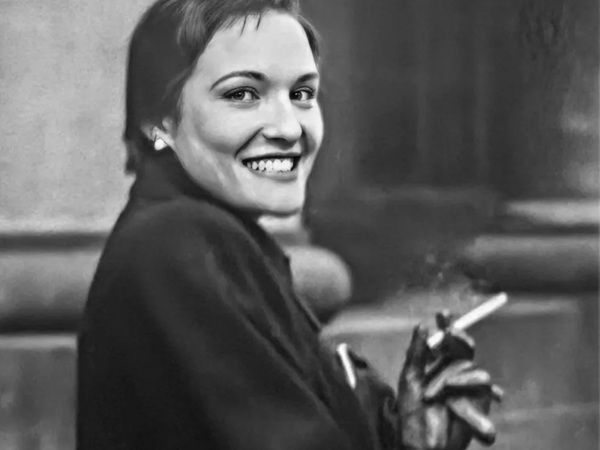
Alex Greenberger (ARTnews) reviews the trajectory of Dominican Republic-born, Puerto Rican Surrealist painter Cossette Zeno. I am sad to report that her solo show, curated by José Correa-Vigier at Richard Saltoun-New York, is only on view through Friday, October 30, 2026.
“This one over here is a weird one,” said Cossette Zeno, pointing to her 1952 painting Let’s Go Higher. Produced while she was still a student at the University of Puerto Rico in San Juan, the painting is a true oddity. It features an array of cubes in a largely vacant landscape set beneath a haze. A set of tiny people climb these angular modules, most of which have no windows or obvious function.
We met at Richard Saltoun’s New York gallery, where she is currently the subject of a small survey of her work from the 1950s. There, she drew my attention to the only cube depicted with a doorway in Let’s Go Higher. The green structure resembles a storage container emanating light. A single figure stands atop the cube proudly gesturing toward everything else around him. “He’s saying, ‘Always up, never down,’” Zeno said with a smile.

It’s an apt description of Zeno’s career, which spans nearly a century yet evaded global recognition until the past few years.
Zeno, 96, figured memorably in two major Surrealism surveys—one presenting a globalized version of the movement, which appeared at the Metropolitan Museum of Art and Tate Modern between 2021 and 2022, and another exploring its Caribbean strain, which showed at the Modern Art Museum of Fort Worth in Texas in 2024. Her latest showing, the Richard Saltoun show, is on view through Friday.
During the ’50s, Zeno forged a connection with André Breton, a cofounder of Surrealism, and exhibited alongside the movement’s adherents in Europe. Yet she never received canonization, perhaps because of her gender or because of the limited geographic focus of many Western art historians. Plus, as the scholar Whitney Chadwick has pointed out, many female Surrealists did not identify as members of the movement, in part because they felt alienated by their male counterparts. This sense of marginalization sidelined painters such as Meret Oppenheim, Leonora Carrington, and Remedios Varo, all of whom are now considered essential to Surrealist art history.
When I asked how she identified, however, she told me, “I call myself a Surrealist because I have their spirit of freedom. I have no fences. I am always evolving, baby!” [. . .]
Zeno was born in the Dominican Republic in 1930, not long after the dictator Rafael Leónidas Trujillo seized power following a period of upheaval. When she was a toddler, Zeno and her family went into exile and left for Puerto Rico. “I don’t know Santo Domingo at all,” Zeno said. “That’s why I call myself Puerto Rican.”
In Old San Juan, Zeno took a liking to the mountains and sea all around her. “No matter where you stand in Puerto Rico, you see the ocean,” she said. “My grandmother used to take me to the ocean at 6 o’clock in the morning, so that I could see the little fish caught in the bubbles. I used to snorkel all the time.” Later, she added, “I’m very close to nature.”
Some of her earliest works reflect that. Two oil crayon drawings feature a mix of swirling white forms; they could represent shells tumbling through a current. (Zeno made them on paper she procured from her father’s business.) Tropical Haze (1954) features vine-like lines running through a greenish background, and it’s not hard to imagine they’re based on greenery Zeno encountered firsthand.
A series of revolts against the US military in 1950 helped galvanize the Puerto Rican nationalist spirit, and artists were enlisted to advance the spirit of self-determination. [. . .]
After graduating from the University of Puerto Rico in 1953, Zeno received a postgraduate scholarship to study at the École du Louvre in Paris. There, she met Breton, whose influential was so great that she named one of her daughters after his 1928 book Nadja.
Her parents were living in Cuba at the time, and her father’s illness called her back to the Caribbean in 1954. More upheaval followed. She recalled being forced to leave Cuba twice. Once, while working for a textile company, she encountered a man bleeding out in the street and ran back to her job, where she warned a coworker of the reach of Fulgencio Batista’s regime; the employee ended up being a secret agent who urged her to leave Cuba expediently. Later, after marrying in the United States, she returned to visit her parents during the Castro era, only to find herself uprooted once more when he changed Cuba’s currency in 1961, rendering her money worthless. [. . .]
But she is still working, and she excitedly told me about a new project: a painting spread across four full-size doors. Her grandson had initially asked her to paint a mural for the Atlanta hotel he’s opening, but she took the idea in a different direction. Working on the floor, Zeno is painting the doors with what she described as “sea elements.” This December, the doors will travel to Richard Saltoun’s booth at the Untitled Art, Miami Beach fair. [. . .]
For full article, see https://www.artnews.com/art-news/artists/cossette-zeno-surrealist-painter-1234804106/?g
Also see https://www.richardsaltoun.com/exhibitions/162-cossette-zeno-san-juan-to-paris/
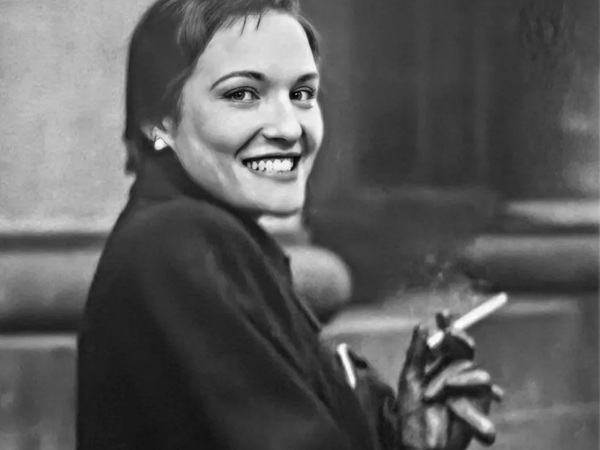
[Shown above: 1) Photo of Cossette Zeno. 2) Cossette Zeno’s Let’s Go Higher, 1952. Both photos, courtesy Richard Saltoun.]
Alex Greenberger (ARTnews) reviews the trajectory of Dominican Republic-born, Puerto Rican Surrealist painter Cossette Zeno. I am sad to report that her solo show, curated by José Correa-Vigier at Richard Saltoun-New York, is only on view through Friday, October 30, 2026. “This one over here is a weird one,” said Cossette Zeno, pointing to her