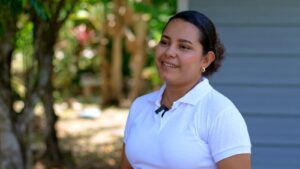
As a young girl living in the village of Indian Church, Judith Reyes spent her days enjoying sunsets from the top of the tallest temple at the nearby Lamanai Maya Archaeological Site. Those days, she says, were “wild and free.” They also often involved staying out past dark with friends and taking a dip in the nearby New River Lagoon. For both her and her friends, they were fun times—humble times. But they weren’t without their challenges.
Found in the Orange Walk District, Indian Church sits about forty minutes away from Orange Walk Town. The village is remote, and like many places in the most secluded regions of Belize, its residents have lived without electricity ever since its establishment.
 Photo by Ignite Ltd.: Judith Reyes, Resident of Indian Church Village, Orange Walk
“I can remember that I used to have to go to San Felipe to print out homework,” said Reyes when asked about her experience growing up without access to electricity. “In school, the teachers used to struggle a lot with that too, you know?”
San Felipe, one of the nearest neighboring villages, lies approximately twelve miles away. It’s a long journey, though one that was often necessary for Judith and others like her. Thanks to European Union support, however, the village is being connected to the electrical grid, which means that it’s a journey the younger generation of Indian Church won’t have to make.
Through funding from the European Union, Belize Electricity Limited (BEL) has been successfully expanding access to energy across five rural villages in Belize. As a long-term partner in the sustainable national development of the country, the EU has been working alongside the Belizean government to extend essential services such as electricity to rural areas. And under its Global Gateway strategy, the EU has prioritized investment in infrastructure, systems, and energy solutions to bridge the energy access gap.
The rural electrification initiative is currently supporting progress in two villages in the north of Belize, namely Indian Church and San Carlos, and three in the south—Jalacte, San Benito Poite, and San Vicente—impacting a diverse range of communities.
Judith, who works as both a librarian and a tour guide in Indian Church, today sees a much brighter future for the children of the community. Her fellow librarian, Sonia Arevalo, shares the same sentiments.
Like Judith, Sonia has seen, year after year, how much of a challenge learning can be for students without access to electricity. And as for herself, it made planning after-school activities at the library difficult.

Photo by Ignite Ltd.: Sonia Arevalo, Resident & Librarian of Indian Church Village, Orange Walk District
“If I want to stay late with them,” she said. “I can’t because I have no lights. Also, when it comes to printing or searching, it’s difficult as we don’t have any computers. And when it hits this time of the year, I don’t have a fan. So, it’s a challenge. It’s been a challenge.”
Thanks to electricity connection, the library will be able to offer services like printing and computer access, things that—while seen as basic utilities for some—neither Judith nor Sonia had the privilege of accessing during their own childhood. Sonia believes, without a doubt, that high school students will benefit tremendously from these services, especially when it comes to internet access. Up until now, many have had to rely on outdated printed encyclopedias to complete research homework—something which has proven very limiting for most of them.
“This will be a big thing for us, for the students in the school, for high school students that come and visit the library, because we’re going to be able to get computers, printers, and also have light inside, and then we can stay later for service.”
Beyond the library, Judith Reyes also has huge hopes for the village itself. She sees the access to electricity as an opportunity for growth and development, whether that’s in the form of new shops and restaurants or even a hotel or two to accommodate visitors wishing to explore the community and nearby Lamanai.
“When [visitors] used to come just for the day, many wished to stay. There’s some that did, but staying here…without electricity, it gets pitch dark,” she said. “Before, we didn’t walk outside at night, but now that we finally have electricity, the streets are lit up. We feel more free. We are spending more hours outside, and I think visitors will love that.”
At the helm of the rural electrification project are the skilled technicians working with the Belize Electricity Limited (BEL)—technicians like Paul McCalla, who says it is an honor to be involved in such an undertaking.

Photo by Ignite Ltd.: Paul McCalla, Grid Edge Senior Technician – Belize Electricity Ltd.
“It’s amazing to see the excitement that happens on these people’s faces every time we turn on the lights for them,” he said.
McCalla is a Senior Technician at BEL. The rural electrification project, and others like it, he says, are proof of what’s possible when Belize and its partners invest in infrastructure.
“It shows that we are forward-thinking and that we have room to develop.”

Photo by Ignite Ltd.: Entrance Sign of San Carlos Village, Orange Walk District
Just a stone’s throw away from Indian Church, the village of San Carlos is also set to receive access to energy. The process is ongoing, and for those who have already been connected to the grid, the difference in day-to-day life is already palpable.
For Telma Reyes, who has resided in the village for almost forty years now, the new grid means comfort and convenience.

Photo by Ignite Ltd.: Telma Reyes, Resident of San Carlos Village, Orange Walk District
“Now that there’s electricity, I have my refrigerator, I can charge my phone, and we use a fan,” she said. “Anything we want to do, like blend something, there’s the blender, and it’s easier now. Life is a little easier because of the electricity, and if you want to use it, well, it’s there.”
And for Gloria Corado, it means that her mother’s store can flourish—thanks, in no small part, to now being equipped with a functioning refrigerator and also being able to remain open later into the evening with the aid of electrical lighting.
 Photo by Ignite Ltd.: Gloria Corado, Resident & Shopkeeper of San Carlos Village, Orange Walk District
“It means a lot for us,” Gloria said. “Especially for my mom’s business. She’s elderly, so I spend my time helping her. We have refrigerators now to store fresh meat. So it really means a lot for the business.”
In addition to being grateful, Gloria is hopeful. Access to energy, for her, means that the community will one day be able to see more development. And just like her, Telma is eagerly looking forward to the project’s completion—and the day the entire village will be connected to electricity.
When it comes to remote areas like Indian Church, San Carlos, and other rural villages, Paul McCalla says it is the cost of connecting them to the national grid that’s been the most prohibitive.

Photo by BEL.: Aerial View of Indian Church Village, Orange Walk
That cost comes due to obstacles like dense vegetation, large bodies of water, and, in the case of Indian Church, having an archaeological site so close by. All these are factors that must be taken into account in the operation. Thanks to the financial support provided by the European Union, the Government of Belize and BEL have been able to address those obstacles ensuring the expansion of electricity to rural communities that had been waiting for many years.
“We were lacking funds, but because of the European Union, we are able to grant these people access to electricity and a variety of more opportunities,” he said. “Without them, this wouldn’t be possible.”
Partnership at Work
Through its partnership with Belize, the European Union is building key energy infrastructure that connects people to the grid and provides them with renewable energy solutions. In Indian Church and San Carlos in the north, BEL has substantially completed the electricity distribution network serving Indian Church and San Carlos. Customer account setup has been completed, home wiring is well underway, and BEL is currently energizing customer connections, bringing reliable electricity service to around 180 households in the two villages.
Meanwhile, in the three southern villages, construction continues to make good progress. The electricity distribution network has been completed in Jalacte, is nearing completion in San Vicente, and is in the early stages of construction in San Benito Poite. At the same time, construction of the solar mini-grids is progressing well, with the mini-grid serving Jalacte and San Vicente approximately 90% complete and the San Benito Poite mini-grid approximately 50% complete.
Thanks to the investment and the efforts currently underway in the five villages under the EU’s partnership with the Government of Belize and BEL, approximately 550 households in total—an estimated 2,000 persons—will have energy access. This will be game-changing not only for families but also for enterprises and public services, including health centers and schools located in areas where there was no electricity before.
The rural electrification project is part of a wider initiative by the EU to support the energy sector in Belize, in collaboration with the Ministry of Public Utilities, Energy, and Logistics. Through it, a lot more has been contributed in recent years. The EU has also invested in training programs for Belizean energy sector professionals, enhancing governance and institutional capacity and empowering local authorities to better manage and expand energy infrastructure, ultimately ensuring that more communities benefit from modern energy solutions.
Through the Global Gateway initiative, the European Union is working with Belize to support real progress that people can see and feel.
The post Access to Electricity is changing the game for these residents in Rural Belize appeared first on Belize News and Opinion on www.breakingbelizenews.com.
As a young girl living in the village of Indian Church, Judith Reyes spent her days enjoying sunsets from the top of the tallest temple at the nearby Lamanai Maya Archaeological Site. Those days, she says, were “wild and free.” They also often involved staying out past dark with friends and taking a dip in
The post Access to Electricity is changing the game for these residents in Rural Belize appeared first on Belize News and Opinion on www.breakingbelizenews.com.