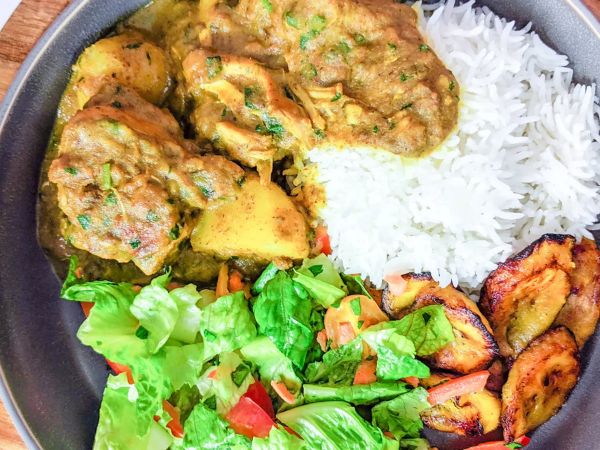
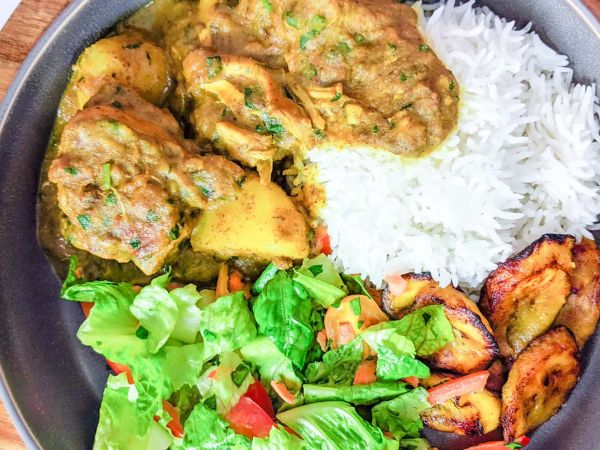
[Many thanks to Peter Jordens for bringing this item and related links to our attention.] The full title of this article by Chef Mireille [Mireille Roc] for Heritage Food Stories, is “Why Caribbean Food Tastes Like Asia: The Untold Story of Indian, Chinese, and Indonesian Communities Who Remade Island Cuisine After Slavery.” [The article is also available as a podcast episode and a YouTube video; here are excerpts.]
Some people are genuinely surprised when someone who looks fully Asian — whether with an Indian presentation or a Chinese one — opens their mouth and out comes Jamaican patois or Papiamentu or a thick Caribbean accent. People who don’t understand the Caribbean will say they’re cosplaying. To a West Indian, there’s nothing to even blink twice about.
The Caribbean is one of the most ethnically diverse regions on earth – something I have said repeatedly. As May and June are when several Caribbean countries celebrate Indian Arrival Day — marking when the first ships of indentured laborers from India arrived — this is the perfect moment to explore how Indian, Chinese, and Indonesian people came to the Caribbean, and what they left behind in the food we still eat today.
The Difference Between Indentured Servitude and Slavery (And Why It Matters)
There were other indentured servants who came to the Caribbean — mostly from Ireland, or from Spain and Portugal fleeing the Spanish Inquisition. That’s not who we’re talking about today. [. . .]Because of the history of Dutch colonization in Indonesia, the only Caribbean countries to receive indentured servants from Indonesia were the Dutch Caribbean — and specifically, Suriname.
Between 1890 and 1939, over 32,000 Javanese people were brought across the ocean to Suriname. Their experience maps almost exactly onto what Indian indentured servants faced throughout the rest of the Caribbean — built on lies and deception by Dutch colonizers.
That said, indentured servitude should never be equated with chattel slavery. There is always one defining factor. Indentured servants were not property. Their children could not be sold away from them. Indentured servitude was brutal in the Caribbean — but it was not slavery. Equating the two erases the full dehumanization that enslaved people suffered for centuries across the Americas. It’s not factually correct, and it’s dismissive.
How People from India Changed Caribbean Food Forever
[. . .] Slavery was abolished in the British Caribbean in 1834, followed in subsequent decades by the French, and finally the Dutch in 1863. Spain was the last to end slavery in Cuba in 1886. [. . .]
Many people signed indenture contracts under lies and coercion — or were forced into contracts they couldn’t read. [. . .]
After their contracts ended, some were able to return to India – but most never did. Some had built families in the Caribbean. Others had their contracts extended by British colonizers long past the agreed terms. Toward the end of the indentureship system, the colonizers had even run out of money to repatriate those who genuinely wanted to go back. Even if they wanted to return home, they were stuck.
Approximately 500,000 people came from India to the Caribbean — primarily to Trinidad, Guyana, and Suriname, with significant numbers also going to Jamaica, Grenada, St. Lucia, Martinique, and Guadeloupe. This is why the Caribbean has such a large, vibrant Indo-descended population today. Including diaspora communities in the United States, Canada, and England, there are approximately 3 million Indo Caribbean people worldwide.
They brought everything with them — religion, music, food, traditional dress. It traveled from the Indian subcontinent across the Bay of Bengal into the Indian Ocean, around the Cape of Good Hope near South Africa, and finally into the Atlantic and the Caribbean Sea. Months of a treacherous journey marked by overcrowding and disease.
And then something miraculous happened. While the core roots of Indo Caribbean cuisine are unmistakably from India, the recipes adapted — sometimes because of ingredient availability, sometimes because of the influence of other cultures in the Caribbean, sometimes just because of local preference. [. . .]
How Chinese Indentured Laborers Built the Caribbean Merchant Class
The first wave of Chinese people to the Caribbean also arrived after slavery ended in the 1830s. These indentured servants — mostly from the southern provinces of Guangdong, with a smaller number from Fujian — were also lied to and coerced into signing contracts, seeking a better life.
Approximately 130,000 Chinese indentured servants were sent to the Caribbean, mostly to Cuba. Only about 20,000 of that number were sent to Jamaica, Guyana, as well as Trinidad and Tobago. In Cuba, where conditions under Spanish colonizers were among the most brutal in the entire Caribbean — some Chinese indentured servants took their own lives to escape. No matter how small the island, today virtually every Caribbean country has some Chinese population. Even on a small island like Dominica, you’ll find a Chinese restaurant.
But there were some key differences between the Indian and Chinese communities that shaped the path forward… [. . .]
For full article, see https://heritagefoodstories.substack.com/p/why-caribbean-food-tastes-like-asia
For more about Chef Mireille (Mireille Roc, according to https://www.linkedin.com/in/mireilleroc), visit https://globalkitchentravels.com or follow her on https://www.instagram.com/chefmireille.
[Many thanks to Peter Jordens for bringing this item and related links to our attention.] The full title of this article by Chef Mireille [Mireille Roc] for Heritage Food Stories, is “Why Caribbean Food Tastes Like Asia: The Untold Story of Indian, Chinese, and Indonesian Communities Who Remade Island Cuisine After Slavery.” [The article is