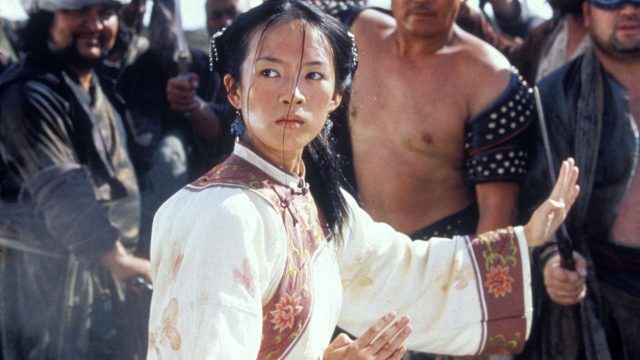
The magic of the movies is how many people first discovered the martial arts, a loosely related set of hand-to-hand combat practices, most closely associated with China, which have diffused across most of the world. This rich tradition has been showcased in the plots and action sequences of countless films, including these eight exceptional, beloved classics.
‘Enter the Dragon’ (1973)
“Enter the Dragon” will always be linked with the untimely death of its young star, Bruce Lee, prior to the film’s wide release. Lee plays Lee, a martial artist recruited by British intelligence to infiltrate the island drug and human trafficking ring operated by Han (Shih Kien) under the guise of a martial arts tournament.
Competing alongside two Americans, Roper (John Saxon) and Williams (Jim Kelly), Lee methodically dispatches Han’s henchmen and avenges his sister’s death in the process. Unquestionably the “most influential martial-arts movie ever made,” its profits, likely in excess of $100 million on a budget of less than $1 million, “were astronomical,” and the film has “more than stood the test of time,” said Tom Gray at BBC. (HBO Max)
‘The Karate Kid’ (1984)’
The 1980s were a time of rising Japanese cultural influence in the U.S., from Hondas to hibachi restaurants. And while “The Karate Kid” might not be the kind of martial arts movie that devoted fans consider canonical, it helped make the Japanese art of karate as “ubiquitous on the extracurricular landscape as Little League and piano lessons,” said Newsweek.
Daniel (Ralph Macchio), freshly arrived in Los Angeles with his widowed mother, keeps getting beaten up by Johnny (William Zabka), a karate black belt and the ex-boyfriend of Daniel’s crush, Ali (Elisabeth Shue). Daniel enlists his building’s janitor, Mr. Miyagi (Pat Morita), to teach him how to defend himself and compete in karate tournaments. The two develop a deeper bond than either anticipates. The film is an “exciting, sweet-tempered, heart-warming story with one of the most interesting friendships in a long time,” said Roger Ebert at the time. (Prime Video)
‘Once Upon a Time in China’ (1991)
Wong Fei-hung (Jet Li) is a doctor and martial arts master in 19th-century Guangzhou, when the U.S. and other imperial powers were attempting to open China to the outside world by force. The film is a biopic of Fei-hung, a real-life Cantonese folk hero who resists efforts by a villainous American named Jackson (Jonathan Isgar) to create a human trafficking pipeline of sex workers and laborers to the United States.
Fei-hung finds himself fighting against Jackson’s local collaborators, including “Iron Vest” Yim (Yen Shi-kwan). A movie that moves “deftly between romping, fizzy martial arts action and sober depictions of the tense situation of China in the 1860s or ’70s,” it is “as much a grave history lesson as a giddy celebration of its stunt team’s physical prowess,” said Tim Brayton at Alternate Ending. (HBO Max)
‘Crouching Tiger, Hidden Dragon’ (2000)
In Qing Dynasty-era China, a renowned warrior, Li Mu Bai (Chow Yun-Fat), tries to track down the bandit who ambushed Yu Shu Lien (Michelle Yeoh) and made off with Li Mu Bai’s Green Destiny sword. The trail leads him to Jen (Zhang Ziyi), trained by Li Mu Bai’s nemesis, Jade Fox (Cheng Pei-Pei).
Directed by the legendary Ang Lee, “Crouching Tiger, Hidden Dragon” was a global sensation, characterized by mesmerizing fight sequences enhanced with magical realism, including a scene where warriors square off while floating above the treeline. It is still by far the highest-grossing foreign-language film ever released in the U.S. The film is known as “wuxia,” a “subgenre of martial arts cinema” that “finds its roots in seventh-century romantic literature and poetry,” said Matthew Thrift at the British Film Institute. Buoyed by the “undeniable elegance of Ang Lee’s direction,” it is also noteworthy for its “explicitly feminist take on the genre.” (Tubi)
‘Kill Bill Vol. 1’ (2003)
A movie that cemented the status of martial arts as an international cinematic genre, “Kill Bill Vol.1” was the first film from director Quentin Tarantino (“Pulp Fiction”) in the six long years after the release of 1997’s “Jackie Brown.” Uma Thurman is Beatrix Kiddo, an assassin known as Black Mamba who tries to escape her life of crime.
On her wedding day, her former boss and lover, Bill (David Carradine), kills the entire wedding party and leaves Beatrix in a coma. When she wakes four years later, she embarks on the titular revenge mission. Its “over-the-top style contributes heavily to the films’ memorability,” said Justin Kim at Loud and Clear Reviews, including the iconic scene in which “Beatrix faces off against 88 assassins in a no-holds-barred katana battle.” The movie was split into two parts, with “Kill Bill Vol. 2” released six months later, in 2004. (Prime Video)
‘Ip Man’ (2008)
Ip Man (Donnie Yen) is a martial arts grandmaster whose life in the Chinese city of Foshan is upended by the 1938 Japanese occupation. He and his family are stripped of their home and possessions, and Ip Man takes work transporting coal.
When Japanese General Miura (Hiroyuki Ikeuchi ) begins organizing brutal matches between his occupying soldiers and Chinese martial artists, Ip Man agrees to a public fight with Miura himself. A loose biopic of a real historical figure who later trained the legendary Bruce Lee, “Ip Man” benefits from “slick, frenetic and plentiful” fighting and “high production values, with stunning set design, locations, camerawork and its atmospheric score making the setting of Foshan come alive,” said Daniel Hooper at Eye For Film. (Peacock)
‘The Raid: Redemption’ (2011)
A film that features and popularizes “pencak silat,” an Indonesian martial art, “The Raid: Redemption” revolves around the efforts of a 20-person police SWAT team including new recruit Rama (Iko Uwais) to storm a squalid apartment complex. Their mission: take down the crime lord Tama (Ray Sahetapy).
The team is quickly trapped, and survivors must fight their way through Tama’s henchmen, floor by floor. It’s a straightforward set-up carried out with unusual panache, although it is not for anyone who can’t tolerate ultraviolence. The result is a “skull-splinteringly violent, uncompromisingly intense and simply brilliant martial arts action movie in a nightmarish and claustrophobic setting,” said Peter Bradshaw at The Guardian. (Pluto TV)
‘Journey to the West: Conquering the Demons’ (2013)
Director Steven Chow (“Kung Fu Hustle”) adapts a prominent Chinese fable in this difficult-to-categorize romp that remains almost completely unknown in the U.S. Tang Sanzang (Wen Zhang) is a demon-hunter who uses nursery rhymes to pacify spirits and return them to their human forms.
He is pursued by Miss Duan (Shu Qi), a rival demon hunter who dispatches them the old-fashioned way—by killing them. Chow’s success in “translating this ancient tale from scroll to screen” is due in large part to the care he takes to “include as much fun, sincerity, and humor in his interpretation as possible,” said Justin Cummings at Critics At Large. (Tubi)
From its origins in East Asia, martial arts cinema has conquered the world