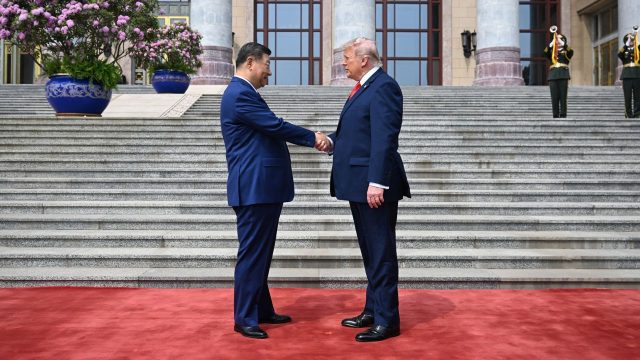
Chinese president Xi Jinping told Donald Trump last week that he hoped the US and China could avoid the “Thucydides trap”. He was referring to an ancient Greek theory of war that has become a staple of geopolitical commentary in recent years. But what was he implying – and what do classical battles have to do with current US-China relations?
What is the Thucydides trap?
It’s the theory that, when a rising power threatens to displace an established power, the result is often war.
It is named after Athenian general and historian Thucydides, whose account of the Peloponnesian War between Sparta and Athens 2,430 years ago included the observation that “the growth of power of Athens, and the fear that this instilled in Sparta, made war inevitable”.
The implication is that, if an established superpower “manages the rising power badly”, it can feel “obliged to go to war when that’s not necessarily the only option”, said David M. Pritchard, an associate professor of Greek history at the University of Queensland, on The Conversation.
The Thucydides quote was re-popularised in the 2010s by US political scientist Graham Allison. He identified 16 moments in the past 500 years when a rising power threatened to dominate a major ruling power, and pointed out that 12 of them resulted in war.
How does it apply today?
In 2026, the established superpower is the United States, and the rising power is China. There is tension between the two over trade and tariffs, and over China’s claims to sovereignty over Taiwan. Analysts believe there’s a danger of both sides misinterpreting each other’s actions. The US may see Beijing’s expansion as aggressive and a challenge to US influence, while China may see US alliances and military presence in Southeast Asia as attempts at containment.
So, according to the Thucydides trap, if Washington insists on a policy of confrontation with Beijing, war will be the likely outcome. Xi’s remarks were “an entirely unsubtle warning, and even a threat”, said Aaron MacLean on The Free Press. He was not voicing a “friendly expression of a shared desire for peace”; he was making it clear that, to avoid conflict, the US must “radically change” its “attitudes and actions”, and “accommodate” itself “to a Chinese-led world order”.
Is it historically accurate?
“Many scholars of ancient Greece take issue with the way the term is used today,” said Pritchard on The Conversation. The word “trap” implies Sparta “made a mistake in 431BC and could’ve handled things better”. But Sparta “had good reason to fear the rising Athenians”, who were “stripping allies off Sparta left, right and centre”. It was pressure from their remaining allies that pushed the Spartans to act against Athens. And, although it took them 27 years, they won.
Nonetheless, there are lessons to be learned from the Peloponnesian War. It “may be foolish” for an established superpower to “check the rise of an emerging one”; although Sparta managed to do so, it came “at a terrible cost”. Decades of war wiped out much of its fighting population and forced it to depend on unreliable allies, triggering its eventual decline. If it had found a way to accommodate Athens and its ambitions, Sparta could have continued as a superpower “well into the fourth century”.
Chinese premier cited ancient Greek history to issue warning to Donald Trump