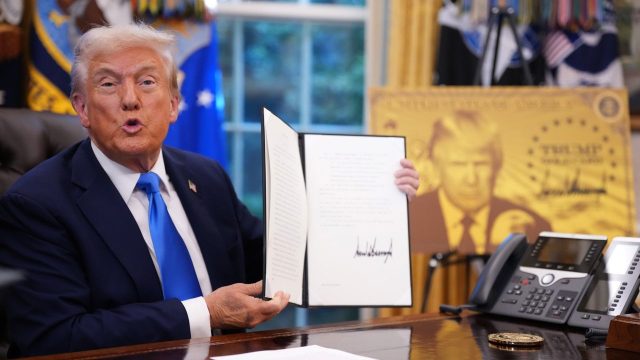
President Donald Trump is, by his own repeated admissions, first and foremost a businessman. Even after entering the rarified echelons of hegemonic decision-making, he often touts his track record as a corporate wheeler-dealer as proof he is prepared for the oceanic pressures of managing a geopolitical superpower.
Now, as commander in chief, Trump has seemingly merged the political with the profitable, commandeering the Oval Office for his own financial interests. From teasing tariffs to raking in royalties, these are the ways the president has used the White House to boost his bank account.
Cryptocurrency
Of all the various Trump-linked business projects operating concurrently with the president’s administration, “none” pose a conflict of interest that can “compare to those that have emerged since the birth” of cryptocurrency firm World Liberty Financial, said The New York Times. Trump is now “not only a major crypto dealer” but one of the industry’s “top policy makers,” whose family-owned foray into digital currency is “eviscerating the boundary between private enterprise and government policy.”
During the first year of his second term, Trump signed the GENIUS Act into law, thereby establishing federal regulations that the “industry had sought around stablecoins, a kind of cryptocurrency pegged to the U.S. dollar,” said Time Magazine. “Earlier that year,” Trump launched USD1, “his own stablecoin business.”
World Liberty also offers “governance tokens,” which can be purchased to offer owners “certain voting rights in its business, though not equity stakes,” The Associated Press said. The result? “Hundreds of millions of dollars” for Trump and his family from his World Liberty ownership and a “separate side deal allowing them a cut of these sales.”
Real estate development
You can take the president out of the cutthroat world of elite property deals, but you can’t take the elite property deals out of the president. At least that is how Trump seems to have operated since taking office, with his geopolitical responsibilities as president often overlapping with international development deals being pursued in his corporate name.
While the eponymous Trump Organization “did zero deals in foreign countries” during the first Trump term, it has done at least eight in his second, “all ostensibly complying with the Trump Organization’s self-imposed rule not to do business directly with foreign governments,” said the AP. But “authoritarian” and one-party states “rarely take a hands-off approach” when it comes to big business deals — “especially when the business belongs to a sitting president.”
The President “continues to profit” from his partnership with a “major Saudi developer with a history of close ties to the royal family,” said The New Yorker. This past winter, the Trump organization began “licensing its name” for the development of a “new golf club, a luxury hotel and a number of mansions in Diriyah, near Riyadh.” It has also “sold the use of the President’s name for a Trump Plaza development in Jeddah.”
Tariffs
In his second term, Trump has centered tariffs as a load-bearing policy of his entire administration. But to “truly understand why Donald Trump likes tariffs so much,” said Jen Psaki on MS NOW, “you have to look at the Trump International real estate development” project moving forward in Vietnam.
Trump’s threat to slap the Vietnamese government with exorbitantly high tariffs on the self-titled “liberation day” came amid a push for luxury developments in and around the country. Hanoi was facing “intense pressure to strike a trade deal that would head off President Trump’s threat of steep tariffs,” said The New York Times. That pressure prompted Vietnamese officials to request support from the top levels of government, as the project was “receiving special attention from the Trump administration and President Donald Trump personally,” per a letter obtained by the Times.
Trump’s “freewheeling use of tariffs as a tool of American power” has seen him apply the economic measure toward “national security goals, as well as the interests of individual companies,” The Washington Post said. Tariffs are a “tool the president enjoys because it’s personal power,” former Interior Secretary Ryan Zinke said at HuffPo.
With tariffs, Trump doesn’t “have to go through Congress” and can “exercise personal power” instead. Tariffs, to Trump, are a “potent and unilateral mechanism for reintroducing systematic corruption into the economy,” said Mother Jones. Controlling tariffs allows the White House to “grant waivers and exemptions,” which forces “people, corporations, localities and even nations and foreign actors to come seeking reprieve on bended knee.”
Tchotchkes and royalties
The first year of Trump’s second term in office was a “lucrative” one when it came to “royalty payments for the various goods that are sold featuring his name and likeness,” said NBC News. Per his 2025 financial disclosure forms, Trump that year earned more than $1 million from sales of his “45 guitar, which features Trump’s ‘Make America Great Again’ phrase inlaid in ‘authentic pearl’ on the neck of the guitar, as well as the “number ‘45’ on the headstock, referring to his time as the 45th president of the United States,” said Fox Business.
The disclosure forms also list him as earning $2.5 million in royalties from “Trump Sneakers and Fragrances” and an additional $1.3 million from the “Greenwood Bible,” inspired by singer Lee Greenwood — a frequent Trump supporter — and his “God Bless the U.S.A.” anthem. “Besides a King James Version translation,” Trump’s bible contains “the U.S. Constitution, the Bill of Rights, the Declaration of Independence and the Pledge of Allegiance, as well as a handwritten chorus of the famous Greenwood song,” The Associated Press said.
Trump’s licensing and merchandise windfalls come after he “launched a number of new licensing deals” in late 2024, a “couple of weeks before taking the oath of office,” Time said.
Settlements and suit threats
Since returning to office, the famously litigious Trump has raked in at least $90 million in lawsuit settlements from tech and media juggernauts, including X, Meta and Paramount, The New York Times said, even as many of Trump’s suits weren’t “justified on the merits.” Several of those high-profile settlements were then used to “help fund the creation of Donald Trump’s presidential library,” The New Republic said.
The Miami-based site, which, in a “perfect Trumpian twist may also double as a hotel,” has earned congressional notice for its unique funding origins. “Not one” of the companies whose settlement funds are being applied “can say with any clarity where their multimillion-dollar donations to Donald Trump’s library slush fund are or where they will go,” Sen. Elizabeth Warren (D-Mass.) said to The New Republic.
Scrutiny over Trump’s settlement-funded library comes as the White House is “engaged in discussions’ with the president’s IRS and Treasury Departments to “resolve” a $10 billion lawsuit filed this past winter that accuses the agencies of an “unauthorized leak of his tax information during his first administration,” CNN said. Trump filed that suit “personally, not in his official capacity as president” although any monetary settlement would see “Trump’s own administration paying him and his family.”
Like father, like sons
For as much as Trump has expanded the horizons of potential presidential profiteering, so too have his eldest sons, Don Jr. and Eric, done the same for the Trump dynasty. Last spring, the pair “contributed their family name — and nothing else of obvious value — to a complicated series of transactions” to take a significant stake in the cryptocurrency mining firm American Bitcoin, said The New Yorker. Had their father lost in 2024, “surely” they wouldn’t have been granted “such a large stake in a business that they had virtually no experience in and to which they had contributed so little.”
As the pair’s “new drone company seeks Pentagon contracts,” other government contracting companies in which at least one brother owns an ownership stake “are taking in tens of millions of dollars of new taxpayer money,” the AP said. Still, the notion that Donald Jr. should “cease living his life and making a living to provide for his five kids” simply because of his father is “quite frankly, a laughable and ridiculous standard,” a family spokesperson said to the outlet.
In less than a decade, the president has turned his office into a billion-dollar pipeline for legally dubious personal enrichment