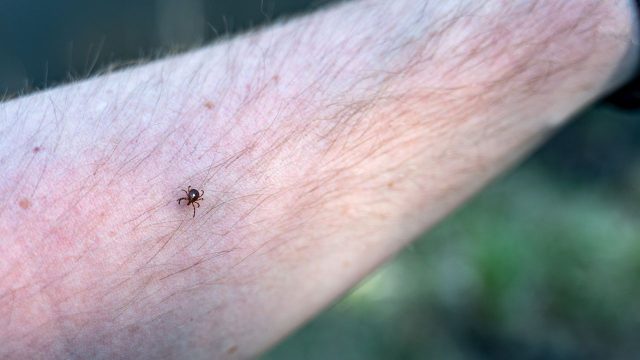
There has been an increase in the spread of alpha-gal syndrome (AGS), a tick-borne disease that can cause a serious allergy to red meat. More than 110,000 suspected cases of AGS were identified between 2010 and 2022, and while the actual number of U.S. cases is not known, as many as 450,000 people may be affected, according to the CDC. With a particularly strong tick season on the horizon and climate change continuing to worsen, the illness is likely to become more common.
What are the symptoms of AGS?
Alpha-gal is a molecule that is “naturally produced in the bodies of most mammals but not in people” and also “found in the saliva (spit) of some ticks,” said the CDC. When someone gets bitten by a tick, the alpha-gal molecule can be transferred to their blood. Then the “body’s natural defenses, or immune system, can identify alpha-gal as a threat and trigger an allergic reaction.” The reaction occurs “after people eat red meat or are exposed to other products made from mammals.”
Unlike most other allergies, which tend to produce reactions almost immediately, “those with alpha-gal may not experience a reaction to a hamburger for four or six hours” because of “how alpha-gal binds to fats, taking longer to absorb,” said The New York Times. Symptoms may manifest in different ways depending on the person, including “hives, angioedema, gastrointestinal distress and life-threatening anaphylaxis,” said an article published in the Journal of Medical Entomology. There is currently no cure for AGS, and the most common treatment is avoiding “not only red meat and dairy but also vaccines, antivenoms and medications made with components derived from mammals,” said Entomology Today.
AGS can be diagnosed through a blood test, but experts advise getting tested only when someone experiences a reaction and not just after being bitten by a tick. “It’s perfectly clear that 50% of people who have a positive test have no reactions whatsoever,” Thomas Platts-Mills, an allergist at the University of Virginia School of Medicine, said to the Times. The factors that determine whether someone has a reaction are still unknown. Along with some people being asymptomatic, “there are so many false positives,” Scott Commins, a professor at the University of North Carolina at Chapel Hill School of Medicine, said to the Times. “So testing after any tick bite would lead to a lot of people avoiding red meat unnecessarily.”
How common is it?
It will likely be a bad year for ticks, “with an unusually high number of bites already reported across the country,” said The Associated Press. “If you have a lot of exposures, there will probably be more cases of tick-related infections,” Alina Filozov, an infectious disease doctor at Middlesex Hospital in Middletown, Connecticut, told the outlet. In the U.S., AGS is “primarily associated with the bite of a lone star tick” and less commonly with the bite of a “blacklegged tick or a western blacklegged tick,” said the CDC. There have been at least 12 tick species linked to alpha-gal syndrome globally, and the disease has been found on six continents.
The best way to prevent AGS is to avoid being bitten by ticks in the first place. Steer clear of heavily wooded or grassy areas, wear light colors and use an approved insect repellent. If you do find a tick on yourself or your pet, remove it immediately.
Climate change is expanding the range of these insects. “Ticks like warm, humid weather, and more can be seen after a mild winter,” said the AP. “More deer and mice available for them to feed on may also factor.” Along with AGS, ticks can spread other diseases, including Lyme disease and Rocky Mountain spotted fever.
This tick-borne illness is on the rise