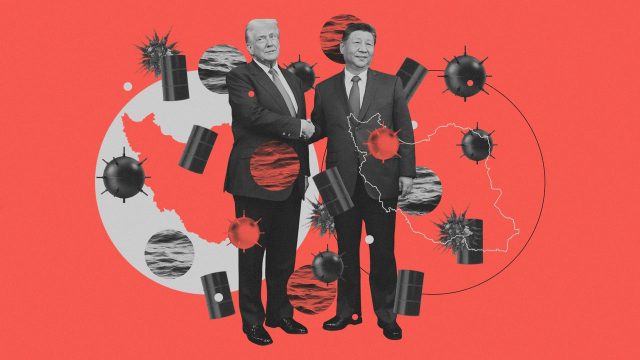
When the US and Israel attacked Iran, many turned to China to see its response.
For decades, Beijing had been the Islamic Republic’s most important economic ally, maintaining close diplomatic ties with Tehran through years of Western sanctions and international isolation.
But China’s relatively muted response to the US-Israeli strikes, its lack of military intervention and calls for de-escalation on both sides, has led many to question whether leader Xi Jinping is a fair-weather friend – or whether there’s a bigger game afoot: its delicate truce with the US, and their battle for global supremacy.
What is the background between China and Iran?
China was once “an important supplier of arms to Iran” before joining UN sanctions in 2007, said The Wall Street Journal. US officials say Chinese companies continued to be “a critical supplier of goods with potential military applications”, such as motors for Iran’s Shahed drones.
When in 2002 George Bush declared Iran part of an “axis of evil”, Beijing “saw an opportunity”, said Richard Spencer in The Times. It “began signing multibillion-dollar oil and gas deals” with Iran, culminating in a 25-year economic cooperation agreement in 2021 that centred on the sale of Iranian oil to China, reportedly worth $400 billion.
About 90% of Iran’s crude exports are sold to China every year, at a steep discount. In return, Iran “kept Washington bogged down in the Middle East”, said Geoffrey Cain in The Spectator. Its regional proxies “added just enough chaos to stop Washington focusing on China”. That was “extraordinarily useful” and cost Beijing “almost nothing”.
In 2023, China helped Iran restore diplomatic relations with Saudi Arabia, among its other mediation efforts in the Middle East. It denounced what it called “unilateral” US sanctions and brought Iran into Beijing-backed diplomatic alliances. Beijing’s ties with Iran “blunted America’s efforts” to isolate Tehran, said Michael Schuman in The Atlantic. China has held regular joint military drills with Iran, and Chinese firms have even supplied chemicals used in Iran’s missile programme, according to Reuters.
How has China responded to the US-Israeli attacks?
Iran says China is helping in various ways, including with “military cooperation”. According to its foreign minister, China is a strategic partner in the war. But so far, China hasn’t provided any direct military support, or deployed any forces, or provided “new weapons assistance to any party involved”, said The Diplomat. It has “primarily engaged through diplomatic channels”.
China has expressed opposition to the US-Israeli strikes, emphasising that they could undermine regional stability. But that has been “notably more restrained” than after the strikes on Iran last year. Beijing has also criticised Iran’s retaliatory attacks on its Gulf neighbours, and its de facto blockade of the Strait of Hormuz.
But it is also not willing to assist the US. Trump has demanded that China send warships to the Gulf. In response, the Chinese foreign ministry said Beijing called on “all parties to immediately cease military operations”.
Why has China’s response been so muted?
For Xi Jinping, “a hard-nosed pragmatism is at play”, said CNN. Iran “ranks below his top priorities”, including China’s fragile détente and trade truce with the US, ahead of the upcoming summit with Donald Trump in Beijing. China “sees no benefit in heightening tension with the US over Iran,” said International Crisis Group analyst William Yang.
Iran’s “strategic importance” to China is far more limited than many assume, as trade and investment flows are “eclipsed” by those with Saudi Arabia and the UAE. China might even appreciate Washington’s resources being diverted from the Indo-Pacific. A sustained campaign could “deplete America’s weapons supplies”.
Trump has threatened to delay the Beijing summit if China doesn’t send warships, said The New York Times. But a delay could also be in China’s interests; “if the war drags on, added pressure on Washington could mean more leverage for China”.
China also “gains diplomatically from the worldwide perception that America is an out-of-control bully”, said Spencer. It does not lose much “whatever happens to Iran” – except oil.
Despite its massive investment in renewables, China is heavily reliant on crude from the Gulf. And as much as 40% of its imports are shipped through the Strait of Hormuz.
China is better placed to weather the storm than most. It had “long braced for a Gulf oil supply shock”, stockpiling one of the world’s biggest oil reserves and diversifying its supply, said the BBC. Still, disruption is “putting its resilience to the test”.
Beijing has long been Iran’s key financial backer and oil buyer, but projection of stability and relations with the US ahead of Xi-Trump summit take precedence