Francisco de Zurbarán was a “genius” of the Spanish baroque, said Laura Cumming in The Observer. Zurbarán (1598-1664) “comes between El Greco and Velázquez”; he is “as wild as the former, as profound as the latter”.
Based mainly in Seville at the moment of the city’s greatest prosperity, he was lauded for his “electrifying” paintings of religious subjects, “hyper-real” down to the last fold of cloth and “pinprick of congealing blood”, and for his “radiant still lifes”.
There has never before been an exhibition devoted to Zurbarán in Britain, partly because the museums that own his greatest paintings are seldom prepared to loan them. This show at the National Gallery thus represents a coup: drawing on collections from Seville to San Diego, it brings together 40 works for a “magnificently choreographed” trawl through Zurbarán’s oeuvre. The paintings here are spotlit “in galleries dark as pitch”, just like the figures depicted in them. It’s a “stupendous” show that “astonishes from first to last”.
Zurbarán is “a mesmerising paradox, a mystical Catholic artist who paints with scientific accuracy”, said Jonathan Jones in The Guardian. The first painting shows Saint Peter Nolasco kneeling before a vision of Saint Peter hanging upside-down, his hands and feet nailed to an inverted cross. “You can see why Salvador Dalí loved this artist”: Zurbarán is “a primitive surrealist”.
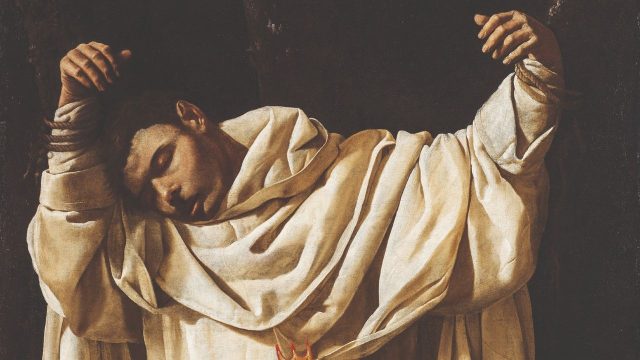
It’s “an exhibition of intense religiosity”, said Alastair Sooke in The Telegraph, and often quite gruesome. The opening room contains three large pictures of suffering, lending it the “foetid air” of a torture chamber. An early, “strikingly realistic” crucifixion scene leads us to “Saint Serapion”, in which the subject – “wrists bound, head slumped” – “appears unable to take much more punishment”. Elsewhere, there’s a “bearded elder” pictured in the act of Christ’s circumcision; Saint Apollonia brandishing a pair of pliers, the instrument of her torture; and the famous “Agnus Dei”, depicting a lamb on a slab, “ready for slaughter”. Not all of Zurbarán’s compositional innovations have stood the test of time: his paintings often seem “theatrical”, their subjects like “actors whose performances don’t quite convince”.
Unlike Velázquez, Zurbarán never left Spain, and cannot match his “sophistication”, said Jackie Wullschläger in the Financial Times. The quality of his art was “uneven”, and in later years could be “vapidly saccharine”. But his work from the 1620s and 1630s, redolent of the vast colonial wealth and “harsh Counter-Reformation zeal” of Seville, was “superbly original and captivating”. On a smaller scale, his still lifes are stunning: in “Still Life with Lemons, Oranges and a Rose”, “cool silver and pale ceramic” contrast with the organic forms, reflecting on the mystery and fragility of the material world. This is a show that “significantly enlarges our understanding” of a fascinating artist.
National Gallery, London WC2. Until 23 August
The ‘stupendous’ exhibition ‘significantly enlarges our understanding’ of the fascinating artist and the ‘mesmerising paradox’ of his works