In her closing keynote on courage and collectivism at the recent Australian Progress Conference, Sisonke Msimang said: “Love — watered by rage — is a powerful impulse.”
I read these words on her sub- stack more than two weeks after seeing Zawadi Yamungu at the Market Theatre.
Finally, I think to myself, here is a phrase that captures a show that spoke to the Anthropocene, nationhood along with reconfiguring ancient texts for contemporary political realities.
Zawadi’s performance teeters between immense rage watered with great stores of ancestral grief and rage.
This is what Nkosingiphile Mpanza, who has adopted the moniker Zawadi Yamungu, which is a Swahili name meaning “Gift from God”, imbues in her cultural work.
In his book, The Land is sung: Zulu performances and the politics of place, Thomas M Pooley discusses the notion of an ethnoscape. The notion, refers in part, to a set of sonic identities that are culturally embedded over time and space. Pooley notes that “the keynotes to a soundscape are its fundamental tones carved out by its geography and climate; water, wind, forests, plains, birds, insects and animals”.
He says “many of these sounds possess archetypal significance; that is they may have imprinted themselves so deeply on the people hearing them that life without them would be sensed as a distinct impoverishment”.
“Ukuphi: Where are you?” I ask Zawadi as our wi-fi connection falters. She giggles. “Ekhaya! Home,” she exclaims. Home could be anywhere for Zawadi. This is similar to jazz. It makes and remakes itself across the world in different tongues and permutations. Zawadi’s jazz trill sounds like she is calling on shamanic tongues or perhaps speaking in biblical tongues.
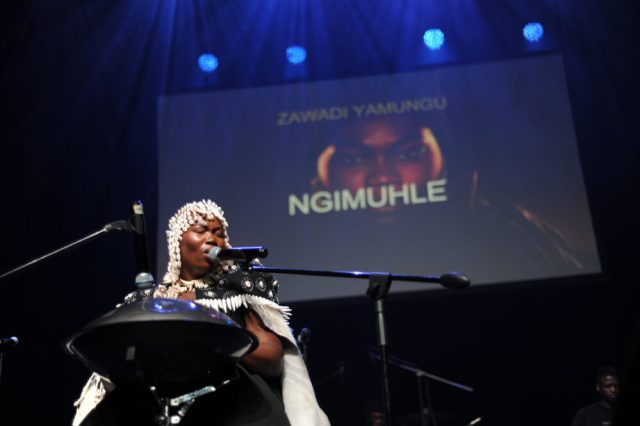
She sits at the intersection of vocalist, composer, arranger, dramaturg and an adept indigenous instrumentalist with a repertoire that includes umakhweyana bow player and the Swedish hand pan.
She teaches both us and the children she has commissioned to perform with her how to play and harmonise to the old technologies of sound. In 2020, Zawadi released a debut album, Magogo School of Thought, as she was paying tribute to Princess Magogo. On the album, she worked with Mbuso Khoza of the African Heritage Ensemble and Nduduzo Makhathini who was the producer of the album.
“Umcimbi,” I burst out laughing! Zawadi laughs. We are both overjoyed because we both know the significations of the Zulu word which is not quite translatable into the flatness of English. Umcimbi denotes an event or more appropriately, in this instance, an event led by matriarchs. We giggle, exhale, marvel and think deeply about how her most recent performance in Johannesburg was reminiscent of this exact notion. Pinnafores, doeks and takkies took centre stage in the style choices of the audiences.
Her most recent album, Ngimuhle, which came out in 2025, is a meditation on the poetics of Zulu matrilineal heritage. The album includes the song Isibikezelo, featuring praise poet Sindiswa Zulu, which is an example of a decolonial counter-history.
The poem resembles Aimé Césaire’s crucial essay “A Discourse on Colonialism” through the lens of a Zulu woman in post-colonial and post-apartheid. Zawadi makes the consistent case for an attuned sense of environmental vigilance through songs like Woza We Mvula, Xoxo and Jabulani Sizwe. In performance, Zawadi grounds the songs with clear missives about nature being a form of communal heritage.
What Zawadi does in this moment is what Mahmood Mamdani does in his book Citizen and Subject. In an attempt to define the realm of the customary, Mamdani argues in 1996 that colonial institutions “cast the net wide enough to catch within its fold every person with any trace of African ancestry. The objective was to arrive at a racial definition, [and not necessarily] a cultural one”.
It is interesting that Mamdani’s son seeks to remake America by remaking New York, a city which is so similar to Joburg in feel, grit and societal ugliness.
In his opening remarks at the historic Culture and Resistance Symposium in Gaborone, Botswana, on July 9, 1982, Thami Mnyele argued that “the act of creating art is not different from the act of building a bridge — it is the work of many hands”.


Zawadi expresses a similar sentiment in our call. She tells me that she sits with her elders. She says she loves the company and attention of her elders. This is her acting as a kind of bridge that undoes the work of situating black people in the customary of both the colonial and apartheid states. When we hear Zawadi sing her song Woza We Mvula on a dry summer’s night in Joburg with a municipality that has cut off water for multiple people in the audience, the torrent of rain that gathers in Newtown feels like an intervention from the divine.
We realise in that moment that black subjectivity is not an archaic or primordial existence but a contemporary one rooted in the modern-now. Western society was unable to understand the differentiations that they encountered in African communities as useful or part of the modern experience and Zawadi’s lyricism reminds us of this.
Rather, they imposed a linear conception of time onto the Global South and effectively cast them and more appropriately, us as backward and underdeveloped.
Zawadi critiques this history by providing oral counter histories through song and performance that upend simplistic and dangerous notions of “the customary”. Zawadi also calls on a rich tapestry of Pan-African musicianship that undoes the root assumptions of xenophobia.
By holding onto a Swahili moniker and introducing her audiences to aural sensibilities of Oliver Mtukudzi, Princess Magogo and songs of another tongue, Zawadi shifts the consciousness and the “us and them” of the dishonesty of parliament.
This is a useful intervention given that in parts of Zulu-land strangers or migrants that do not self-identify as being Zulu effectively have a questionable claim to the resources within that community or the resources within that land.
Xenophobia or xenophobic attitudes can be read as state sponsored in this regard. This Zulu state, to some degree, is seen as an institution of trusteeship which effectively safeguards resources its citizens are entitled to. Given the fact that there are a finite number of resources, one can start to grapple with why individuals who are seen as “outsiders” to the state can be seen as threatening.

When we hear Zawadi sing Adonja, we are tricked into Hebrew pronunciations of Adonijah, which is a Hebrew name meaning “my Lord is Yahweh”. We are also sent hurtling to the biblical character of Adonijah who was born at Hebron during the long conflict between David and the House of Saul. In 1 Kings, he briefly proclaimed himself king of Israel.
Finally the Nguni speakers in the crowd hear a cutting critique of the men in our lives — we hear Zawadi sing that we are not to be relegated to the position of dogs in their lives. We carry this as armour against being dispossessed by the men that animate the patriarchy that crushes us.
Nationalist discourse and various forms of Zulu nationalism which have been entrenched further under president Jacob Zuma’s term which equated indigeneity with access to resources starts to persist in the post-colony.
Imbued in the character of the indigeneity rhetoric is an insidious move from nationalism to a kind of ultra-nationalism wherein some have suggested a kind of national chauvinism and subsequent racism persists.
Zawadi undoes simplistic notions of Zulu supremacy through her musical oeuvre and through her introduction of collaborators such as The Soil, Dumza Maswana, Sindiswa Zulu and the multiple church choristers from Soweto Central Choir, along with members of DWC Church that help situate the meaning(s) of her message beyond the confines of an album and a theatrical performance.
Her performance is a testament to spirit-led musicianship as a kind of artistic praxis. Zawadi makes us new by recounting the old. She holds the position as dramaturg, Mother Gaia, Princess Magogo and spirit leader.
Blending jazz, folk and indigenous instrumentation, Zawadi crafts a sound that reconnects audiences to heritage while confronting the politics of the present