The painter William Nicholson is a largely forgotten figure these days, said James Beechey in The Art Newspaper. Known for his “bravura brushwork” and his singular ability to capture the effect of light falling on metal or glass, Nicholson (1872-1949) belonged to no distinct artistic movement, declined all invitations to join exhibiting societies – and “was steadfastly unrevealing about his own work”. That reticence may well have helped to diminish his reputation; indeed, his contribution has been largely eclipsed by that of his eldest son, the abstract painter and sculptor Ben Nicholson.
This exhibition, the first in 20 years, sets out to prove that Nicholson senior was a “sophisticated and original figure”, and a much more intriguing talent than is generally acknowledged. The show is a comprehensive retrospective of his career, bringing together portraits, illustrations, prints and posters, alongside the “ravishing” still lifes for which he is best known. But can it really make us reappraise a painter so regularly “damned as a minor artist”?
From the show’s first room, it’s clear that Nicholson was never “the dullard of legend”, said Mark Hudson in The Independent. Rather, he was “a precocious fin-de-siècle dandy” who flirted with many currents of London’s early 20th century avant-garde. He first came to prominence with a series of posters and book designs that have an “instant iconic quality even now”: his 1895 poster for “Don Quixote” at London’s Lyceum Theatre, for instance, blends “the quirky silhouettes of traditional English woodcuts” with flourishes borrowed from Aubrey Beardsley and Toulouse-Lautrec. Success as a graphic artist wasn’t enough for Nicholson, who was determined to become a master of “all genres” – an ambition that led him to embrace “much that was very far from cutting edge”. His paintings of Morris dancers are “clunky period pieces”, while his portraits – for which he was most celebrated in his lifetime – now look “dully conventional”.
Much better are Nicholson’s landscapes, said Chloë Ashby in The Times. “A keen walker, he traced the rolling hills and craggy coastline” of southern England, “portable paintbox tucked under his arm” – creating delightful works such as “A Glade near Midhurst” (1937), a “sun-dappled woodland scene” in which tiny figures pick their way through birch trees.
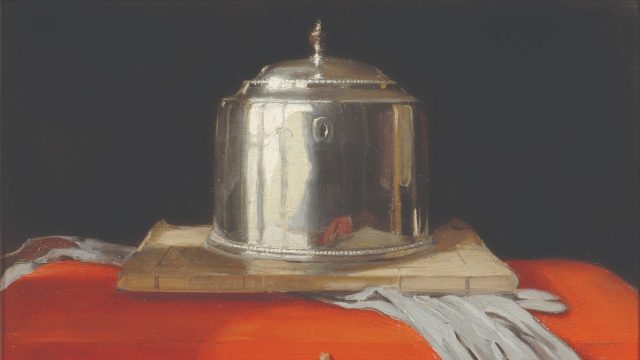
But it’s his still lifes that really dazzle. Nicholson “brings inanimate objects to life” like no other artist, depicting objects such as “pears, poppies and pewter” with virtuosic flair. “I could spend an entire afternoon” with “The Lustre Bowl with Green Peas” (1911), in which the “verdant veg” contrasts against a grey tablecloth, “bright-white gleams” reflecting against the silver, a single open pod revealing “pearly” peas “huddled in a row”. It’s a highlight of a “rich and varied” show that offers “a wide-angle view of a prolific and versatile artist”.
Pallant House Gallery, Chichester. Until 10 May
The wide-ranging show brings together portraits, illustrations, prints and posters, alongside ‘ravishing’ still lifes