Iran has signalled that any peace deal must include an end to Israel’s offensive against Hezbollah in Lebanon. But it’s unclear if the US could get Israel to agree to that, even if it wanted to.
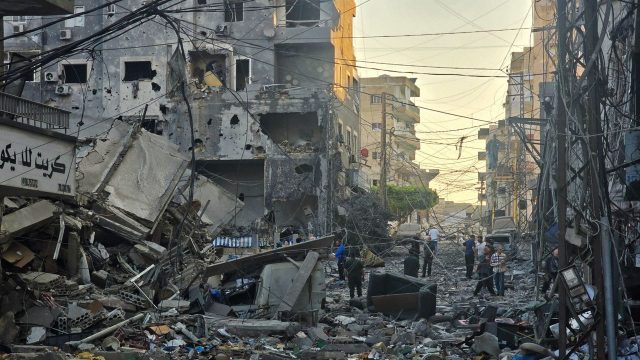
Despite last month’s ceasefire, Israel has continued to pound Lebanon with airstrikes, killing at least 608 people, according to the World Health Organization. Yesterday, in response to a Hezbollah attack on its military posts, Israel launched one of its most intense waves of bombings, saying it had hit more than 100 Hezbollah targets. “I have ordered an even greater acceleration of our operations,” Benjamin Netanyahu said. “We will intensify our blows, increase our firepower, and we will crush them.”
What did the commentators say?
“Lebanon is in danger of becoming an overlooked but increasingly deadly sideshow”, as both Israel and Hezbollah violate the ceasefire, said Tom Kington in The Times. Israeli troops are occupying swathes of southern Lebanon, and won’t withdraw unless Hezbollah disarms. But the Iran-backed group says it won’t stop attacking Israeli positions until Israel withdraws. “The result has been a stand-off.”
Hezbollah is “waiting for a cue from Iran, which in turn depends on how Iran’s talks with the US go”, Michael Young, of the Malcolm H. Kerr Carnegie Middle East Centre in Beirut, told The Times. “If Iran emerges stronger from its clash with the US, Hezbollah will feel reinvigorated.” They will “be able to say they resisted and claim victory”. Meanwhile, Israel will be trying “to torpedo any deal”.
Washington is “pressuring” Lebanon’s leaders to disarm Hezbollah or else “face more Gaza-style destruction”, said Rami G. Khouri, a policy analyst at the American University of Beirut, in Al Jazeera. It has also “tied financial support” for the country’s reconstruction to “Beirut’s compliance with US-Israeli terms”. The Lebanese government faces “a disgruntled, deeply impoverished population, exasperated by relentless Israeli attacks”.
April’s ceasefire agreement heralded “weakened US-Israeli positions in the region”, as well as dealing “deep political blows” to Netanyahu and gifting “new diplomatic leverage” to Iran and Hezbollah. Having survived their “existential” battles and now pressing for permanent ceasefires, they could “weaken Israeli postures and help reshape Lebanon’s internal dynamics”.
“But far-right members of Netanyahu’s coalition are pushing him to challenge” Donald Trump on the “ceasefire with Hezbollah”, said The Guardian’s chief Middle East correspondent, Emma Graham-Harrison. “It is time for the prime minister to bang on Trump’s table and inform him that we are returning to war in Lebanon,” said Itamar Ben-Gvir, the national security minister, on social media. “There is an urgent need to put an end to the threat posed by Hezbollah’s explosive drones,” the finance minister, Bezalel Smotrich, posted on Telegram. Hezbollah has “ignored repeated requests to stop firing at Israel”, a US official told Reuters. Israel will never “passively absorb attacks on its forces and civilians”.
But Tehran won’t accept such attacks on its proxy, either, Danny Citrinowicz, a Middle East expert at the Atlantic Council, told The New Yorker. Lebanon is of “real strategic importance” to Iran; Hezbollah is “a vital element” of its “so-called Axis of Resistance”. So Trump “has a mountain to climb”. If he wants an agreement with Iran, he will have to “force Netanyahu’s hand on Lebanon”.
What next?
On Friday, delegations from Israel and Lebanon will meet for direct talks in the US, in preparation for further negotiations on 2 and 3 June.
The shaky US-Iran ceasefire, meanwhile, is under increasing strain: Iran has said US strikes near the Strait of Hormuz on Monday were a “gross violation”, and validated its “deep suspicion”. The US said its attacks were “defensive”.
But “even if Lebanon is part of a US-Iran peace deal, the Lebanese people will be wary”, said Kington in The Times. After all, April’s Pakistan-brokered ceasefire between the US, Israel and Iran, supposedly included Lebanon – but Israel “denied this was the case and launched 100 attacks in a few minutes”.
Tehran wants peace deal to include end to Israel’s war on Hezbollah but Israel vows to ‘crush’ Iran-backed group