The stakes couldn’t be higher this weekend as the UK and the EU attempt to win concessions from the US over a peace deal between Ukraine and Russia.
Depending on how the next few days play out, “in the very best scenario there could eventually be peace in Ukraine”, said The Times. But in the worst-case scenario for the UK and the EU, “President Trump cuts Ukraine and Europe loose and sides with Moscow in his desire to bring the conflict to an end at any price”.
Yesterday, White House spokesperson Karoline Leavitt said Trump is “extremely frustrated with both sides of this war”, and he is “sick of meetings just for the sake of meeting”. In essence, “the transatlantic relationship feels very fragile right now,” a senior government source told The Times. “Anything could happen.”
What did the commentators say?
Despite Trump’s frustrations, “signs of a potential compromise are emerging”, said Politico’s London Playbook. The US and Ukraine are now talking about Kyiv withdrawing its troops from the Donbas region in order to create a “free economic zone” which would also be protected from Russian forces. “Ukraine seems willing to engage on this, but says it will only withdraw if it receives meaningful security guarantees.”
But reports of a demilitarised zone (DMZ) such as this “must be taken with a pinch of salt”, said UnHerd’s Wolfgang Munchau. “There are some suggestions that a DMZ would be a dealbreaker for Russia, like Nato Article 5 security guarantees for Ukraine.” Equally, Trump’s tilt toward the Kremlin in the National Security Strategy released by the White House last week has complicated negotiations. The US president “seems to want to stand equidistant between a democratic Europe and an autocratic Russia”, said The Washington Post’s David Ignatius. But “that evenhandedness between friend and foe makes no sense, strategically or morally – and it genuinely worries Europe.”
Trump “still views Ukraine as the weaker, more malleable party in the conflict”, two US government sources told Politico. “The Americans continue to act as though accepting Russia’s demand to hand over territory it has failed to occupy will bring peace,” said The Economist. But “all the evidence suggests Vladimir Putin sees it as a means to achieve Ukraine’s political subjugation”.
Indeed, many countries “remain concerned that a lopsided peace deal could work in Moscow’s favour, and prelude further aggression in Ukraine or against Nato’s long eastern flank”, said the National Security Journal’s Georgia Gillholy. European leaders “see little evidence that the Kremlin”, with more than 700,000 troops and its vast defence industry still geared for conflict, “is preparing for anything resembling a genuine de-escalation”.
What next?
According to officials from two of the countries involved, Trump’s special envoy Steve Witkoff intends to take part in talks with national security officials from the UK and Europe this weekend.
One senior government source told The Times that developments in recent days had been “very significant” and that there was now at least a chance of achieving a unified “Western” set of proposals to present to Moscow.
But whether that means peace before Christmas is very much up in the air. Kremlin foreign policy aide Yuri Ushakov said ahead of the discussions this weekend that Moscow has not seen the revised peace plan – and that “when we see them, we may not like a lot of things, that’s how I sense it”.
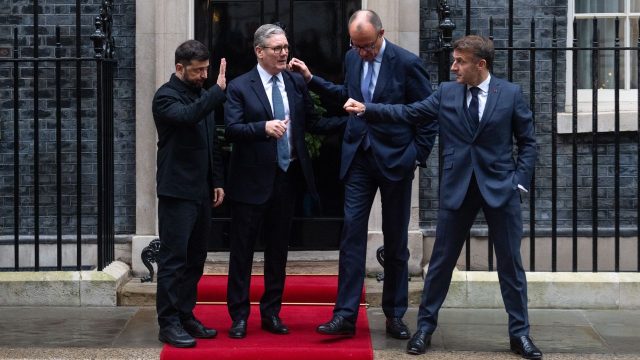
Discussions over the weekend could see a unified set of proposals from EU, UK and US to present to Moscow