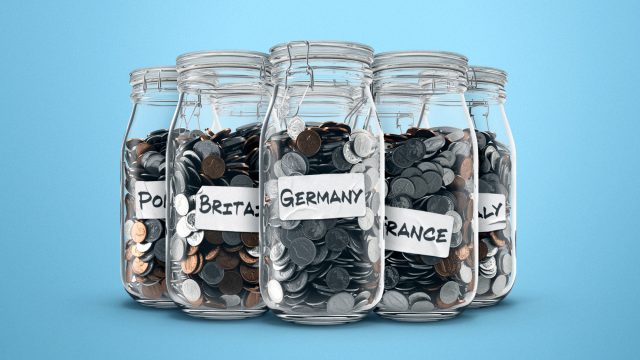
President Donald Trump has long accused other NATO countries of being freeloaders, relying on the United States to provide the bulk of Europe’s defense. Now those countries have pledged to ramp up their spending amid fears of an American pullout.
NATO leaders agreed to an “ambitious spending goal” at this week’s summit, said The New York Times. They set a 2035 target of 5% of each country’s national income on defense needs like “troops, weapons, shells and missiles.” That more than doubles the current 2% goal, which is a “win for Trump.” Some countries “may never reach these targets,” though. Prime Minister Pedro Sanchez of Spain said his country would spend “no more, no less” than 2.1% of its GDP on defense, and small countries like Slovakia and Belgium said the 5% goal will “be impossible to meet.”
Most European countries “can ill-afford to spend 5%” on defense, said Reuters. The new goal will force some “unpalatable sacrifices” to domestic spending budgets as governments shift spending from butter to guns, and it will also require some “creative accounting” to classify current spending as defense-related. NATO allies agreed to the goal, however, as they worried about Trump’s threats to pull America out of the alliance. That will likely leave European countries with a “less generous” welfare state, said Bruegel think tank fellow Guntram Wolff.
What did the commentators say?
Trump is “right that Europe needs to do more,” The Washington Post said in an editorial. NATO is the “most effective, powerful and vital military alliance” in world history, but America cannot “bear a disproportionate share” of the cost. And while the U.S. commitment “should remain ironclad,” Europe needs to take up more of the burden so that Washington can “make major investments” to confront the rise of China. It should be worth it to Europe: NATO is “worth fighting, and spending, to preserve.”
NATO’s 5% goal “misses the mark,” Todd Harrison said at The Hill. Setting an “arbitrary target” for defense spending is “bad policy for both the alliance and America.” The target “puts the budget ahead of strategy” and makes defense spending “subject to the whims” of the business cycle. A better approach would start with determining NATO’s actual defensive needs and setting budget goals from there. The amount of spending is important, “but how we spend it is even more important.”
What next?
“Key questions” still hover over NATO despite the American president’s “big win,” said CNN. Trump declined to offer a “full-throated endorsement” of NATO’s commitment to collective self-defense that would obligate the United States to come to Europe’s aid in the event of a Russian attack. America is “committed to being their friends and I’m committed to helping them,” Trump said. NATO General Secretary Mark Rutte is satisfied. The U.S. is “totally committed to NATO,” Rutte said.
The cost of keeping Trump happy