Chancellor Rachel Reeves has proposed to increase defence spending by less than £10 billion over the next four years, despite warnings from the Armed Forces of a £28 billion funding gap in the same period, and that Britain’s “national security and safety is in peril”, said The Times.
Lord Robertson of Port Ellen, a former Nato secretary-general, accused the Treasury in a speech on Tuesday of “vandalism” for inaction on defence. Leader of the 2025 Strategic Defence Review, Robertson said that for the UK “building deterrence will not be quick or cheap”. He added that “the public need to face that uncomfortable fact or suffer the consequences of not being safe in a very turbulent world.”
With a fragile ceasefire in the Middle East and continued conflict in Ukraine, many fear that the government’s pledges to defence will prove difficult to fulfil.
What has the government pledged?
Minister of State for the Defence Readiness and Industry Luke Pollard stated in the House that the government was undertaking the “largest sustained increase in defence spending since the Cold War”, in response to Lord Robertson’s claims, but this is a “low bar”, said Ben Chu on BBC News. Defence spending has been on an “almost constant downward path since the fall of the Berlin Wall”.
The UK government currently spends 2.4% of GDP on defence, and Keir Starmer has committed to hitting 2.5% from April next year. This will then rise to 3% “at some point during the next parliament”, said The Times, though some critics think that the UK “should be hitting the 3% target now”.
More broadly, in June last year the government also committed to a Nato-wide agreement to spend 5% of GDP on national security. This figure will be split into 3.5% on “core defence” and 1.5% on “resilience and security” by 2035.
What state are the armed forces in?
In 1990, at the end of the Cold War, the army had “153,000 regular soldiers in its ranks”, said the BBC. Now, it has less than half that number, just 73,790, according to the Ministry of Defence.
When it comes to recruitment, “Britain is at serious risk of being left behind” as other countries look to bolster their ranks, said Cahal Milmo and Jane Merrick in The i Paper. European neighbours Germany, Finland, Poland and France are “forging ahead with rearmament schemes” and programmes to increase numbers applying to their armed forces.
In the year to September 2025, the number of applications to the British Army Regular Forces (108,020) decreased by 36.6% compared to the previous year (170,380), according to the MoD.
In terms of equipment, in 1990, the Royal Navy had 13 destroyers and 35 frigates, which has since dropped to six and 11 respectively, said the BBC. Similarly, in 1990 the RAF had 300 combat jets. Though the current 137 Eurofighter Typhoons and minimum 37 Joint Strike Fighter F-35 Lightning IIs are “technically superior”, they are fewer in number. The use in combat of unmanned drones, which did not exist in 1990, is rising, and these also form part of the UK’s military aircraft.
How have recent ventures fared?
The “sad state” of the Armed Forces was illustrated by the delay in the deployment of HMS Dragon to the Middle East, said Richard Norton-Taylor in The Guardian. Even after the delay, the destroyer “needed further repairs almost as soon as it arrived”. It is the Navy’s “lone destroyer available to help protect British interests” in the Middle East, as the Navy’s “largest and most expensive” ships, the Queen Elizabeth and the Prince of Wales – which “cost more than £6 billion” – were unavailable.
On land, ministers are facing “scrapping” the Ajax armoured vehicle programme, due to health concerns for its operators. Its issues are “so serious that vibration and noise have made soldiers training on it sick, with some suffering hearing loss”. More than £6 billion has been spent on the project, and it is “already eight years late”.
The government is also “under increasing pressure” to deliver its “long-delayed” Defence Investment Plan, said The i Paper. This promises to “overhaul Britain’s military capabilities with about £300 billion of investment over a decade”, said the outlet. Though expected to have been released last October, due to concerns over the MoD funding gap, it is not expected “until June at the earliest”.
What needs to be done?
The war in the Middle East should be a “wake-up call” for the UK to recognise its “vulnerabilities”, said George Robertson in Prospect. “There are many.” Public attention is mostly focused on the tangibles – such as planes, tanks and ships – but they are the “baubles on the Christmas tree”. “We need to focus on the tree itself” by addressing “crises in logistics, engineering, cyber, ammunition, training and medical resources”.
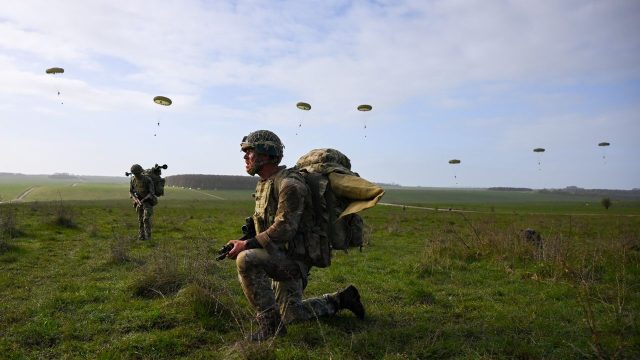
Requiring greater funding, and with shrinking personnel numbers, Britain is at ‘serious risk of being left behind’ its allies