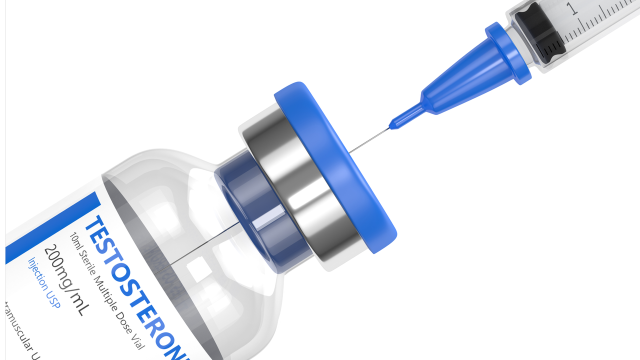
The Department of Health and Human Services is moving to make adjustments to testosterone-therapy labels, reversing changes made over a decade ago that restricted availability for some men. With hormone drugs being hailed as yet another wellness drug, experts worry the requested adjustments could trigger a testosterone free-for-all.
Why is the HHS asking for revisions?
The Food and Drug Administration as of 2015 required testosterone therapy labels to state that the “safety and effectiveness of the treatment had not been established” in men with symptoms associated with idiopathic hypogonadism, an age-related condition “involving low testosterone levels without a known underlying cause,” said Reuters. Now the HHS is requesting that labels be revised to remove that statement. The HHS also wants to update information related to prostate cancer risk and revise warnings regarding enlarged prostates after reviewing new data and evidence on the safety and benefits of hormone therapy.
These updates could “pave the way for easier access to testosterone replacement therapy” for a wider subset of men, said CNN. During Men’s Health Month, the HHS is “putting science back at the center of men’s healthcare,” said HHS Secretary of Health Robert F. Kennedy, Jr in a press release.
What are the risks of lessening the barrier to testosterone therapy?
No matter the outcome of the suggested revisions, experts warn that patients should still have “in-depth talks with their doctors about whether testosterone therapy could be helpful for them,” and doctors should “complete thorough evaluations,” said CNN. Besides, taking a warning off a label “isn’t the same as saying every man should be on the medication,” Jamin Brahmbhatt, a urologist and men’s health expert at Orlando Health, said in an email to the outlet.
For a man who genuinely has low testosterone, the “benefits are real: improved energy, sex drive, mood, muscle and bone strength,” Brahmbhatt said of testosterone therapy. However, for those with normal levels that are just “chasing an improvement in health motivated by online influencers,” the risks “may not outweigh the benefits.”
While experts insist that testosterone is not just a lifestyle drug that “men take to build muscle and feel good,” it is “increasingly being marketed that way,” said Nature. Influencers and “podcasters such as Joe Rogan and his guests” have “sung the hormone’s praises” and “scores of testosterone clinics are popping up” globally.
People have always “wanted a fountain of youth,” said Landon Trost, a urologist, to the Houston Chronicle. Hormones, “since really the 1970s or even earlier,” were considered the magical pills to achieve that goal. Today, the hormone is “widely prescribed in ways that aren’t covered by insurance” and that don’t “always align with mainstream medical guidance,” said the outlet.
The revisions could make access much easier