
Sounds and Colours (S&C) ponders why older, traditional rhythms from Puerto Rico are now at the front and center of Latin pop. The article traces Bad Bunny’s successful use and blending of plena, bomba, salsa, and música jíbara, but it also avers that one “can hear that shift beyond Bad Bunny.” Here are just a few excerpts; read full article at Sounds and Colours.
For many years now, the path of Latin pop has been easy to predict. Everything was getting slicker, louder, more synthetic, more optimised for playlists, more built for immediate impact. Then something changed. When Bad Bunny released Debí Tirar Más Fotos in January 2025, the record didn’t just sound like another global urbano blockbuster with a few tasteful nods to tradition. It sounded like an artist deliberately turning towards home, folding plena, bomba, salsa and música jíbara into a record that still moved with the force of contemporary pop. By February 2026, that turn had carried all the way to the Grammys, where the album became the first Spanish-language winner of Album of the Year.
That matters because the album’s success wasn’t framed as a branding exercise or a respectable side project. It moved like a proper pop event. It topped charts, dominated streaming, and landed in spaces that have historically treated Puerto Rican traditional forms as source material rather than the main attraction.
Who gets to define “modern” in this genre?
What makes this moment interesting is that it doesn’t feel nostalgic in the soft-focus sense. It isn’t about pretending the past was tidier, richer or more authentic than the present. It’s about who gets to decide what modern Puerto Rican music sounds like. On Debí Tirar Más Fotos, older forms aren’t treated as quaint artefacts to be dusted off for a prestige track. They’re active, rhythmic, social, and fully capable of carrying contemporary feeling. The record samples older ensembles, works with current groups like Los Pleneros de la Cresta, and lets those textures sit inside the same conversation as reggaetón, trap and electronic pop.
That sense of continuity is all over the wider scene too. Plena Libre’s recent Legado is explicitly presented as a living tribute to Gary Núñez and to more than three decades of Puerto Rican rhythm and pride, with each collaboration described as a bridge between generations. Los Pleneros de la 21, meanwhile, followed their 40th anniversary with a 2025 album and continue to run workshops and community events this spring around bomba and plena technique. [. . .]
[. . .] The reward isn’t only cultural dignity, though that matters. It’s musical freshness. Heritage, in this context, isn’t a burden. It’s a route out of repetition.
It suggests that even producers most closely associated with futuristic urbano polish now understand that older Caribbean and Puerto Rican forms aren’t just sentimental reference points. They’re living structures, things to be handled, bent, translated and carried forward carefully. [. . .] Puerto Rican music right now feels less like a neat family tree and more like a dense mangrove, old growth and new shoots tangled together, impossible to separate cleanly. [. . .]
For full article, see https://soundsandcolours.com/subjects/travel/why-puerto-ricos-older-rhythms-are-back-at-the-centre-of-pop-151337/
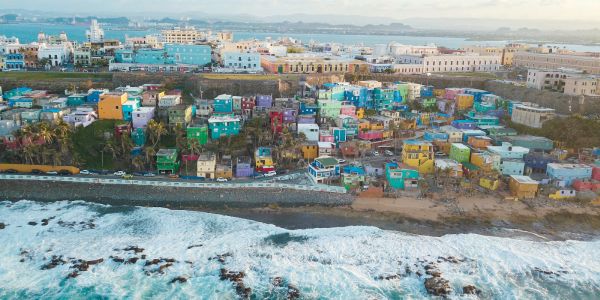
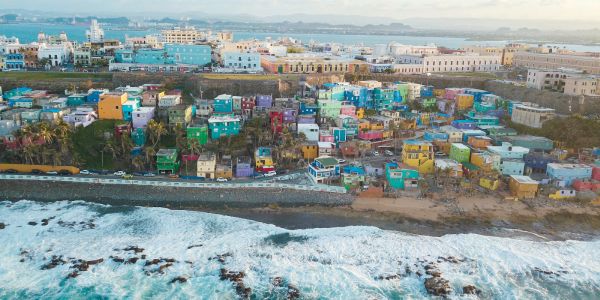
[Credit for photo of La Perla, Puerto Rico was not available in the original article.]
Sounds and Colours (S&C) ponders why older, traditional rhythms from Puerto Rico are now at the front and center of Latin pop. The article traces Bad Bunny’s successful use and blending of plena, bomba, salsa, and música jíbara, but it also avers that one “can hear that shift beyond Bad Bunny.” Here are just a