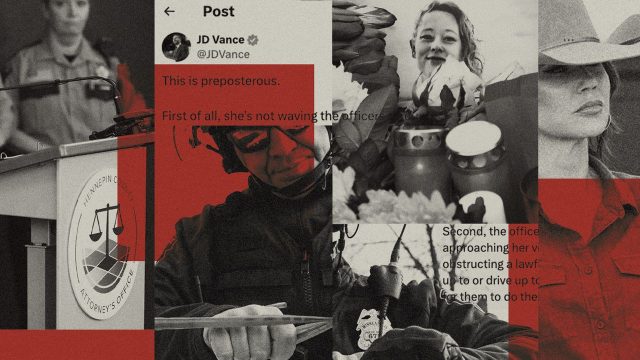
The shooting death of 37-year-old Renee Nicole Good in Minneapolis last week has thrust Minnesota into the national spotlight as the Trump administration and local officials spar over who has the authority to investigate. Minnesota law enforcement authorities “don’t have any jurisdiction in this investigation,” said Homeland Security Secretary Kristi Noem, and the officer who shot Good enjoys “absolute immunity,” insisted Vice President J.D. Vance. That officer, identified by multiple outlets as Jonathan Ross, “does not have complete immunity here,” countered Hennepin County Attorney Mary Moriarty as she announced plans for a locally led investigation, regardless of federal exclusion.
What did the commentators say?
The Justice Department’s decision to abruptly end what had initially been presented as a partnership between the FBI and local Bureau of Criminal Apprehension investigators is “highly unusual,” having “hardly any precedent” outside of “specific investigations against a state itself,” said Courthouse News Service. Pointedly, the lack of cooperation is a “jarring reversal of the joint investigation model” conducted after the police murder of George Floyd in Minneapolis five years prior.
Beyond the evidentiary challenges for Minnesota officials determining whether to bring charges without full access to investigative materials, “legal precedent” indicates that federal law enforcement is “shielded from state charges by the Supremacy Clause of the U.S. Constitution,” The New York Times said. Should Minnesota ultimately file local charges, they will be “likely to face scrutiny from a judge.”
Federal agents are “typically immune” from local prosecution when the behavior in question is “directly tied to their official duties,” said Fox 9. Minnesota authorities must prove that Ross “clearly broke the law or acted outside the scope of his duties.” That is a much “harder” burden to meet “if the FBI won’t share evidence.”
While it is “common” for federal and local law enforcement to “pool resources to investigate crimes that could fall under all their jurisdictions,” Homeland Security officials, including Noem, have stressed that the Trump administration “did not view the shooting as one of those cases,” Fox News said.
To bring local charges, Minnesota prosecutors would have to “consider both state and federal laws to overcome the hurdles of immunity,” said University of Wisconsin Law School Professor Robert Yablon to The Associated Press. Not only would prosecutors need to show that local law had been broken, but that the “use of force” had been “unconstitutionally excessive under federal law” as well. Minnesota’s use-of-force laws currently allow for deadly force from state law enforcement “only if reasonable officers would believe doing so was necessary to protect themselves, or others, from death or serious harm,” Reuters said. Federal law has a “similar standard.”
What next?
Although some elected officials in Minnesota, including Gov. Tim Walz (D), have “slammed the Trump administration” for painting Good “as an agitator” and Ross “as a hero,” local prosecutors have been more circumspect, said Bring Me The News. Moriarty’s statement that an independent investigation is “not an attack on the FBI” is, in part, an attempt to “placate federal officials.” Despite a “respect” for the FBI process, Minnesota’s community expectations are “much different in terms of transparency,” Moriarty said. On the federal side, officials are “skeptical of Minnesota’s desire to conduct a good-faith investigation,” said Fox, citing “remarks from state leaders,” including Minneapolis Mayor Jacob Frey’s previous assertion that claims of self-defense by the officer are “bullshit.”
Noem’s claim that Minnesota lacks the “jurisdiction” to investigate Good’s death may also not be as clear-cut as the secretary implies. While the government can say “we’re not going to cooperate with you,” said University of St. Thomas Law Professor Mark Osler at Courthouse News Service, it would be surprising “if they assert authority to stop an investigation.”
For now, Minnesota officials are encouraging the public to submit any footage of Good’s death or other evidence to a secure online portal. The evidence will then be evaluated by the Bureau of Criminal Apprehension, which “submits the case file to the county attorney’s office” — in this case, Moriarty’s office — which then “makes a decision if criminal charges are appropriate,” said Minnesota’s Sahan Journal.
Minneapolis has become ground zero for a growing battle over jurisdictional authority