
Periodismo de Barrio (Global Voices) writes about how “Cuba’s biodiversity faces growing threats, but scientists, communities and activists work to protect endangered species.” The author interviewed Cuban biologist Isbel Díaz Torres, who underlines that “Conservation cannot be imposed from above. Without social participation, without real ecological incentives and without critical environmental education, any policy is destined to fail.”
This article by Periodismo de Barrio was first published on January 23, 2026. An edited version is being republished on Global Voices under a content partnership agreement. The story is part of Global Voices’ May 2026 Spotlight, “Global crisis, local solutions.” This series will offer stories of resistance and successful climate action, insight into how communities in the Global South are fighting back against the crisis, analysis of what this might mean for future generations, and more. You can support this coverage by donating here.
Reuters published an article about the efforts of professionals in the Ciénaga de Zapata, of Cuba’s Matanzas Province, to save the manjuarí from extinction, a fish endemic to the island that has been on the Red List of the International Union for Conservation of Nature (IUCN) since 2020.
The celebration was warranted, but unfortunately, there are many more Cuban species that face the danger of disappearing completely — and not all benefit from protection efforts which, for the manjuarí, include the creation of a hatchery and the production of food to feed them before they are released.
According to the Project for the Integrated Management of Water, Land and Ecosystems in Caribbean Small Island Developing States (IWECO), Cuba is among the ten most important islands in the world in terms of the richness of its biodiversity.
According to the Cuban biologist, essayist, and environmental communicator Isbel Díaz Torres, “While there are protected areas, decrees, strategies and plans, the problem is that protecting on paper is not the same as conserving in reality. Real conservation requires active science, constant monitoring, functional infrastructure, transparency and citizen participation. And today, practically none of those elements is guaranteed.”
In a report carried out in 2019 by the United Nations Development Programme (UNDP) and Cuba’s Ministry of Science, Technology and Environment, there were 157 species of vertebrates on the island under different categories of threat: 52 critically endangered, 42 endangered and 63 vulnerable. Among terrestrial invertebrates, mollusks were the most threatened group, with 34 vulnerable species and 31 critically endangered. [. . .]
The Cuban Biodiversity portal published a study that analyzes which areas of the country are most exposed to the impacts of climate change based on a calculation of the loss or increase of species in each region by the year 2050; those located where the change would be greatest were considered to be “most vulnerable.”
The results pointed primarily to low and flat areas — especially large plains such as Zapata, Colón, Júcaro, the Cauto Valley, southern Camagüey and the Jardines de la Reina archipelago — that could suffer significant losses of biodiversity; even more severe if greenhouse gas emissions are not reduced.
Regarding the protection and restoration of mangroves, the Guanahacabibes Peninsula has benefited from UNESCO’s MangRes project – restoration of mangroves as a nature-based solution in Biosphere Reserves of Latin America and the Caribbean – which promotes the restoration of different species such as the red mangrove, as well as “the documentation of local knowledge about their use and management, and the building of capacities for environmental governance, education for sustainable development and knowledge exchange.”
Likewise, over the past decade, the Manglar Vive project has reached the coasts of Mayabeque, specifically benefiting the protected area of the Gulf of Batabanó. Six years after its implementation, the good health of the mangroves along this 84-kilometer stretch between Punta Sucia and Punta Mora was bolstered by comprehensive reforestation and other actions aimed at better understanding the impact of climate change on those ecosystems. [. . .]
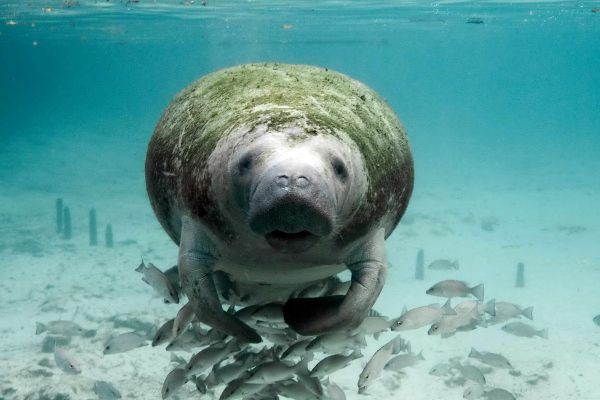
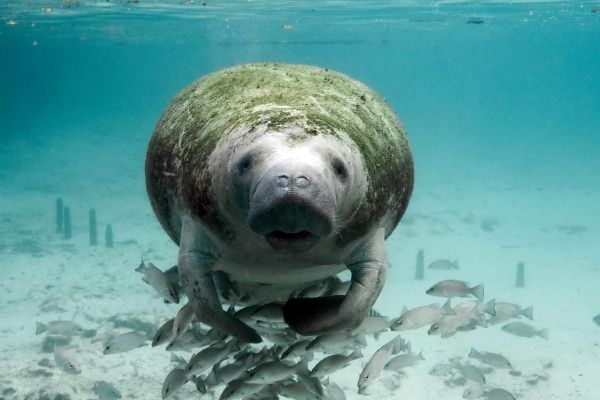
In 2025, the Journal of Marine Research published the article “Conservation of the manatí antillano Trichechus manatus north of Villa Clara, Cuba,” which examined the danger of extinction this species faces on the island. Human activity affecting these mammals and their ecosystems – even “in areas designated for their protection,” the research warns – is the main cause of their possible disappearance. For the authors, conservation depends on a comprehensive approach that combines habitat protection, the reduction of human threats, continuous monitoring (conducting censuses and periodic observations), as well as the promotion of environmental education for communities that coexist with the manatees.
Other species such as polymitas have been a priority for projects and international alliances in pursuit of their conservation — especially the Polymita sulphurosa, one of the most threatened and whose distribution is considered very restricted. [. . .]
Cuban civil society has also made important contributions not only to the conservation of biodiversity, but also to popular education about its importance. One organization that has not stopped working since its creation in 2021 is Nativa. Red de Microviveros, a collective for the protection of the island’s native flora. [. . .]
The work of Guardabosques, an organization active between 2007 and 2019 that was dedicated to promoting environmentalism, also made a difference. [. . .]
For full article, see https://globalvoices.org/2026/05/13/who-is-defending-cubas-threatened-species/
Periodismo de Barrio (Global Voices) writes about how “Cuba’s biodiversity faces growing threats, but scientists, communities and activists work to protect endangered species.” The author interviewed Cuban biologist Isbel Díaz Torres, who underlines that “Conservation cannot be imposed from above. Without social participation, without real ecological incentives and without critical environmental education, any policy is