
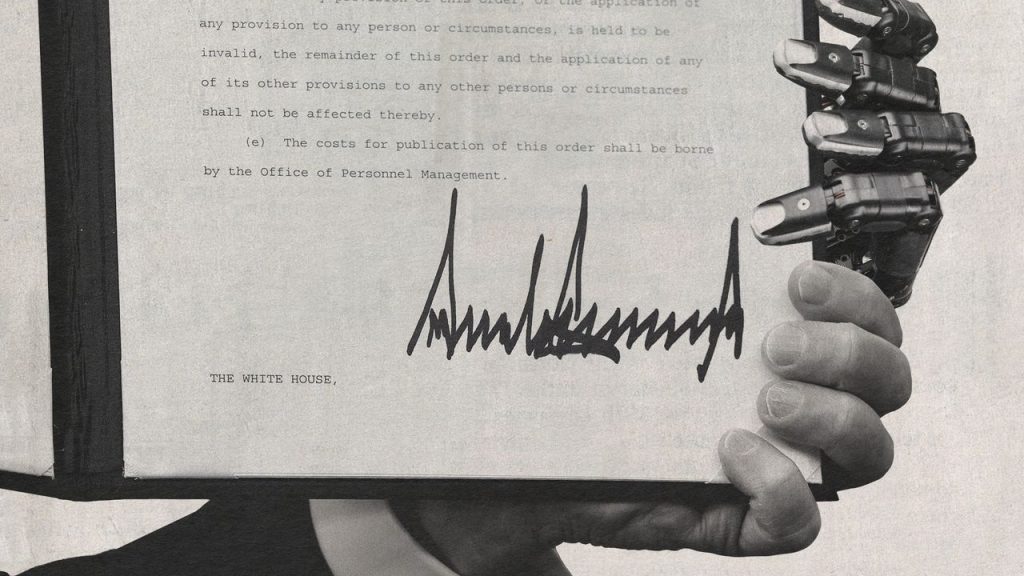
President Donald Trump recently signed an executive order that would voluntarily allow artificial intelligence companies to receive more government oversight. The order marks a shift in the White House’s attitude about AI. Now it seems Trump, Republicans and even some Democrats are changing their tune.
What did the commentators say?
The order signed by Trump is “relatively toothless” because most major AI companies “already had agreements in place that allowed the government to preemptively test their models for safety risks,” said The Atlantic. But it is also “meaningful in that the president is doing something — anything — about AI” given that when Trump retook office, he largely “signaled to tech companies that he would stay out of the way.”
National Economic Council Director Kevin Hassett previously said the administration was considering federal guidelines that would “require AI models to go through an evaluation process similar to that used by the Food and Drug Administration,” said The Hill. But this idea seemed to fizzle out as AI advocates became “concerned that an evaluation process from the White House could strangle development.”
The order that was signed “nonetheless represents a sea change in Washington’s willingness to tighten oversight of the technology,” said Politico. For the “first time it’s on a piece of paper, a structure and a process,” former Trump adviser Steve Bannon told the outlet.
Some argue that Democratic politicians were already doing the same thing. “This executive order is implementing a voluntary regime to do pre-deployment evaluations of models for security risks,” Saif Khan, a tech adviser under former President Joe Biden, told Politico. “That is the thing that the Biden administration was doing.”
What next?
It is unclear where the Trump administration may go next with AI. The “entire chaotic saga — a wishy-washy White House, confused statements from populist and tech-elite Trump whisperers — is only the latest in a long string of strange, often contradictory AI policy positions,” said The Atlantic. There is a chance Trump could change his mind again, as his policies on the matter have been “inconsistent, if not incoherent, almost since the day he retook office.”
While Trump says he is focused on AI security, his White House has also slashed major portions of the Cybersecurity and Infrastructure Agency (CISA), the “government agency that aims to protect the nation against hackers,” said The Atlantic. The budget cuts mean CISA is “heading into the AI era with shrinking resources and a diminished role,” said Axios, which could pave the way for future vulnerabilities. Many fear the agency “no longer has the capacity to help utilities, banks and other critical infrastructure operators prepare for a coming wave of AI-fueled cyberattacks.”
Others believe that both sides of the aisle have it wrong. Sen. Bernie Sanders (I-Vt.) wants to ban data centers and is currently “calling for the government to own 50% of AI companies” — and it “would be easier to dismiss his ideas if they weren’t partially built on bipartisan consensus,” said The Washington Post editorial board. But U.S. tech policy works and the “U.S. is a wealthy country because it doesn’t engage in the kind of government ownership schemes that Bernie Sanders and Donald Trump are fond of.”
Trump has gone back and forth on the issue several times