What does it mean to remember a place you can no longer physically inhabit?
And what does it mean to map a journey that was never meant to be purely geographical in the first place?
For Cape Town artist Manyaku Mashilo, the questions are less theoretical than lived. Across her layered mixed-media paintings, drawings and collages, figures move, sometimes in procession, sometimes in quiet drift, through expansive, abstract terrains that feel at once terrestrial and celestial. Beyond travelling, they’re searching, returning, remembering.
Born in Limpopo in 1991, Mashilo has built a distinctive visual language rooted in spiritual identity, ancestry, community and belonging. Her work draws deeply from family archives, historical photography and community memory, yet the worlds she constructs feel speculative, even otherworldly.

The result is a practice that sits in the fertile space between documentation and dreaming, between what was and what might be.
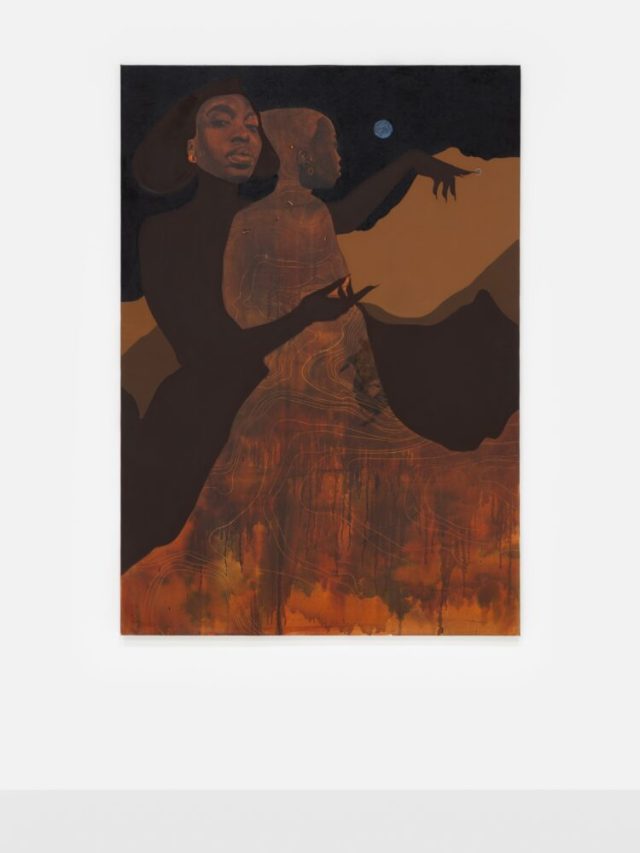
Her recent body of work, Here I Saw My Ancestors First (2026), presented at the Investec Cape Town Art Fair, offers perhaps one of her most distilled meditations yet on lineage, womanhood and spiritual inheritance.
When Mashilo approached the fair, her instinct was not to overwhelm but to refine.
“I chose to try and be very minimal,” she explains. The presentation ultimately comprised four or five large-scale works, a deliberate decision that speaks to how she understands narrative in painting.
“I personally believe that the narrative that I’m trying to tell, which is the story of my grandmother but also that kind of representation, should be experienced on a large scale,” she says.
Scale, for Mashilo, is memory made spatial. The expansiveness of her canvases mirrors the physical and emotional landscapes of her upbringing in Limpopo: wide church grounds, open rural horizons, the felt immensity of childhood environments.
Within the works, two visual registers often coexist. The first is figurative: women and girls emerge from layered colour fields, their presence calm but insistent. The second is cartographic: delicate linework ripples across the surface like topographical markings, suggesting mountains, rivers and migratory routes.
“I always try to include all the different kinds of my practice,” she notes. “One is very figurative … and then there’s another aspect of my work which has to do with map-
making and the mapping of these women migrating through these sort of liminal spaces.”
The contour-like markings do more than structure the composition. They position Mashilo as a kind of spiritual cartographer, charting movements that are emotional, historical and metaphysical all at once.
Mashilo’s figures are never invented in isolation. They emerge from a dense personal and collective archive she has been building
for years.
“There’s two kinds of figures that I work with,” she explains. One draws from contemporary imagery like friends, self-portraits and photographs she has taken herself. The other comes from a carefully gathered visual repository: historical photographs, family albums and the work of black South African photojournalists.

made you this way.
She speaks with particular admiration for photographers like Santu Mofokeng and Peter Magubane, whose images documented black life under and beyond apartheid. What interests her, however, is not the violence that often frames the archives in public memory.
“The history that frequents our eyes the most are some of the violent images,” she says. “But when I look at some of those images I see a different story and I have different memories.”
One recurring reference point is the visual rhythm of mass baptisms, lines of worshippers in white garments moving toward water. Where documentary photography might emphasise sociopolitical context, Mashilo sees something else: choreography, spirituality, quiet collectivity.
“I just thought it looked really magical,” she recalls.
The act of re-seeing is central to her practice. Images travel: from lived moment to photograph, from photograph to archive, from archive to canvas. Each stage adds distance but also possibility.

“I like that it has travelled so long,” she says of the images she repurposes. “Then we can speak about this place where they’re going.”
Movement is everywhere in Mashilo’s work. Figures rarely appear static; they are almost always in transition, suspended between departure and arrival.
The roots of the motif lie partly in her childhood experiences within the Zion Christian Church, where annual Easter pilgrimages left a deep visual imprint.
“Every Easter you watch queues and queues of people heading to this mountain,” she recalls. What stayed with her was the collective belief that movement itself could be healing.
“I thought that was something that I carry with me every day,” she says.
In her paintings, the destination is often ambiguous. The women are “heading to a place that is not necessarily a physical destination but a metaphor for a place that is able to hold them”.
The ambiguity opens the work outward. Migration becomes multivalent: rural to urban, earthly to spiritual, historical to speculative. It also resonates across the African diaspora, something Mashilo has observed in the reception of her work abroad.
Audiences from Caribbean backgrounds, in particular, often recognise familiar visual cues: uniforms, colour palettes, ritual formations.
“It tells me that there’s a way that black people are connected across the globe,” she reflects.
“Our symbols and the way that we’ve had to build our communities are very tied together.”
If movement structures Mashilo’s work, spirituality animates it.
Her childhood memories of church are filled with sensory intensity: brass bands, choral repetition, the percussive footwork of her people’s musical traditions.
The experiences produced what she describes as an “otherworldly feeling”, a sense that the visible world was only part of the story.
“The repetition of song and the repetition of footwork, those things speak to the way that I understand spirituality,” she explains.
The sensibility extends beyond the church interior into the night skies of Limpopo, where the stars felt unusually close. “When you think about how vast the sky is at night, the stars in Limpopo in the evening feel like they look closer than when you’re in the city,” she says.
In her work, celestial space and terrestrial landscape often collapse into one another. Constellations, moons and atmospheric washes of colour suggest what she describes as an “astral landscape”, a realm where ancestors reside and from which knowledge flows.

Layered reds and ochres in Here I Saw My Ancestors First deepen the cosmological register. Portraits become vessels: for memory, for ritual, for passage.
At the emotional core of Mashilo’s practice are her grandmothers, figures whose creative and spiritual labour shaped not only her worldview but that of her siblings, many of whom are also artists.
“We grew up watching our grandmothers literally make something out of nothing,” she says.
On her father’s side, her grandmother was a farmer who gathered women in her yard to harvest, paint houses and repair what needed fixing. On her mother’s side, her grandmother was a healer who worked primarily with children and read natural phenomena such as the moon and the shadows as sources of knowledge.
The memories surface repeatedly in Mashilo’s imagery: geometric patterning reminiscent of decorated homes, communal female groupings, chromatic palettes drawn from rural environments.
“I don’t think it was a surprise that we all became artists,” she reflects. “Every holiday we were with our grandmothers: incredibly creative, incredibly knowledgeable women.”
In Here I Saw My Ancestors First, she explicitly references both grandmothers, positioning them as spiritual anchors within the work’s visual and conceptual language.
If Mashilo’s work teaches us anything, it is that movement does not always signal restlessness. Sometimes it is the most faithful form of remembering.
Her figures keep walking, across canvas, across history, across the thin veil between the visible and the felt, carrying with them the knowledge systems of the women who came before.
In tracing their paths, Mashilo is not only mapping where they have been. She is sketching, with remarkable tenderness, where they might go.
Manyaku Mashilo transforms memory and ancestry into expansive, layered canvases where spiritual landscapes, historical archives and women’s journeys converge