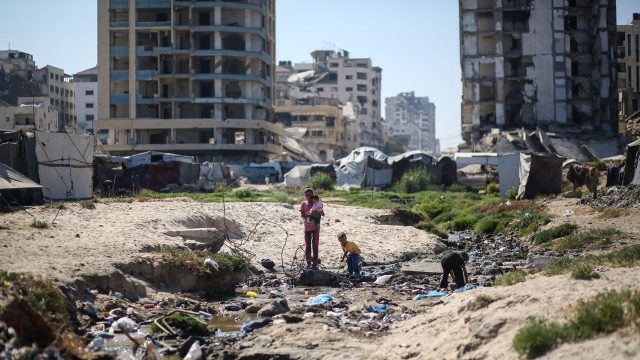
Under the terms of the US-brokered ceasefire agreed last October, the Israel Defence Forces (IDF) withdrew to a demarcation line known as the “yellow line”, and retained control of some 53% of Gaza. Nearly all of Gaza’s two million residents are living in Hamas-controlled areas, where the militant group has tightened its grip: since the turn of the year, it has extended its control over security, tax revenue and government services.
In the meantime, Israeli forces have pushed the yellow line steadily into Hamas-controlled areas. PM Benjamin Netanyahu recently confirmed that Israeli forces now control about 60% of Gaza, and that he hopes to increase that to 70% (though Israel officially denies that it wants to occupy the strip permanently).
In at least one place, Israel has moved the yellow line to intersect with Salah al-Din Road, Gaza’s main north-south artery.
What were the terms of the ceasefire?
In theory, Israel and Hamas stopped fighting on 10 October. Under Phase One of the deal, Hamas agreed to return the last 20 hostages it had taken during its attack on Israel in October 2023, while Israel agreed to release 1,950 Palestinian prisoners, mostly Gazans. Israel also allowed aid delivery to resume.
Under the second phase of the deal, announced by Trump’s special envoy Steve Witkoff in January, military control was to be handed over to an International Stabilisation Force, and civilian affairs to a Palestinian-led technocratic administration. The IDF was meant to withdraw further; Hamas was meant to disarm; and international funds were to be provided for Gaza’s rebuilding.
Why has progress stalled?
Israel refused to withdraw before Hamas disarmed, arguing that it would leave a security vacuum that a technocratic administration or international force could not fill. It also complains that the remains of dead hostages have not been returned. The Palestinians, and Arab mediators, regard this as a violation of the ceasefire deal. And though the intensity of fighting in Gaza – at least 70,000 Palestinians were killed in the two years to October – has slowed greatly since the ceasefire took effect, it has not stopped. According to the Gaza Health Ministry, more than 900 Palestinians have been killed there since October 2025; a substantial proportion of these deaths occurred near the yellow line. Five Israeli soldiers have also been killed in Gaza.
How are conditions in Gaza?
The vast majority of Gaza’s occupants – about 1.7 million – are still living in tents or makeshift accommodation, according to the UN. Overcrowded campsites are afflicted by raw sewage and pests such as rats and weasels.
The World Health Organisation says there have been reports of some 111,500 cases of disease or infestation due to external parasites this year. About 728,000 school-aged children have been out of formal education for almost three years. Only about half of hospitals are even partially functional. Thousands of patients needing medical treatment have been evacuated to more than 30 countries, including through the Rafah Border Crossing into Egypt, which reopened in February.
Meanwhile, aid agencies continue to have trouble making humanitarian deliveries to Gaza; they were halted last week following Iranian attacks on Israel. Food shortages continue, and one in five families are eating only once a day, the UN says.
Is any rebuilding taking place?
Ahead of the ceasefire, Donald Trump and his aides talked of turning Gaza into a gleaming hub for trade, tourism and tech. The “Board of Peace” unveiled by Trump in September was supposed to oversee the reconstruction, which the UN estimates could cost more than $70 billion. But so far, no contracts to clear the rubble and start rebuilding have been awarded, while the Board of Peace is struggling with funding shortfalls.
Meanwhile, Israel is razing buildings on its side of the yellow line (it says it is taking down uninhabitable buildings, and destroying structures that could pose a threat to Israel and the IDF).
How strong is Hamas now?
During the war, Hamas lost roughly 10,000 fighters, most of its political top echelon, and nearly the entire military command council that planned the massacres of 7 October 2023. Prior to the war, however, it had run Gaza since 2007 – and it has used the truce to rebuild. It immediately launched a crackdown on rival gangs that had taken control in parts of Gaza City and Rafah.
By February, it had largely reasserted control over the population: traders say Hamas fighters routinely extort fees and taxes from them. Israeli intelligence assessments now suggest that Hamas has rebuilt some of its infrastructure, including sections of its underground tunnel network and command-and-control systems.
Are there any signs of diplomatic progress?
Talks designed to push the ceasefire plan forward began in Cairo last week. According to a draft text, Hamas would hand its weapons over to an agreed Palestinian authority, in return for Israel announcing a timetable for its departure from Gaza. However, these proposals have not been accepted by the US or Israel, which has reportedly drawn up plans for a new round of attacks on Gaza, to begin when the war with Iran ends.
What other challenges are there?
The US is distracted by the Iran conflict. Netanyahu is seeking re-election by late October, and is unlikely to view an Israeli withdrawal from Gaza as politically expedient; ministers in his coalition have long talked of overseeing the “voluntary migration” of Gazans from the enclave. Gazans are very concerned that Israel now controls much of their territory, including around 60% of its fertile agricultural land, the majority of its water wells, and some of its wastewater facilities.
Since the ceasefire between Israel and Hamas, the Gaza Strip has largely dropped out of the headlines, but suffering continues