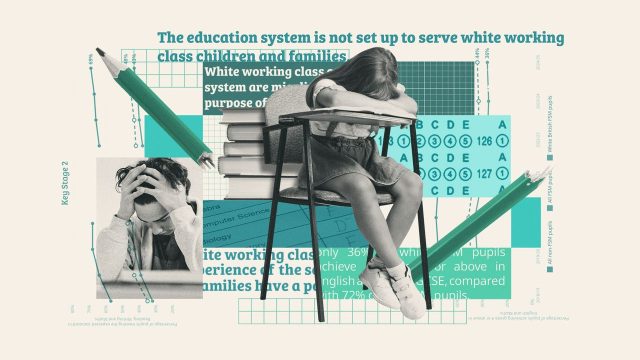
The education system is “not set up to serve white working-class children and families”, an independent inquiry has found, and has created a “white working-class disadvantage gap”.
The Inquiry into White Working Class Educational Outcomes, found that in 2025, just 36% of white British pupils on free school meals achieve a Grade 4 or above in English and Maths GCSE, compared with 72% of non-free school meal pupils.
This independent investigation is the “biggest piece of research in recent years into white working-class underachievement in England”, said education editor Nicola Woolcock in The Times. But without immediate investment and implementation of recommendations, the gap could widen.
What did the commentators say?
Realising the reasons of why white working-class children “don’t make it” in education “may not be rocket science but it is complicated”, said social affairs editor Jackie Long on Channel 4 News’ Substack. “Behaviour, disengagement and absenteeism” seem to be the most significant factors for low attainment, but the “intersection between geography, culture, opportunity and aspiration” has yet to be “fully unravelled by the inquiry.” “There will be no quick fix.”
Nigel Farage and the political right have “overreached” by blaming the Equality Act and a “proliferation of critical race theory” in British institutions, said Dr Rakib Ehsan on UnHerd. There is an “endemic” problem, facilitated by a “broader economic malaise of regional and class disparity, deindustrialisation, a lack of secure local employment”. This is a lesson for the right: they should be “wary of indulging in the very types of racial victimhood and identity politics they seek to condemn”.
This demographic group has “dominated the headlines” in recent years, said educator Sir John Townsley in The Telegraph. Recent analysis by University College London revealed that 40% of white working-class pupils miss a day of school every fortnight, and that they are “more than twice as likely” than the average pupil to be “severely absent” from school.
But the reality is harsh. Blame lies not just with the government and wider society, but also with “the families in question” for perpetuating a “culture of low-expectations” and placing “no value whatsoever on education”. Without “radical change” and “generational” planning, we are headed for “further disaster”.
The narrative that white working-class boys have been neglected by the system is “set like concrete”, said Terri White in Prospect. But “what about our white working-class lasses?” White working-class girls still marginally outperform their male counterparts (by 38% to 35%) to achieve the “expected standard” at GCSE level, the girls’ numbers have “dropped dramatically” over the past six years, while boys are “seeing change in the opposite direction”.
And once girls leave school, they are “plunged” into an earning disparity which resembles a “yawning chasm”, with boys out-earning them even when they have fewer qualifications. White working-class girls are “walloped by” a “double disadvantage”: discrimination by both class and gender.
In an environment where education has become “increasingly politicised”, white boys are seen as a “problem”, said Joanna Williams on Spiked. With the prime example of Keir Starmer’s initiative to show Netflix’s “Adolescence” in every school, it appears the government has offered white working-class boys nothing except “panic-fuelled hectoring”. They have been let down by a political class that has done little to provide “well-paid, meaningful employment”, and been ignored by a schooling system that “prioritises therapeutic interventions over discipline and high standards”. “All children deserve better.”
What next?
Education Secretary Bridget Phillipson said that there is “clear” evidence that children “arrive at school not ready to learn, having not achieved the levels that they should”. Opportunities for progress lie not just with schools but “beyond the school gate, because so much of what a child is able to achieve in their life comes down to the support their family have”.
The inquiry has raised free transport for under-21s, a “crackdown on excessive screen use” and for high-performing schools to “take more white working-class children” as possible solutions, said Woolcock in The Times. In order to achieve progress, there must be a “clearer definition” of the term white working-class and that communities should “provide significantly greater access to sport, arts, culture, volunteering, outdoor activity and employer engagement, backed by sustained long-term funding”.
A new inquiry has highlighted that the demographic has been let down by the system, with educators calling for ‘radical change’ and investment