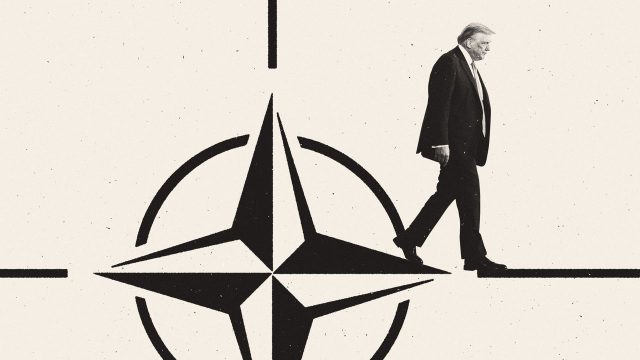
Donald Trump has repeated his threat to pull the US out of Nato, after Britain and other allies refused to send warships to help reopen the Strait of Hormuz. Dismissing the alliance as a “paper tiger”, he told The Telegraph’s Washington correspondent that the idea of removing America from the defence treaty had now gone “beyond consideration”.
“We’ve been there automatically, including Ukraine,” Trump said. “And we would always have been there for them”. But, in an apparent misunderstanding of the limits of the alliance, the US president believes that, in the Iran conflict, “they weren’t there for us”.
What would it mean for Nato?
Nato, formed by the signing of the North Atlantic Treaty in 1949 by 12 founding countries, does not have its own army. Instead, member states pledged to provide collective defence and security. The US is the Nato’s largest single military power, as well as funding 62% of its spending, so American withdrawal would dramatically weaken the alliance. Without Washington’s military might behind it, Article 5 – the treaty clause that states that an armed attack against one or more members will be considered an attack against all – would lose credibility .
Trump’s recent threats will further encourage Canada and the European member states in their efforts to rely less on the US for security – a shift that is a boon to their own domestic defence industries.
What would leaving Nato mean for the US?
The US would save money, both by ending its contribution to Nato spending and by no longer maintaining a presence in Europe, Africa and the Middle East. But it would also lose access to many military bases around the world, meaning the US Navy, would have to “operate closer to America’s shores”, and US bombers would no longer be able to “reach targets halfway around the world”, said Modern Diplomacy. More broadly, the shift away from US global leadership would accelerate, with America increasingly divorced from an international framework.
Buyers for US arms could also dry up, as America’s former allies seek to re-arm elsewhere. The US spends more on its own military than any other country but that wouldn’t be enough to keep all its arms manufacturers afloat. Without crucial foreign sales, hundreds of thousands of US jobs would be at risk.
What would the process actually look like?
Leaving Nato wouldn’t be easy for the US because a 2024 law prohibits the president from doing so without the approval of a two-thirds Senate majority or an act of Congress. Even if all Republicans in the Senate voted for it, Trump would still need at least 14 Democrats to join them, and it’s unlikely he would even get unanimity from Republicans: Thom Tillis, Republican co-chair of the Senate NATO Observer Group, has already warned that leaving Nato would be an “enormous, enormous risk”.
Given the political obstacles, most Nato observers don’t think Trump will try to withdraw, “despite his obvious displeasure at alliance leaders”, said The Times. But he could use an executive order to suspend US participation, and eke that suspension out while legal challenges are mounted.
But, even without leaving, Trump could still “cause irreparable damage” to the alliance, said UnHerd. He could ignore or slow-walk an Article 5 request, withhold intelligence from Nato partners, cancel weapons deliveries, and limit the export of security-related technologies.
Donald Trump keeps threatening to withdraw from the alliance but actually doing so would present major challenges